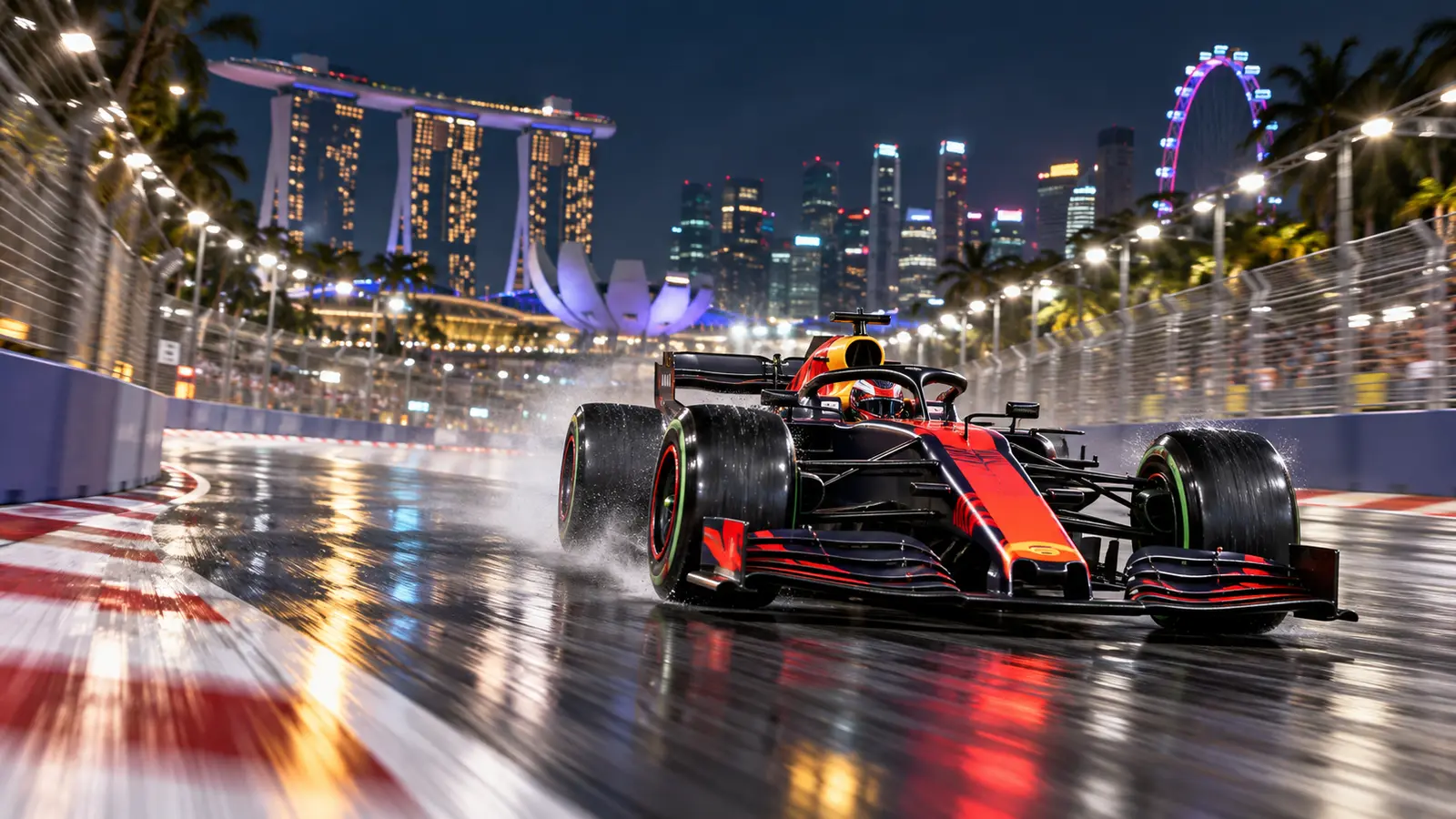
Max Verstappen took pole position for the Singapore Sprint after a tight Friday night qualifying session at Marina Bay, putting Red Bull at the front for Saturday’s short race and resetting the tone of a weekend that had first looked open across several teams.
Verstappen’s best lap was 1:31.156. George Russell was second for Mercedes, 0.120 seconds slower, while Charles Leclerc put Ferrari third with a 1:31.399. Oscar Piastri and Lando Norris followed in fourth and fifth for McLaren, close enough to keep the Sprint from looking like a one-team contest.
The result mattered because Singapore is not a routine Sprint venue. The street circuit is narrow, bumpy, humid and unforgiving, with walls close enough to punish small errors. A front-row start is valuable anywhere, but at Marina Bay it can define the rhythm of the race before strategy has much room to breathe.
Verstappen Converts When It Counts
The session had enough evidence to suggest that pole was not guaranteed. Russell had led the only practice session, Ferrari showed speed through the early parts of Sprint Qualifying, and McLaren remained close enough to threaten if the final laps were messy.
Verstappen’s decisive lap arrived at the end of SQ3. The lap did not blow the field apart, but it was clean enough and late enough to leave Russell with too little margin to answer. In a session measured by tenths and hundredths, that timing was the difference between control and chasing.
For Verstappen, the pole also carried a wider weekend meaning. He arrived in Singapore after winning the previous race in Malaysia, and a Sprint pole at Marina Bay keeps that momentum visible even before the Grand Prix qualifying session and Sunday’s race decide the main points of the weekend.
Russell And Leclerc Keep The Fight Close
Russell’s second place gives Mercedes a strong Sprint starting position despite a weekend complicated by power-unit concerns and setup work. His 1:31.276 was close enough to show genuine pace, but the final gap to Verstappen left the front row slightly out of reach.
Leclerc’s third place was useful for Ferrari but not quite the session Ferrari seemed to be shaping earlier. The team had pace in the opening stages, and Leclerc’s final time placed him only 0.243 seconds behind Verstappen, yet Ferrari still ended the session behind Red Bull and Mercedes when the soft-tyre laps mattered most.
Lewis Hamilton finished sixth in the second Ferrari, behind both McLarens. That leaves Ferrari with two cars in the top six but split by Piastri and Norris, a pattern that could make the Sprint start especially important. If the McLarens launch well, Ferrari may spend the short race managing traffic rather than attacking the lead group.
McLaren Stay In Range
Piastri was fourth on 1:31.454, only 0.055 seconds behind Leclerc. Norris was fifth on 1:31.587. Those gaps keep McLaren in the story because the Sprint is short enough that track position matters, but Singapore also has enough safety-car risk and tire-temperature variation to punish any hesitant start.
McLaren’s position is therefore mixed. Fourth and fifth is not the front row, but it is close enough to pressure Ferrari and watch for trouble ahead. If Verstappen and Russell control the start, McLaren may need patience. If the leaders squeeze each other into the first sequence of corners, Piastri and Norris are placed to gain.
Kimi Antonelli, the championship leader, qualified seventh for Mercedes. That is not disastrous for a Sprint, but it puts him behind several rivals at a circuit where overtaking is difficult. In a title race, small Saturday points can still matter, especially when a team-mate starts on the front row.
Yellow-Flag Review Leaves Pole Intact
There was a brief cloud over the result after Verstappen was investigated for a yellow-flag incident involving Hamilton in SQ1. The stewards reviewed the episode and decided not to impose a penalty, meaning Verstappen kept pole for the Sprint.
That decision was central to the final story of the session. Without it, the front of the grid could have changed after the track action had ended. With it, the qualifying order stayed as Verstappen, Russell, Leclerc, Piastri and Norris at the front.
The episode also showed how fine the margins are on a street circuit. Drivers are balancing push laps, traffic, yellow flags and closing speeds in a space where the next corner arrives quickly. The stewards’ decision removed the uncertainty, but the incident will remain part of how the session is remembered.
What The Sprint Sets Up
The Sprint now gives Verstappen the first chance to turn Friday speed into points and race control. Russell starts beside him with enough pace to make Turn 1 important. Leclerc has a Ferrari close enough to attack if the front row compromises itself. Piastri and Norris give McLaren two cars in the immediate chase group.
Further back, Antonelli’s seventh place adds championship interest. Starting behind Hamilton and the McLarens gives him work to do, and a short race gives less time to recover from a poor launch or an early traffic problem.
The broader Singapore weekend still has two separate questions. The Sprint will decide Saturday’s short-race points, while Grand Prix qualifying later on Saturday sets the grid for Sunday’s main race. Verstappen has taken the first major result of the weekend, but Marina Bay still has enough sessions left to reshape the story.
For a Saturday morning global sports slot, this qualifies as a high-value highlight because it is a verified Formula 1 result from the previous 24 hours, involves leading drivers and teams, sets up a Sprint on a major race weekend, and was confirmed by both Formula 1 and the FIA after the yellow-flag review.
Sports score: 82 out of 100. The story clears the Global Sports Highlights threshold through official confirmation, international motorsport audience, strong weekend implications, close competitive margins, and a clean distinction from GDU’s previous Formula 1 coverage.