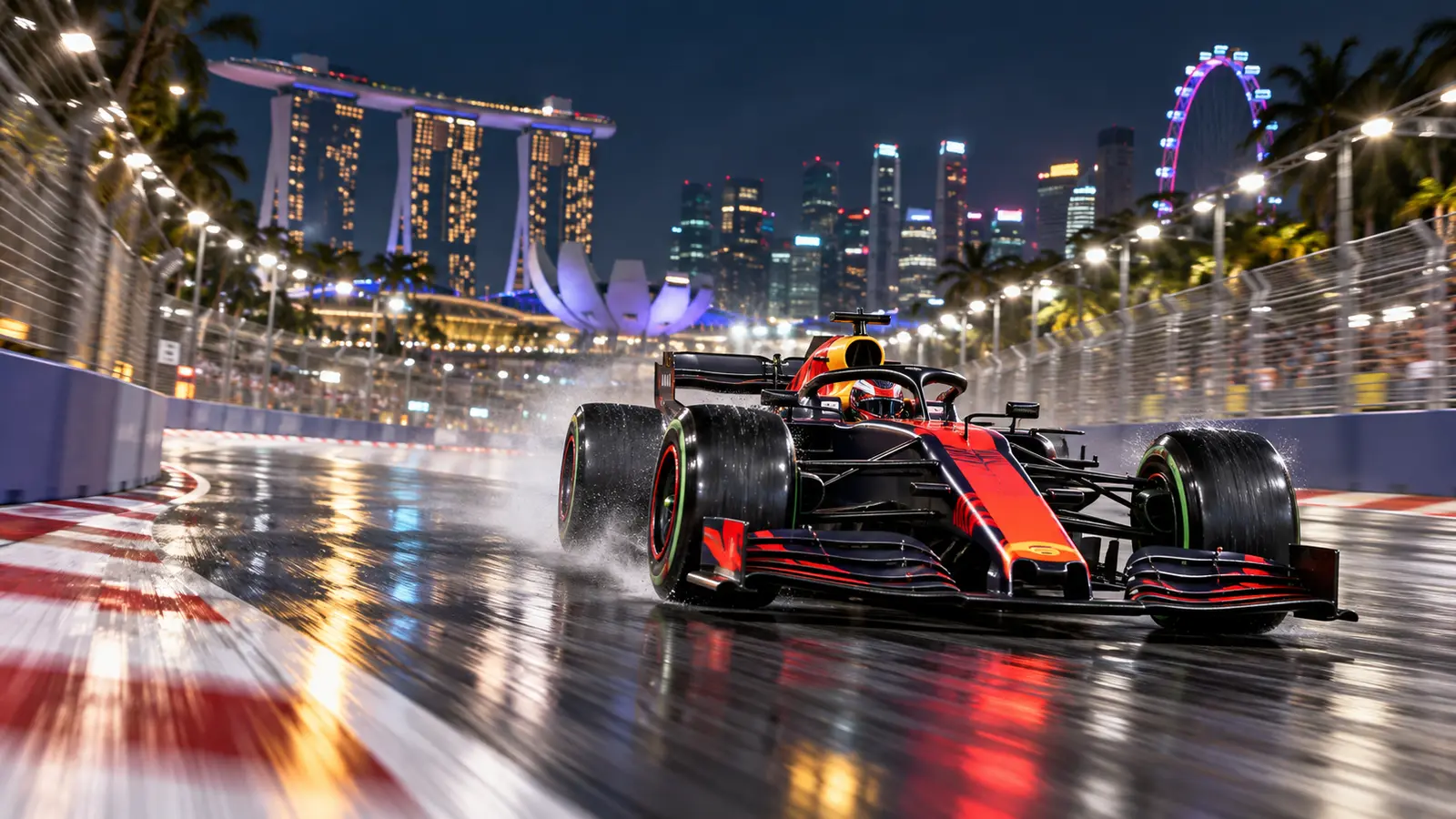
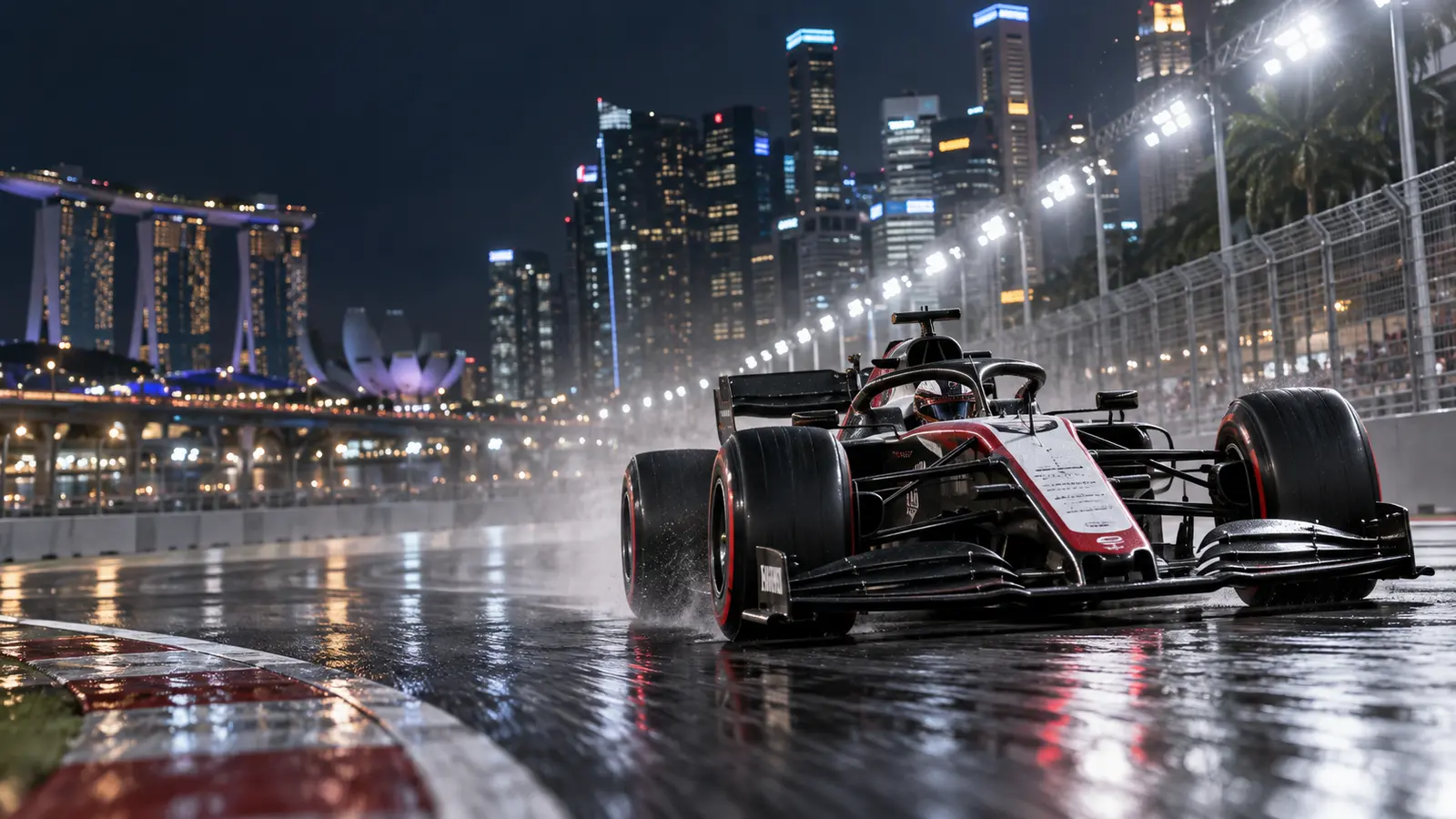
Max Verstappen turned a dominant Singapore Saturday into pole position for Sunday’s Grand Prix, beating Charles Leclerc by 0.054 seconds in a tight qualifying session at Marina Bay.
Verstappen’s fastest lap was 1:31.373. Leclerc put Ferrari second with a 1:31.427, while Lewis Hamilton qualified third on 1:31.496 after setting the pace earlier in the hour. Kimi Antonelli was fourth for Mercedes, Lando Norris fifth for McLaren, and George Russell sixth before an expected grid drop reshuffles the order behind the front rows.
The result matters because it came only a few hours after Verstappen won the Singapore Sprint. The earlier short race gave Red Bull points and rhythm; qualifying gave Verstappen track position for the main event. At Marina Bay, where walls sit close, overtaking is difficult and humidity punishes every mistake, that combination gives Sunday a clear competitive frame.
Verstappen Finds The Lap Ferrari Could Not Beat
Ferrari looked capable of taking pole for much of qualifying. Hamilton was fastest in Q1 and Q2, and Leclerc entered the final segment with enough pace to make Red Bull work for every hundredth. Yet Verstappen’s first Q3 run proved decisive.
The lap was not a comfortable margin. Leclerc missed by just over five hundredths, and Hamilton was only 0.123 seconds away from pole. But the timing of Verstappen’s effort mattered. Once the benchmark was set, Ferrari needed a clean final answer under lights, traffic pressure and track evolution. Neither driver quite found enough.
For Verstappen, the achievement carries extra weight because Singapore has often been one of the harder venues to convert into a clean weekend. The circuit’s stop-start corners, heavy braking zones and heat make it harder for a driver to rely on one strength. A car must be stable over bumps, quick on traction, kind enough on tires and predictable when the track grip changes.
Ferrari Still Has Two Cars In The Fight
Leclerc’s second place gives Ferrari a genuine chance to attack on Sunday. He starts close enough to Verstappen to make the opening lap important, and a street-circuit race can shift quickly if the leader is pressured into tire management or safety-car timing.
Hamilton’s third place is also a strong platform, even if pole slipped away. He had shown the session’s early speed and placed Ferrari on both sides of the immediate Red Bull threat. That matters strategically: Ferrari has two front-running cars available to challenge Verstappen, cover pit timing and respond if the race becomes disrupted.
The frustration for Ferrari is that a strong hour became a near miss. Hamilton had the pace to look like a pole contender, and Leclerc ended up closest to the final benchmark. When both cars are within a tenth and a half, the headline can feel harsher than the performance.
Mercedes And McLaren Need A Clean Race
Antonelli’s fourth place keeps Mercedes in the front group after a complicated Sprint day. He was close enough to the pole time to remain relevant, but not close enough to control the first phase of the race. If he inherits cleaner air from Russell’s grid drop, his Sunday may depend on whether Mercedes can keep tire temperatures stable in traffic.
Norris starts from fifth after McLaren’s difficult day. The team had already seen its drivers collide during the Sprint, and the main qualifying session did not produce a front-row recovery. Oscar Piastri qualified seventh, meaning McLaren remains near the leading group but without the track position that usually gives a team strategic authority at Singapore.
That leaves McLaren with a narrow but real path. A sharp start, pressure on Antonelli and clean tire management could move Norris into podium range. But if Verstappen, Leclerc and Hamilton settle into rhythm early, fifth may become a defensive rather than attacking position.
Russell’s Penalty Changes The Pack Behind
Russell’s qualifying result adds another layer to the grid. He was sixth on the timing sheet, but Formula 1’s report noted the incoming grid drop. That means the final starting order behind the top five will be adjusted, affecting Piastri, Pierre Gasly, Liam Lawson, Arvid Lindblad and others in the chasing group.
For Mercedes, the penalty hurts because Russell had shown speed earlier in the weekend. He challenged Verstappen in Sprint Qualifying and briefly led the Sprint before crashing out on the opening lap. Instead of converting that pace into a clean second-row start for the Grand Prix, he now faces a recovery race on a circuit where passing is rarely straightforward.
The penalty also gives the cars behind him a small but useful lift. At Singapore, one grid place can change the first stint. It can decide whether a driver spends the opening laps attacking the car ahead or protecting tires in disturbed air.
Why This Result Leads The Sports Slot
This was the strongest Saturday evening global sports selection because it was an officially confirmed Formula 1 qualifying result from a major Grand Prix weekend, completed within the previous 24 hours and carrying clear Sunday implications. It was also distinct from GDU’s earlier Singapore Sprint qualifying report, which covered Friday’s short-race grid rather than the main Grand Prix pole.
The wider motorsport thread now has a sharper shape. Verstappen has the Sprint win and Grand Prix pole. Ferrari has two cars directly behind him. Mercedes and McLaren have enough pace to stay close, but both need cleaner execution than they found earlier on Saturday.
Sunday’s race will answer the central question: whether Verstappen’s qualifying edge becomes a first-corner lead and race control, or whether Ferrari’s two-car pressure turns a narrow Saturday defeat into a Grand Prix fight.
Sports score: 88 out of 100. The story clears the Global Sports Highlights threshold through official timing confirmation, Formula 1’s global audience, a front-row margin of 0.054 seconds, Ferrari’s two-car challenge, Verstappen’s wider Singapore context and the immediate consequence for Sunday’s main race.