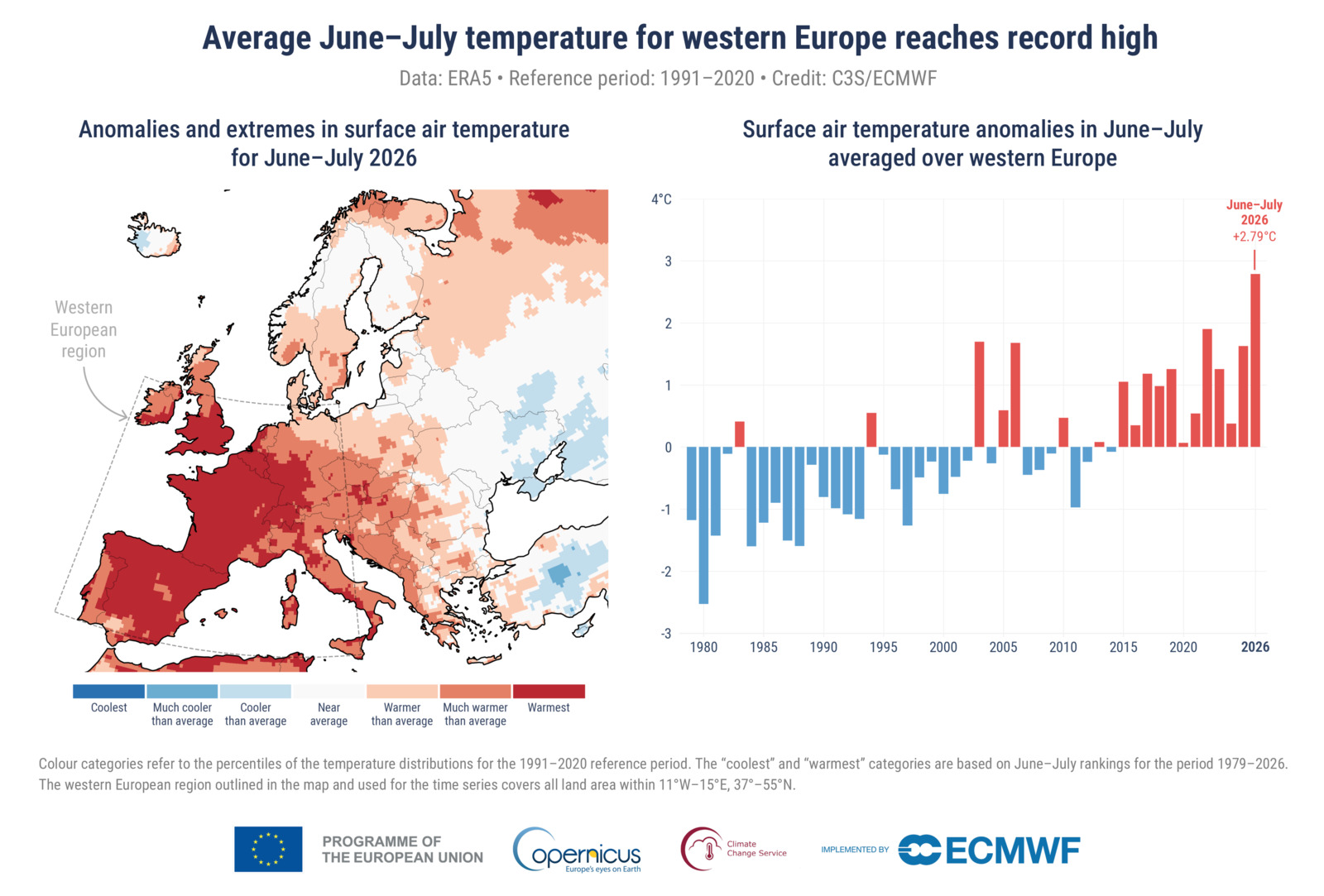
Western Europe has entered the second half of summer with a new climate benchmark: June and July were the region’s hottest such two-month period on record, according to the European Union’s Copernicus Climate Change Service.
The finding turns this summer’s heat from a sequence of national emergencies into a regional infrastructure story. Copernicus said western Europe’s average temperature for June-July reached 21.62C, or 2.79C above the 1991-2020 average. The previous record was set in 2022, a year already remembered for severe drought, river disruption and energy stress.
The new record matters because the heat has not arrived alone. Copernicus linked the prolonged hot and dry conditions to intensified wildfires, exceptionally low soil moisture and much lower than average river flows across dry regions. The Seine, Rhine and Danube were among the rivers highlighted by the climate service, raising pressure on water supply, irrigation, ecosystems, river transport and electricity production.
That is why the heatwave is no longer only a weather headline. It is testing health systems, farms, firefighting capacity, nuclear cooling, hydropower, inland freight and tourism across several countries at once.
What Copernicus Found
Copernicus reported that July 2026 was the joint-second warmest July globally in its ERA5 dataset, tied with July 2024 and behind July 2023. The average global surface air temperature was 16.90C, 0.67C above the 1991-2020 July average and 1.47C above the estimated pre-industrial baseline.
Europe as a whole did not rank as dramatically because the continent was split. Western Europe was much hotter than average, especially France, Spain, England and Ireland, while much of eastern Europe and Scandinavia was cooler than average. That contrast kept the wider European land average to the 11th-highest July on record, but it did not reduce the severity of the western signal.
The hydrology data sharpened the warning. Copernicus said dry conditions seen in May and June persisted and intensified in July across much of western and central Europe, including parts of the Iberian Peninsula, France, Germany, Austria, Hungary, the United Kingdom, Ireland, Iceland and the Benelux region. Surface soil moisture in western Europe was significantly lower than in July 2022, the last summer widely associated with severe drought across the region.
The ocean added another layer. Copernicus said July brought the highest sea surface temperature ever recorded for that month across the extra-polar global ocean, partly reflecting developing El Nino conditions in the equatorial Pacific. Around Europe, record sea surface temperatures along the Atlantic coast and the western Mediterranean were associated with strong or severe marine heatwaves.
UK Summer Record Comes Into View
The UK is becoming one of the clearest examples of how the western European pattern is playing out locally.
The Met Office said on Tuesday that the UK is on course to record its warmest meteorological summer for mean temperature, with only near-average conditions needed through the rest of August to pass the record set in 2025. Provisional statistics put the UK mean temperature from June 1 to August 10 at 16.48C, or 1.88C above the 1991-2020 average.
England and Wales are running even hotter relative to normal. England’s summer mean temperature stood at 18.19C, 2.46C above average, while Wales stood at 16.80C, 2.17C above average. The Met Office also said the UK’s record for average maximum summer temperature, set in 1976, is under threat if the rest of August remains modestly above the modern seasonal average.
The Guardian reported that the Met Office warning came as England faced another burst of extreme heat, with temperatures of 37C to 38C possible in parts of the country. Heat-health alerts were in place across England, and drought conditions had spread across a large share of the country after a dry July and a dry start to August.
The result is a compound stress test: people need cooling during the same period that water systems, power demand and emergency services are under pressure.
Fire, Health and Power Pressure
The effects are visible well beyond the UK. Associated Press reported last week that Italy placed all 27 cities monitored by its national heat surveillance system under the highest red alert, a warning level that applies to the wider population and not only to vulnerable groups. Austria and Slovakia also set national heat records during the current European heatwave.
In France, wildfire danger has remained high. In the UK, firefighters have been working to contain a large fire in the New Forest, where dry heathland and peat have complicated efforts to stop hotspots from spreading. Copernicus said the broader western European fire signal has been exceptional in terms of burned area and emissions.
Energy systems are also exposed. When rivers run low and warm, plants that depend on water for cooling or generation lose flexibility just as electricity demand rises for air conditioning. Previous stress on the Danube has already shown how quickly a drought story can become a power-grid story, with hydropower output, nuclear cooling and industrial consumption all affected.
The same mechanism can hit transport. Barges on major European rivers may need to carry lighter loads or stop moving if water levels fall too far. That can raise costs for fuel, grain, chemicals and industrial inputs that move through inland waterways.
Why The Record Matters
A single hot month can be disruptive. A hot, dry sequence across multiple months is more dangerous because it removes the buffers that normally help societies absorb heat.
Dry soil heats faster because less energy is used for evaporation. Low rivers leave less water for cooling, navigation and ecosystems. Warm nights reduce recovery time for people without reliable cooling. Marine heatwaves can damage coastal ecosystems and add warmth to nearby air. Wildfire smoke can travel far from the fire line and affect air quality across borders.
That is why this record has a global audience. Western Europe is a major economic region with dense cities, heavy industry, high tourism traffic, large agricultural markets and interconnected energy systems. Heat stress there can move into food prices, insurance losses, shipping costs, electricity markets and public-health planning.
The immediate question is whether late August brings enough rain and cooler air to ease the pressure. The longer question is how fast governments can adapt roads, railways, hospitals, water networks, farms and power systems to summers in which 2022-style conditions no longer look exceptional.
For readers following recent climate-risk coverage, the new Copernicus and Met Office data connect directly with earlier warnings about Danube drought and energy stress and record ocean heat tied to El Nino. The story is now broader: heat, water and energy risks are converging across borders at the same time.