
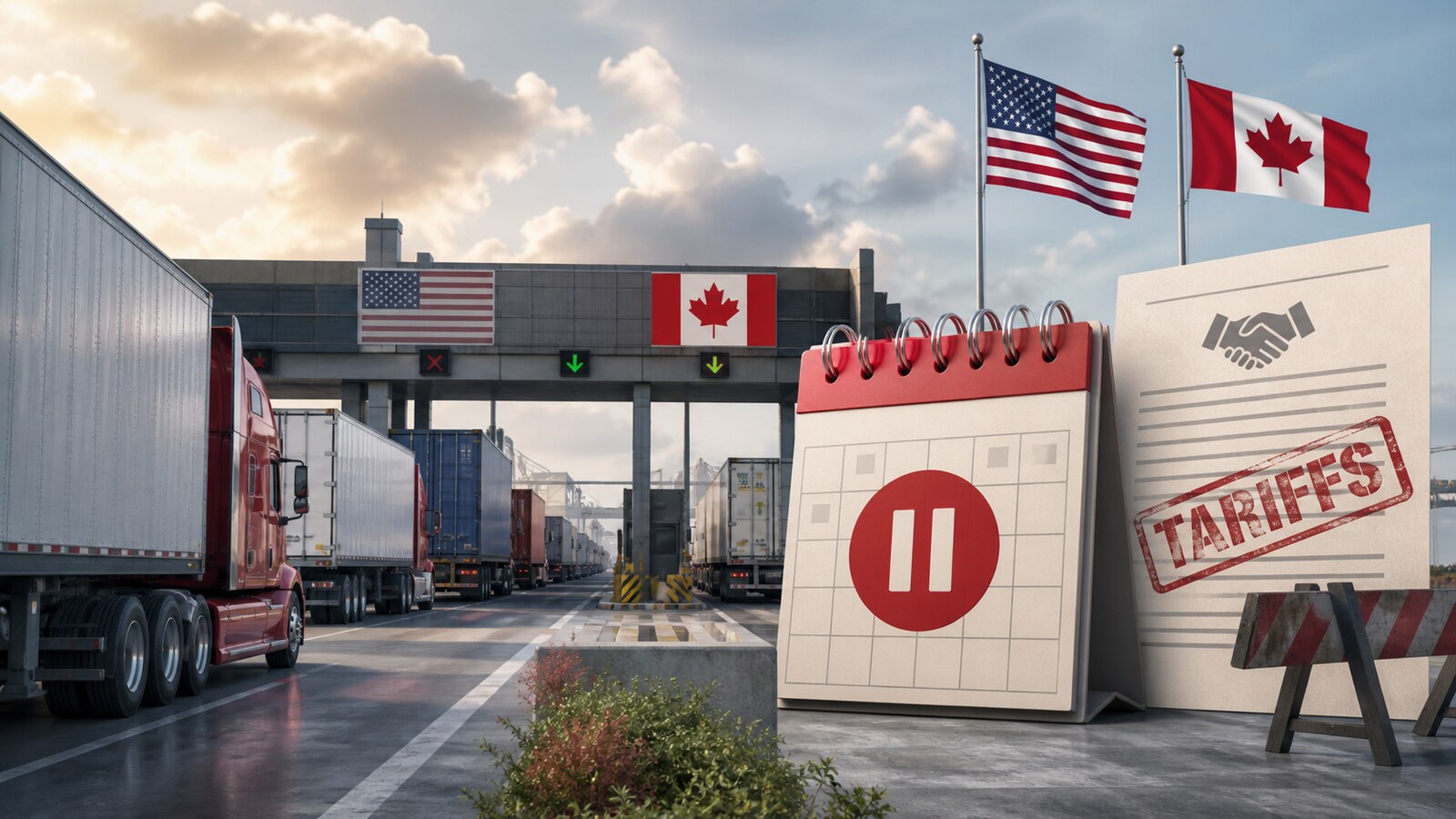
The United States has delayed a planned 50% tariff increase on selected Canadian goods for three days, giving Washington and Ottawa a brief opening to turn late-night diplomacy into a written trade settlement.
The White House proclamation signed on August 18 moved the effective date of the additional duties from August 19 to 12:01 a.m. eastern time on August 22, 2026. The order applies to earlier tariff actions targeting Canadian alcoholic beverages, dairy products and motor vehicles under Section 338 of the Tariff Act of 1930.
That makes the confirmed development narrow but important: the tariffs have not been cancelled. They have been suspended for a short period while negotiators try to finalize terms.
Associated Press, the Guardian, Al Jazeera, Euronews and trade-compliance specialists all reported the pause as a last-minute move after President Donald Trump said the two countries had reached a deal subject to final documents. Canadian Prime Minister Mark Carney said substantial progress had been made, while stressing that work remained.
For businesses, the difference between a pause and a settlement matters. Importers, exporters, logistics firms, retailers, farmers, auto suppliers and customs brokers still have to plan for a deadline that could return within days if the diplomatic paperwork fails.
What Changed
The July White House tariff announcement said the United States would impose additional 50% duties on certain Canadian imports, including goods connected to wine, dairy, vehicles, hockey sticks and cement. The administration said the measures were meant to answer what it called discriminatory Canadian treatment of U.S. commerce.
The August 18 proclamation did not withdraw those findings. Instead, it said senior U.S. officials had received information about the status of negotiations and Canada’s expressed commitment to remove disputed measures. The proclamation concluded that the public interest favored a three-day suspension.
The order also directed U.S. agencies to take steps to implement the delay. U.S. Customs and Border Protection was told to suspend collection of the additional duties as required and process refunds under standard procedures if implementation created a refund issue.
That technical detail is important for cross-border companies. A tariff headline becomes real only when customs systems, product classifications, entry dates, duty deposits and refunds line up. A three-day delay may prevent immediate collections, but it does not remove the need to check whether goods fall inside one of the affected categories.
Why The Dispute Matters
The United States and Canada are not marginal trade partners. The Office of the U.S. Trade Representative says goods and services trade between the two countries totaled an estimated $909.1 billion in 2024. It also describes Canada as one of the top U.S. trading partners, with deep integration in autos, textiles, energy and agriculture.
That integration is why even targeted tariffs can create wider pressure. A vehicle may cross the border several times before final assembly. A retailer may source seasonal goods months before a policy deadline. A food producer may rely on ingredients, packaging, trucking capacity and retail contracts across both countries.
The July tariff threat also carried political weight because it sat alongside disputes over the future of the United States-Mexico-Canada Agreement, known as USMCA in the United States and CUSMA in Canada. The White House said in July that the United States did not agree to renew the agreement in its current form. Canada’s prime minister said the U.S. tariff plan followed a series of unilateral actions that Ottawa viewed as violating the trade pact.
The pause therefore buys time on more than one product list. It buys time for both governments to decide whether they can keep North American trade rules predictable while still claiming wins on dairy, autos, alcohol access and broader market treatment.
The Canadian Position
Canada has argued that the dispute should be solved through negotiation and modernization of the North American trade framework. In a July statement, Carney said Canada had made detailed proposals to resolve the dispute and modernize CUSMA.
Ottawa has also maintained counter-tariffs on U.S. steel, aluminum and autos while removing many earlier countermeasures on other U.S. imports. Canada’s finance department says its approach is intended to protect Canadian workers and businesses while incentivizing a negotiated settlement.
That balance is difficult. Retaliation can show political resolve, but it can also raise costs for domestic companies that use U.S. inputs. Standing down too quickly can reduce leverage. The short U.S. suspension gives Canada a chance to lock in concessions without immediately triggering another round of commercial disruption.
The political message from Ottawa is likely to remain cautious. Carney can welcome progress, but a deal that touches vehicles, dairy, alcohol or energy infrastructure will face scrutiny from provinces, industry groups and opposition parties. Any revived discussion of Keystone XL, which Trump referenced in connection with the broader talks, would add another layer of energy, climate, Indigenous rights and landowner politics.
What Businesses Should Watch
The immediate deadline is August 22. If the suspension is extended, replaced by a formal agreement, or allowed to expire, customs treatment will change quickly.
Companies moving goods between the two countries should watch for Federal Register notices, CBP implementation guidance, Canadian government responses and any final joint statement. They should also check whether tariff exposure depends on product classification rather than broad sector labels. “Dairy” or “auto” is not enough; customs treatment depends on the specific tariff code and origin rules.
There is also a contract question. Buyers and sellers may need to decide who bears tariff risk for shipments already ordered, goods already in transit, or goods that clear customs after the deadline. That can affect margins even before a tariff bill arrives.
For consumers, the first impact may not be immediate shelf-price changes. It may show up through delayed purchasing, reduced product availability, slower restocking, supplier surcharges or cautious inventory decisions. Businesses facing tariff uncertainty often adjust orders before final prices change.
The Bigger Trade Signal
The pause shows how volatile tariff policy has become. Governments can use duties as negotiating leverage, but businesses need stable rules to price goods, sign supply contracts and invest in production.
For global readers, the story is not only about Canada and the United States. It is a test of whether two wealthy, highly integrated economies can manage a dispute without undermining the trade architecture that other regions study and sometimes emulate.
If Washington and Ottawa finalize a deal before August 22, the result may ease pressure on North American supply chains and give both leaders a political win. If talks fail, the return of 50% duties could deepen uncertainty around USMCA, raise costs for selected industries and invite another round of retaliation.
The practical answer is simple: this is a reprieve, not closure. The next three days will decide whether the US Canada tariff pause becomes a path to a wider settlement or just another deadline in a long-running trade fight.