
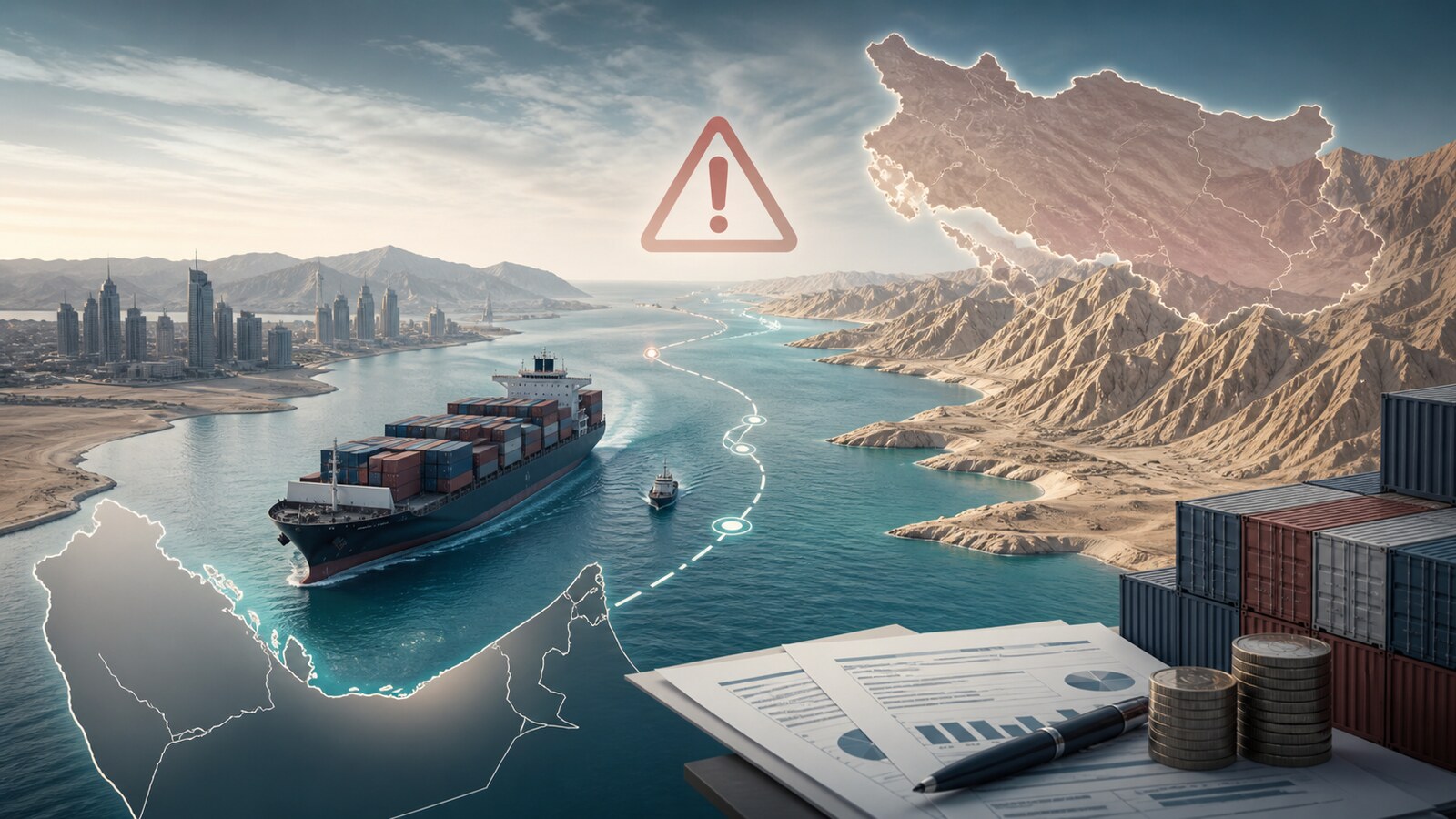
The United Arab Emirates’ decision to halt trade, commercial exchanges and financial transactions with Iran has turned a Gulf security crisis into a direct test of economic pressure, sanctions enforcement and regional commercial confidence.
The measure followed Emirati accusations that Iran fired ballistic missiles toward the Gulf state this week, an allegation Tehran denies. The UAE Ministry of Foreign Affairs said all trade, commercial exchange and financial transactions with Iran had been halted until further notice, while stressing that Abu Dhabi still supports dialogue, regional integration and respect for international law.
Associated Press reported that the suspension came after renewed missile fire triggered warnings for residents to seek shelter. Al Jazeera reported that Iran denied launching the missiles and suggested the incident was a false-flag operation. Financial Times and Guardian reporting framed the move as part of a wider U.S.-led pressure campaign on Tehran as talks over the Strait of Hormuz and Iran’s economy remain stalled.
That combination makes the story bigger than a bilateral dispute. The UAE has long been one of Iran’s most important commercial gateways, with Dubai serving as a re-export, logistics and finance hub for businesses that trade across the Gulf. If that channel narrows sharply, the effects could reach shipping companies, banks, insurers, energy traders and consumer-goods suppliers far beyond the Middle East.
What The UAE Announced
The UAE’s public position is that the latest restrictions are a response to regional escalation that threatens peace and security. The Foreign Ministry statement said trade and financial activity with Iran was stopped until further notice, but did not release a detailed exemptions list, enforcement timetable or sector-by-sector implementation plan.
That leaves immediate questions for businesses. Companies with goods in transit, outstanding invoices, bank transfers, customs documents, freight bookings or re-export contracts will need to know whether existing transactions can settle or whether all commercial activity is frozen immediately.
The UAE has also tied the move to maritime security. Earlier this month, the UAE condemned what it called an Iranian attack on an ADNOC-linked carrier in the Strait of Hormuz and said targeting commercial shipping threatened regional stability and global energy security. Iran has disputed or denied several accusations linked to the wider Gulf conflict.
The factual record therefore has two layers. The UAE has made an official allegation and taken a concrete economic step. Iran denies responsibility for the latest missile incident. Independent public evidence released so far does not settle every operational detail, including the exact missile trajectory, intended target or chain of command.
Why It Matters Globally
The UAE-Iran trade relationship is commercially important because it connects sanctioned Iran to one of the world’s most active logistics and finance hubs. Dubai’s ports, free zones, banking networks and re-export businesses have historically helped move goods between Iran and wider global markets.
An open-ended halt can affect more than Iranian importers. It can complicate supply chains for electronics, machinery, food, medical goods, consumer products and industrial parts that previously moved through Emirati intermediaries. It can also increase compliance risk for banks and insurers that already face U.S. sanctions exposure.
For energy markets, the timing is especially sensitive. Recent Global Daily Update coverage of ADNOC-linked vessel attacks and Hormuz shipping talks showed how commercial confidence in Gulf routes was already under pressure before the trade suspension.
The new restrictions add an economic choke point to the physical one. Even if ships can move, cargo owners still need banks to process payments, insurers to cover voyages, customs systems to clear goods and counterparties willing to accept legal risk.
The Sanctions Dimension
Washington has been pushing for tighter economic pressure on Iran after military pressure and indirect diplomacy failed to produce a durable settlement over the Strait of Hormuz, Iran’s nuclear program and wider regional security.
Guardian and Financial Times reporting described President Donald Trump’s latest campaign as an effort to increase penalties on entities that help Iran financially or commercially. The UAE’s halt therefore matters because it affects a practical route through which Iranian trade and payments have often been able to reach broader markets.
But enforcement will be complicated. Dubai’s commercial strength comes from openness, speed and dense cross-border networks. Those same traits make it difficult to quickly distinguish permitted humanitarian trade, legacy contracts, informal re-export activity, sanctions evasion and ordinary regional commerce.
If the UAE applies the halt broadly, Iran loses a major economic outlet. If the rules contain broad exemptions or uneven enforcement, the political signal may be stronger than the practical effect. Either outcome will be watched closely by Washington, Tehran, Gulf governments and companies that depend on regional trade.
The Risk To The UAE
The move also carries costs for the Emirates. The UAE has built its global business reputation on stability, neutrality, connectivity and commercial predictability. A sweeping halt on activity with a nearby trading partner can reassure security partners, but it can also unsettle merchants and investors who use Dubai precisely because it normally keeps trade moving through regional shocks.
There is also a diplomatic risk. Abu Dhabi has periodically sought to balance deterrence with de-escalation, maintaining channels with Tehran even while objecting to Iranian military activity and supporting broader Gulf security coordination. A full trade stop narrows that space.
Iran’s denial matters in that context. If Tehran continues to reject responsibility for the missile incident, the dispute may harden into a contest over evidence, attribution and retaliation rather than a narrow response to a single event.
What To Watch Next
The first test is enforcement. Businesses will look for customs notices, central-bank guidance, port instructions, sanctions advisories and any humanitarian or legacy-contract exemptions.
The second test is Iran’s response. Tehran could answer diplomatically, pursue legal or regional mediation, increase pressure around shipping, or try to reroute trade through other hubs.
The third test is whether other Gulf states follow the UAE’s lead. A wider regional trade squeeze would make the policy far more damaging for Iran and more disruptive for commercial networks.
The fourth test is the Strait of Hormuz. If shipping incidents continue while trade channels close, energy markets may treat the Gulf crisis as both a maritime-security risk and a sanctions-enforcement shock.
The UAE’s halt does not by itself decide the Gulf crisis. It does, however, move the pressure point from warships and missiles into banks, ports, invoices and insurance desks. That is why the decision has global consequences even before its full enforcement details are known.