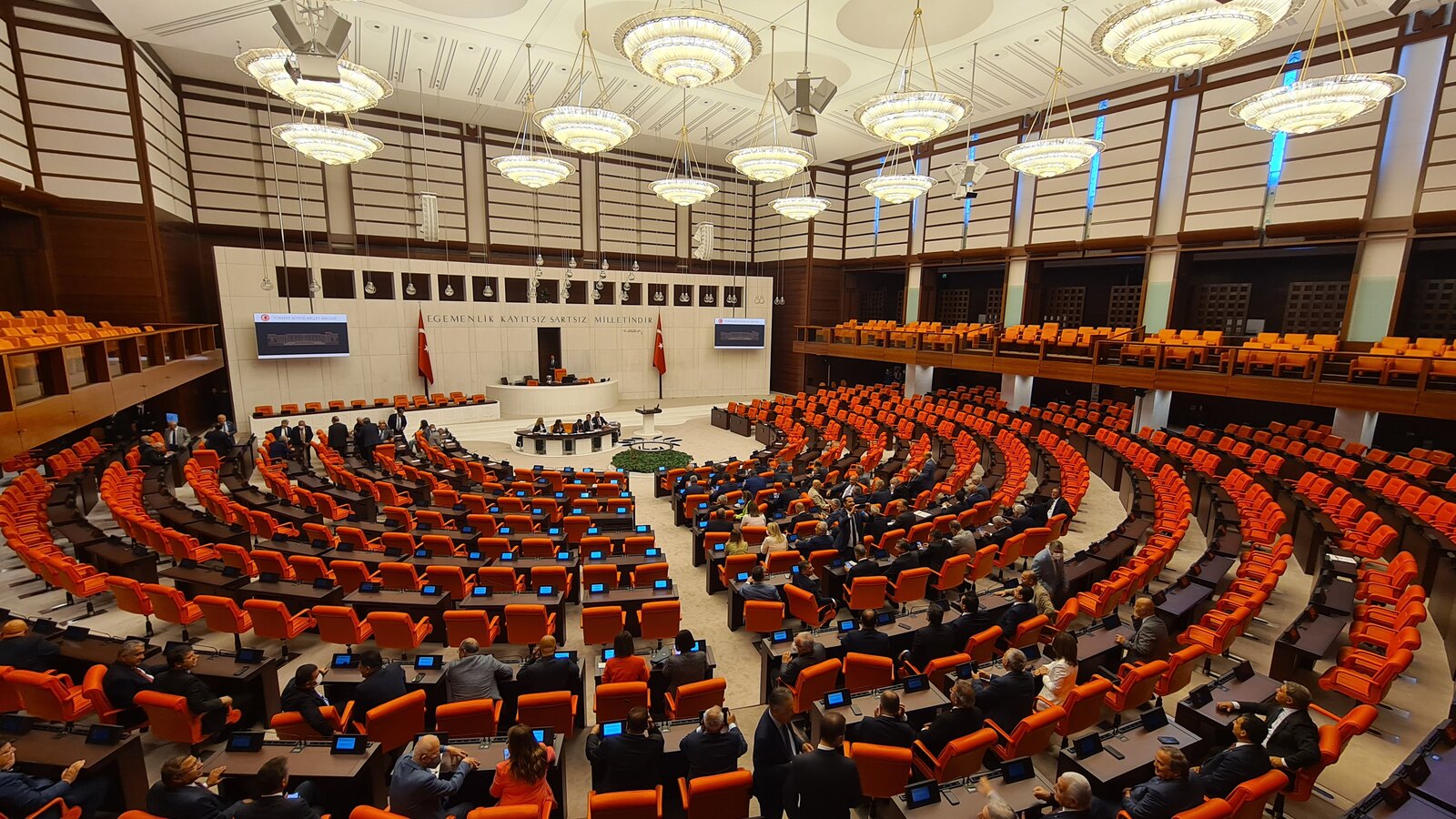
Turkey’s renewed peace process with the Kurdistan Workers’ Party has moved from statements and symbolic gestures into parliament, where lawmakers are considering a framework bill that could decide whether one of the Middle East’s longest-running internal conflicts becomes a managed political settlement.
The bill, filed this week by President Recep Tayyip Erdogan’s ruling alliance, seeks to create a legal route for parts of the PKK’s disarmament and reintegration. Associated Press reported that the proposal includes an effective pardon for some former fighters, while Reuters reported that it would protect many former militants from prosecution and suspend prison sentences for some others.
The measure matters far beyond Ankara. The PKK conflict has shaped Turkey’s domestic politics, its security operations in northern Iraq and Syria, its relationship with Kurdish political movements, and its diplomacy with Europe and the United States for decades. If the bill advances, it would be the most concrete legislative step yet in a process Ankara has framed as a “Terror-Free Turkiye” initiative.
What The Bill Would Do
Reporting by AP, Reuters, Bianet and AFP-backed accounts describes the draft as a limited framework for reintegration rather than a blanket amnesty. Its core idea is to create legal incentives for former PKK members who were not involved in killings or other excluded serious crimes to return, face defined procedures, and avoid an automatic return to armed conflict or exile.
Bianet reported that the proposal is officially titled the Law on Strengthening National Solidarity and Social Integration. It said implementation would depend on official verification of the PKK’s dissolution by Turkey’s National Security Council, giving the state security body a central role in determining whether disarmament conditions have been met.
Reuters reported that the bill is intended to facilitate the return of potentially thousands of former fighters and civilians from northern Iraq, where the PKK has long maintained bases and networks. AP reported that militants convicted of homicide or sentenced to life before 2005 would be excluded from the benefits, and that jailed PKK leader Abdullah Ocalan is not being considered for release under the current proposal.
That structure reflects Ankara’s balancing act. The government wants the bill to be strong enough to draw fighters out of the mountains and camps, but narrow enough to reassure nationalist voters, security institutions and families affected by decades of violence.
Why Parliament Is The Key Test
The process has already passed several symbolic milestones. Ocalan called for the PKK to lay down arms and dissolve. The group later announced it would disband and staged a symbolic disarmament ceremony in northern Iraq. Turkey’s parliament also formed a commission to discuss reforms linked to national solidarity, democracy and the Kurdish question.
But symbolism cannot settle practical questions: who qualifies for legal protection, who verifies disarmament, how former fighters return, how prosecutions are handled, and what political space Kurdish parties will be allowed to exercise afterward.
Parliament is where those questions become enforceable. According to Bianet, the bill was submitted with signatures from 360 lawmakers across six parties, including the ruling Justice and Development Party, its nationalist ally the MHP, the pro-Kurdish DEM Party, the main opposition CHP, the New Path Party and HUDA PAR. The nationalist Good Party opposed the process, while another opposition grouping had not signed the text.
That broad but uneven support explains why the vote is significant. It suggests the bill has enough momentum to pass, while also showing that the peace process remains politically fragile. Turkey’s last major attempt at talks collapsed in 2015, and the memory of that failure still shapes public skepticism.
The Regional Stakes
The PKK began its insurgency in 1984 and is listed as a terrorist organization by Turkey, the United States and the European Union. The conflict has killed more than 40,000 people, according to Reuters, and has drawn Turkey into repeated cross-border security operations in Iraq and Syria.
A credible settlement could reduce pressure along Turkey’s southeastern border, lower the risk of renewed clashes in northern Iraq, and change Ankara’s approach to Kurdish-led political and security structures in Syria. It could also affect migration diplomacy with Europe, where Kurdish diaspora politics, refugee flows and Turkey’s wider democratic trajectory are closely watched.
The European Policy Centre argued last year that the renewed Kurdish peace process has implications for Europe’s migration management, counterterrorism cooperation, democratic engagement and regional stability. Its analysis also warned that peace talks would be hard to separate from broader concerns about opposition pressure, jailed Kurdish politicians and the rule of law.
That tension is central to the bill. A security-only settlement could reduce armed violence without resolving the political grievances that have repeatedly pulled Turkey’s Kurdish question back into crisis. A rights-based settlement, by contrast, would require legal clarity, space for democratic Kurdish politics, and public confidence that the process is not simply a tactical deal.
What Ankara Has Said
Turkey’s National Security Council has repeatedly tied the initiative to the government’s broader vision of removing terrorism from the national agenda. In an April statement published by the Directorate of Communications, the council said efforts toward a “Terror-Free Turkiye and a terror-free region” were discussed and that regional conflicts would not be allowed to undermine the process.
That official framing shows why Ankara views the bill as a national-security measure as much as a reconciliation measure. The government is trying to turn disarmament into a state-managed sequence: verification first, legal protection for eligible participants, and political follow-through through parliament and ministries.
The risk is sequencing. Kurdish parties and analysts have argued that legal and political reforms must accompany disarmament to build trust. Turkish officials have insisted that full disarmament must come before deeper legal changes. The bill is therefore less an endpoint than a test of whether both sides can accept a staged settlement.
What To Watch Next
The immediate question is whether parliament passes the bill before its recess and whether the final text keeps the same eligibility limits, verification powers and sentence-suspension provisions reported this week. Any expansion or narrowing could change how former PKK members, Kurdish parties and nationalist opposition groups respond.
The second question is implementation. A law on paper will not resolve the conflict if return procedures are unclear, if local politics remains heavily restricted, or if armed factions believe the state is not honoring its side of the process. Verification by the National Security Council may reassure Ankara, but it may not by itself reassure Kurdish constituencies without transparent procedures.
The third question is regional spillover. Turkey’s security posture in Iraq and Syria will reveal whether the peace track is reducing conflict risk or simply shifting it across borders. Any breakdown in northern Syria, northern Iraq or Turkish domestic politics could quickly test the durability of the parliamentary effort.
For now, the significance is clear: Turkey’s PKK peace process has entered its legislative phase. After decades of insurgency, failed talks and cross-border conflict, the next test is whether parliament can turn a fragile opening into rules that armed actors, political parties and the public are willing to trust.
The story follows recent international developments on Gaza disarmament talks and Strait of Hormuz diplomacy, where security guarantees, political sequencing and regional trust are also shaping whether conflict-management plans can survive contact with reality.