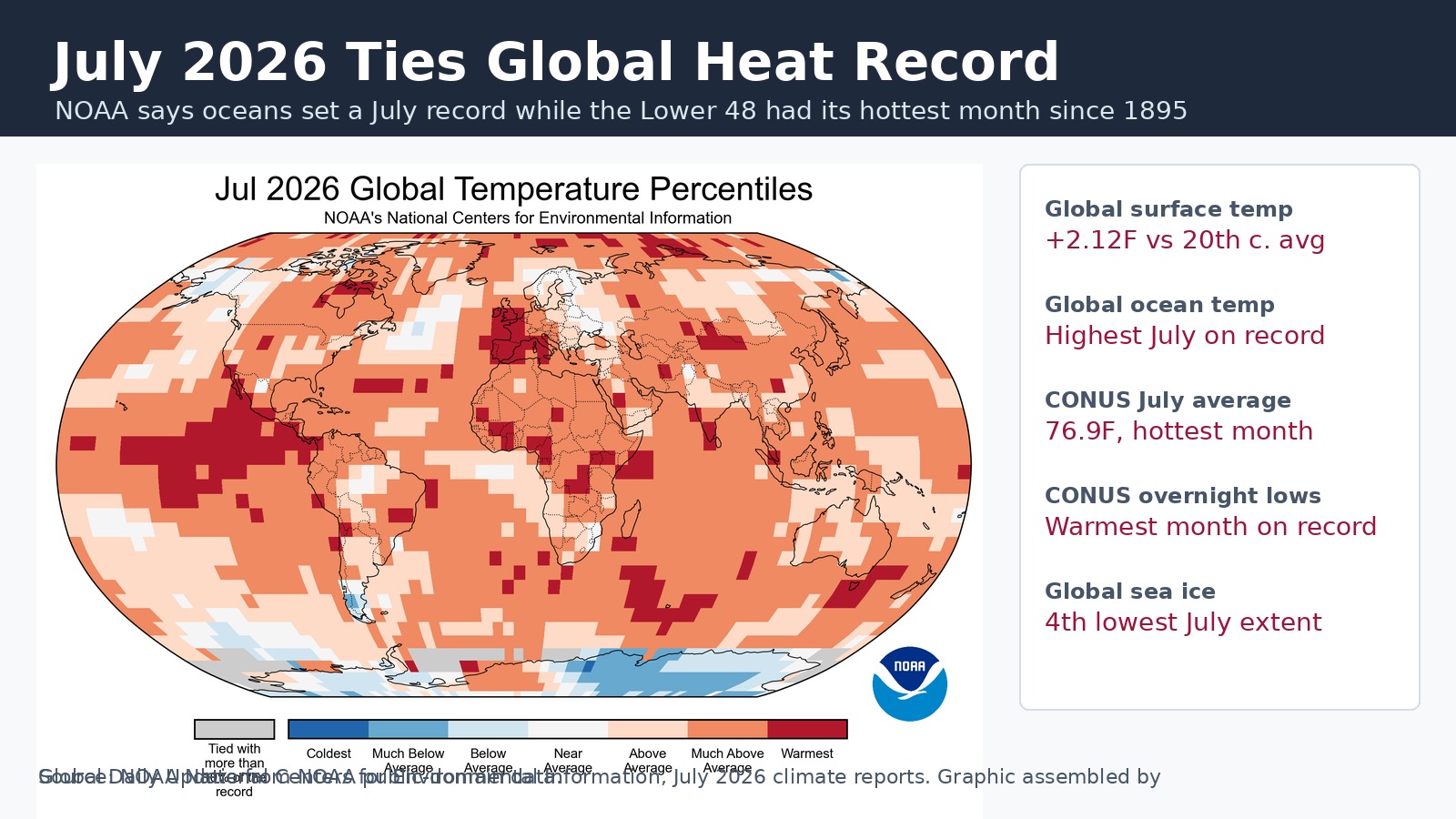
NOAA’s July climate reports have turned a summer of regional heat emergencies into a global record story, with the agency saying July 2026 tied for the warmest July ever measured worldwide, ocean temperatures reached a July record, and the contiguous United States recorded its hottest month in 132 years of data.
The numbers matter because they connect several risks that often appear separately: heatwaves, high overnight temperatures, drought, wildfire potential, sea-ice loss, electricity demand, health strain and El Nino-driven ocean warming. Together, they show why July 2026 is now one of the clearest climate markers of the year.
NOAA’s National Centers for Environmental Information said global surface temperature in July was 2.12F, or 1.18C, above the 20th-century average, tying July 2024 as the warmest July in its record. The agency also said the past four Julys, from 2023 through 2026, are the four warmest Julys on record.
That is not only a ranking. It is a signal that the baseline for summer heat is moving across land and ocean at the same time.
What NOAA Found Globally
NOAA’s global report said areas with record-high July temperatures were widespread across parts of most continents and every major ocean basin. North America, Africa and Asia each recorded their warmest July, while South America, Europe, the Arctic and Oceania all finished among their warmer Julys even where regional patterns varied.
The ocean result is especially important. NOAA said global ocean temperature was the highest on record for July, at 1.84F, or 1.02C, above average. It was the first July in the dataset to exceed a 1.8F ocean-temperature departure.
That ocean heat can influence weather long after a calendar month ends. Warm seas can feed stronger humidity, marine heatwaves, coral stress, heavier rainfall potential and shifts in storm behavior. NOAA linked the high ocean departure to El Nino conditions in the tropical Pacific, which were present during July and expected to strengthen through the end of the year.
The agency also reported that global sea ice extent was the fourth smallest for July in the 48-year record. Arctic sea ice ranked sixth lowest for the month, while Antarctic sea ice ranked fifth lowest.
Those findings make July’s heat a global systems story rather than a single heatwave story. The land warmed. The oceans warmed. Ice cover remained unusually low. Several regions saw extremes at once.
The U.S. Broke A Dust Bowl-Era Benchmark
The most striking national result came from the contiguous United States. NOAA said the Lower 48 averaged 76.9F in July, 3.3F above the 20th-century average. That made July 2026 the warmest July and the warmest month of any kind in the U.S. record dating back to 1895.
Associated Press reported that the average edged past July 1936, the Dust Bowl-era benchmark, by about an eighth of a degree Fahrenheit. The new mark also surpassed July 2012, another major U.S. heat year.
The record was not limited to daytime highs. NOAA said average daytime maximum temperatures ranked as the sixth-warmest month on record, while overnight minimum temperatures ranked as the warmest month on record for lows. That nighttime signal is crucial for health because people, buildings and power systems get less time to cool down after hot afternoons.
The Weather Channel, citing NOAA data, reported that Salt Lake City reached 109F, Billings reached 111F and Rapid City reached 112F during July, each setting all-time high-temperature records. NOAA’s own summary said Wyoming recorded its warmest July and warmest month on record, 6.3F above average.
The result was broad rather than isolated. NOAA said all contiguous U.S. states were at least 1F above their 20th-century average, and every state ranked in the warmest third of its July record.
Why The Nighttime Heat Matters
Extreme heat becomes more dangerous when nights stay warm. A hot day can be stressful; a hot day followed by a hot night can become a compounding health risk, especially for older people, outdoor workers, children, people without reliable cooling and those with chronic health conditions.
Warm nights also keep air conditioners running longer. That can lift electricity demand, raise household bills and strain grids during periods when power plants and transmission systems are already operating under stress.
The Guardian reported that the July heat affected daily life across the United States, including cooling costs, travel plans and outdoor activity. Those impacts are consistent with the physical pattern NOAA described: widespread warmth, unusually warm lows and drought pressure across large parts of the country.
This is why climate scientists watch minimum temperatures closely. Rising overnight lows are one of the clearest fingerprints of a warming climate, and they often determine how severe a heatwave feels on the ground.
Drought, Fire And Flood Risks Are Moving Together
NOAA’s U.S. report did not describe July as simply hot. It also showed a country split between dryness and heavy-rain events.
The agency said total precipitation across the contiguous United States was 2.55 inches, 0.23 inch below the 20th-century average, ranking in the driest third of the historical record. At the same time, heavy rainfall produced major flash-flooding events in parts of Texas and eastern New York.
About 48.5 percent of the contiguous United States was in drought as of August 4, according to the U.S. Drought Monitor cited by NOAA. Drought persisted across much of the interior West, Southwest and Rockies, and expanded or intensified in parts of the Northwest, Plains, Upper Midwest and far Northeast.
NOAA’s monthly outlook also warned that significant wildland fire potential for August was above normal across the Northwest, Great Basin, central Rockies, parts of the northern and southern Plains, the Lower Mississippi Valley, southern Florida and Puerto Rico.
That mix is becoming familiar: hotter air can dry soils faster in one region while a warmer atmosphere holds more moisture for intense rainfall in another. A single national average can hide those local extremes, but the infrastructure consequences can appear at the same time.
How It Fits With Europe And El Nino
The NOAA update lands just after Copernicus reported that western Europe had its hottest June-July period on record, with drought, wildfires and low river flows raising concern for public health, transport, agriculture and energy systems.
The same global report helps explain why these regional events are connected. NOAA said record-high July temperatures spanned the British Isles, western Europe, the central and eastern tropical Pacific, parts of North and South America, Africa, Asia, the Arctic and major ocean basins.
El Nino adds another layer. NOAA’s Climate Prediction Center has already said El Nino conditions are present and expected to strengthen through the end of the year. Ocean heat does not guarantee one specific outcome in every country, but it can tilt global temperature rankings and shift rainfall patterns, storm tracks and marine heat stress.
That is why the July report links directly with earlier coverage of El Nino and ocean heat warnings and western Europe’s heat record. The new data does not replace those stories. It gives them a global frame.
What To Watch Next
The first question is whether August extends the pattern. NOAA’s U.S. outlook favors above-average August temperatures across the central and southern tiers of the country, with especially elevated odds in parts of coastal California and the southern Plains.
The second question is how strong El Nino becomes. If Pacific warming continues, it could influence global temperature rankings, rainfall distribution and storm behavior into late 2026 and early 2027.
The third question is adaptation. July’s records are already in the books, but the practical effects are still unfolding through electricity demand, crop stress, wildfire risk, public-health alerts, insurance losses and infrastructure planning.
For governments and households, the message from NOAA’s July reports is direct: heat records are no longer rare data points that sit apart from daily life. They are becoming operating conditions for health systems, energy grids, farms, water managers, transport networks and cities across several continents at once.