Flash floods and mudslides along the Nepal-China border killed at least 98 people on Wednesday and left hundreds more missing, turning a Himalayan travel corridor into a major cross-border disaster zone.
The most stable public baseline by Wednesday evening was that Nepal had reported at least 95 deaths and China had reported at least three deaths in Tibet’s Gyirong County, according to AP reporting that cited Nepal’s prime minister’s office and Chinese state broadcaster CCTV. Rescue agencies and tourism officials also reported hundreds of people unaccounted for, including foreign tourists, pilgrims, workers and local residents.
The Nepal China flash floods hit a region where steep valleys carry rivers, roads, border trade, hydropower projects and pilgrimage traffic through the same narrow terrain. That geography explains why the disaster moved quickly from a local flood into an international emergency: the affected area links Nepal’s Rasuwa and Nuwakot districts with Tibet’s Gyirong crossing, and river systems downstream eventually connect toward India.
Officials were still investigating the trigger. Nepal’s foreign minister told parliament that early information pointed to a possible earthquake-linked avalanche or ice-and-rock collapse, but he said the theory needed verification. Other assessments cited by international reports pointed to a possible blockage and sudden release of water in the Lhende Khola-Bhote Koshi river system.
What Is Confirmed So Far
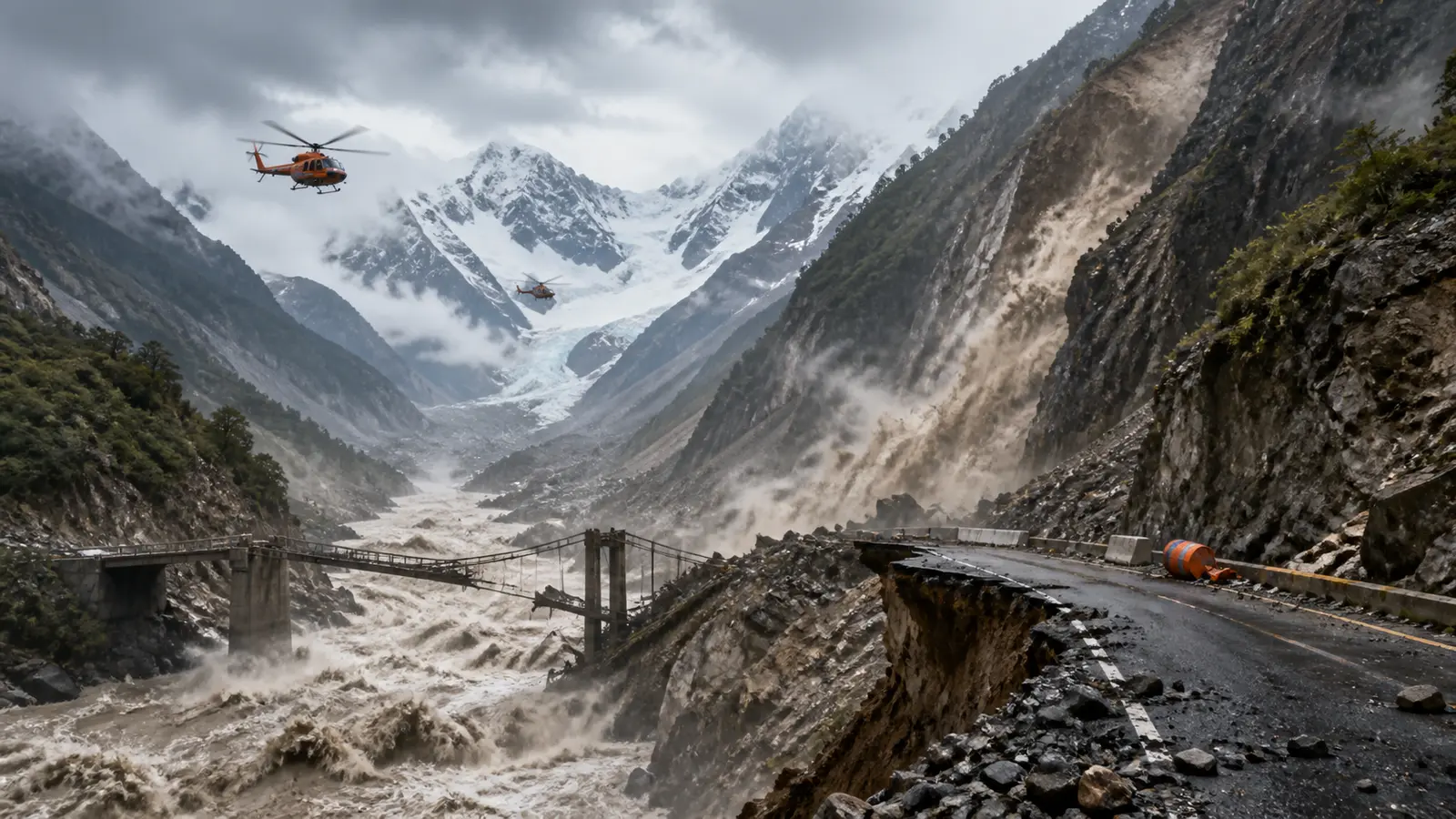
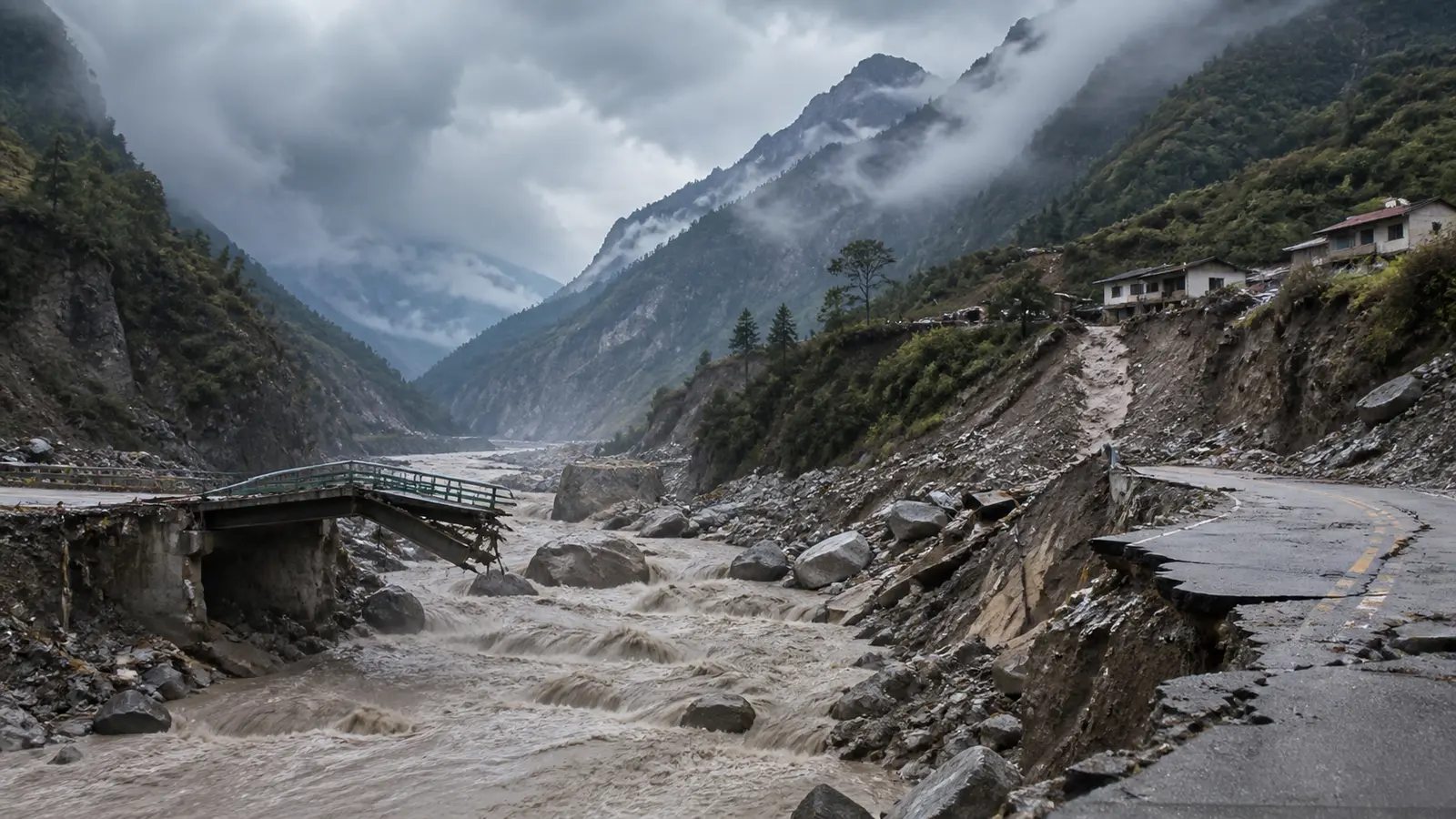
The flood struck on Wednesday morning near Nepal’s northern border with Tibet. It sent water, mud and rock through communities and infrastructure sites along the Bhote Koshi and Trishuli river corridor, damaging roads, bridges, homes, vehicles and power projects.
AP reported that Nepal’s prime minister’s office put the death toll at 95, while CCTV said a mudslide in Tibet’s Gyirong County killed at least three people and left 265 missing. The figures may change as search teams reach cut-off areas and confirm duplicate or preliminary missing-person lists.
Missing-person totals were also moving quickly. AP cited officials saying 403 people were unaccounted for, including 341 foreign nationals. The Guardian, citing Nepal tourism figures and Reuters reporting, reported 384 missing travellers, including Britons, South Africans and Nepalis associated with a trekking company, and said 95 bodies had been recovered in the unfolding disaster.
Those differences are not unusual in the first hours after a fast-moving disaster. Tourist agencies, embassies, local police, hydropower employers and village authorities may all hold partial lists. The central editorial point is therefore not one exact missing-person number, but the scale: hundreds of people were still unaccounted for across a damaged border zone.
Why The Border Corridor Matters
The affected route is more than a scenic mountain road. It is part of a trade and travel corridor between Nepal and China, a route used by pilgrims heading toward Mount Kailash, tourists, transport workers and hydropower staff.
When floodwater tears through a valley like that, it does not only destroy riverbank settlements. It can remove bridges, block roads, cut communications, isolate rescue teams and halt power generation. Reuters-syndicated reports said hydropower projects were damaged, while AP described buildings buried in mud and roads destroyed.
China’s side of the border also faced serious disruption. Chinese state media said Gyirong was hit by a mudslide, with roads, communications and power links affected. State reports cited large search-and-rescue deployments, while Chinese President Xi Jinping called for stronger search, monitoring and early-warning work.
For Nepal, the immediate operating challenge is access. Helicopters and rescue teams can move quickly only when weather, landing zones and valley visibility allow it. Several reports described high water, thick mud and blocked roads complicating rescue operations in and around Syapru Besi, Timure, Nuwakot and the wider Rasuwa district.
The Cause Is Still Under Investigation
The most important caution is that the cause has not been finally established. A flood like this can follow several related triggers: intense rain, a landslide dam that fails, an ice or rock avalanche into a river, a glacial lake outburst, earthquake shaking, or a combination of those processes.
Nepalese officials and outside researchers were examining whether a magnitude-4 range earthquake in Tibetan territory happened close enough in time and location to have destabilized ice or rock. But a time match is not proof. Investigators still need satellite imagery, field evidence, river-gauge data and local observations before they can explain the sequence confidently.
That uncertainty matters because Himalayan risk is changing. Warmer conditions can destabilize glaciers, permafrost and high mountain slopes, while monsoon rainfall adds pressure lower in the system. A sudden release upstream can become deadly downstream within minutes, especially where roads, homes and work camps sit close to narrow river channels.
Recent Global Daily Update coverage of NOAA’s July climate report and record rain in Chiba, Japan showed how climate and infrastructure risks can converge in very different settings. The Nepal-China disaster is a sharper high-mountain version of the same problem: settlement, transport and energy systems are exposed when extreme water moves faster than warning and evacuation systems can respond.
International Response And Travel Risk
The missing include people from several countries, according to international reports. AP cited foreign nationals from India, the United States, Australia, Britain and Canada among those unaccounted for. Other reports also mentioned Malaysian, South Korean and South African citizens or workers affected by the disaster.
That makes embassy coordination part of the emergency. Governments need to confirm who entered the affected zone, which tour operators were moving groups through the border area, who reached shelter, and who may still be unreachable because phones and roads are down.
Local authorities urged tourists and residents near the Bhote Koshi and Trishuli rivers to move to safer ground and avoid travel into affected areas. Those warnings remain central because the first flood may not be the only danger. Blocked valleys, unstable slopes, damaged riverbanks and continuing rain can create secondary floods or landslides after the initial surge has passed.
The disaster also has regional implications for India. Rivers from Nepal’s mountains feed downstream systems in northern India, where sudden upstream surges can raise alert levels in densely populated plains. Even when the worst destruction is in Nepal and Tibet, downstream states may still monitor water levels, bridges and embankments closely.
What To Watch Next
The first priority is the human toll: confirming deaths, reconciling missing-person lists and finding survivors in communities and work sites that rescuers have not yet reached.
The second is access. If roads and bridges remain cut, helicopters, military teams, police and local volunteers will carry more of the search burden. Bad weather or unstable slopes could slow that work.
The third is the technical investigation. Whether the flood began with an avalanche, a landslide dam, a glacial-lake failure, earthquake shaking or a combination will shape future monitoring along the border. A confirmed upstream blockage would raise immediate concern about whether any remaining material could fail again.
The fourth is infrastructure recovery. Roads, bridges, customs facilities, hydropower projects and communications links are economic lifelines in the high Himalayas. Their loss can isolate communities after the emergency phase ends.
For global readers, the significance is clear. The Nepal-China flash floods are not only a tragic mountain disaster; they are a warning about the exposure of travel, trade, energy and border infrastructure in a warming, unstable Himalayan region where a sudden surge can turn a narrow valley into an international emergency within minutes.