Thousands of people on Indonesia’s Flores Island were still waiting for reliable shelter, medical care and supplies on Monday as aftershocks continued to shake communities hit by a powerful magnitude 7.7 earthquake.
Indonesia’s Meteorology, Climatology and Geophysics Agency, BMKG, said the quake first struck the Flores region on Saturday morning and was followed by 1,624 aftershocks by late Monday morning local time. The agency said 23 of those aftershocks were stronger than magnitude 5, while 59 were felt by residents.
The official update put the confirmed toll at 53 dead and 137 injured, with damage reported across Manggarai Barat, Manggarai, Manggarai Timur, Sikka and Maumere. Associated Press later reported that the death toll had risen to at least 68, with more than 200 injured and about 19,000 people in temporary shelters as aid crews tried to reach isolated areas.
The numbers may continue to shift as Indonesian authorities reconcile reports from local governments, hospitals, search teams and villages cut off by landslides or damaged roads. That uncertainty is common after a major earthquake, but the scale of the aftershock sequence is making the response more urgent.
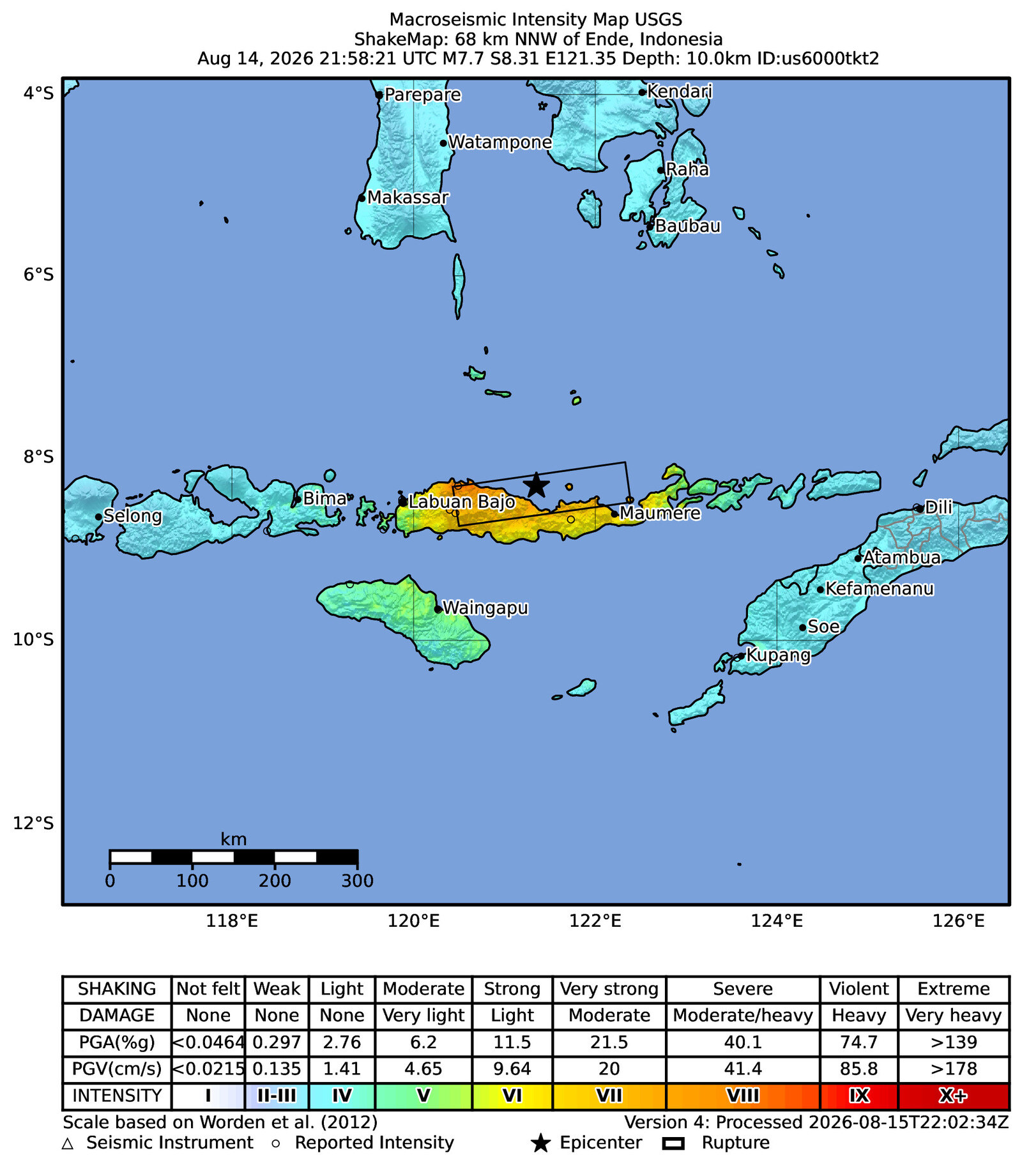
BMKG said the earthquake was a shallow event linked to thrust movement along the Flores Back-Arc system. The U.S. Geological Survey placed the quake at 21:58 UTC on August 14, or early Saturday in Indonesia, about 68 kilometers north-northwest of Ende at a depth of 10 kilometers.
Why The Flores Quake Was So Damaging
The Flores earthquake combined several dangerous factors: high magnitude, shallow depth, coastal exposure, steep terrain and vulnerable buildings. A shallow quake releases energy closer to the surface, which can create stronger shaking in nearby communities than a deeper event of the same size.
BMKG’s initial tsunami warning showed why authorities treated the event as more than a land-shaking disaster. The agency said its early model warned parts of East Nusa Tenggara, West Nusa Tenggara and South Sulawesi of possible tsunami effects. The warning was later ended, but BMKG said sea-level observations confirmed tsunami waves in 16 locations across four provinces.
The highest observed wave was recorded at Pota in East Manggarai, East Nusa Tenggara, at about 1.605 meters. That level is far below the worst tsunamis in Indonesian history, but it was still enough to validate the urgency of coastal evacuations and warnings.
The shaking itself appears to have caused the heaviest losses. BMKG described deaths, injuries and building damage across a wide zone. AP reported damaged or destroyed homes, public facilities and health services, while The Guardian and Al Jazeera reported blocked roads, landslides and communication disruptions that slowed access to the worst-hit communities.
The disaster also struck during Indonesia’s Independence Day weekend. President Prabowo Subianto led a national moment of silence as the country marked its 81st Independence Day, turning a national celebration into a test of disaster response in one of the world’s most seismically active countries.
Aid Race Meets Aftershock Risk
For rescue teams, the first challenge is access. Flores has mountainous terrain, coastal settlements and roads vulnerable to landslides. When bridges, hillsides or sections of highway are damaged, relief supplies cannot simply move in by truck on a normal schedule.
The second challenge is safety. Aftershocks can injure people who return to cracked houses, damage already weakened buildings and force emergency teams to pause work around unstable structures. BMKG urged residents to avoid damaged buildings and to keep following official channels as aftershocks continue.
The third challenge is health capacity. AP reported that field hospitals were being set up in Ruteng because local health facilities were damaged or overwhelmed. That matters because earthquake injuries often need quick treatment: crush injuries, fractures, wounds, dehydration, infections and trauma care can worsen fast when people are sleeping outside or waiting in crowded shelters.
Aid needs are likely to change quickly. In the first days, rescue, trauma care, water, food, tents, blankets and temporary toilets are the priority. After that, the pressure usually shifts toward safe-school planning, building inspections, disease prevention, cash support, debris clearance and decisions about whether damaged houses can be repaired or must be rebuilt.
Indonesia’s national and provincial authorities have experience with large disasters, but the geography of eastern Indonesia still makes every major response difficult. Boats, aircraft, military logistics, local volunteers and provincial coordination all become part of the same operation when damaged roads slow normal movement.
The Seismic Context
Indonesia sits on the Pacific Ring of Fire, where several tectonic plates meet. That geography gives the country frequent earthquakes, volcanic eruptions and tsunami risk. Flores is particularly exposed because the island lies near active structures that can generate both strong ground motion and undersea displacement.
BMKG said the Flores event was caused by thrust-fault movement. That detail matters because thrust earthquakes beneath or near the sea can move the seafloor and generate tsunami waves. In this case, BMKG’s warning system issued its first tsunami alert just over two minutes after the quake, according to the agency’s public statement.
USGS data listed the event as magnitude 7.7 with a yellow alert, meaning shaking damage was expected and economic losses were possible. Its ShakeMap showed the strongest shaking concentrated around the Flores region, consistent with reports of severe damage in communities near the island’s north side.
The event also revived memories of previous Indonesian disasters, including the 1992 Flores earthquake and tsunami and the 2004 Indian Ocean tsunami. The comparison does not mean this event is on the same scale, but it explains why tsunami warnings, evacuation discipline and public trust in official information are central to the response.
What To Watch Next
The most important short-term question is whether aid reaches isolated villages quickly enough. If roads remain blocked or communications fail, official casualty and damage figures may lag behind the conditions on the ground.
The second question is shelter. Thousands of people are likely to remain outside until inspections show which buildings are safe. That creates pressure for clean water, sanitation, food distribution and protection for children, older people and patients with chronic health needs.
The third question is aftershock behavior. BMKG said the sequence had not yet settled into a clearly declining pattern by Monday. More strong aftershocks would raise the risk of additional building collapses and could delay residents’ return home.
The fourth question is reconstruction. Flores will need more than emergency supplies if damage assessments confirm widespread losses to homes, schools, clinics, roads and ports. Safer rebuilding, not only fast rebuilding, will determine whether the next major quake produces the same pattern of casualties.
For readers following recent global disaster pressure, the Flores earthquake comes days after Global Daily Update covered record flooding in Chiba and a separate Colombia earthquake response. Together, those events show how quickly infrastructure, shelter and emergency coordination can become the central global-news story.
Flores is now in that difficult window between rescue and recovery. The earthquake has passed, but the aftershocks, damaged buildings and blocked access routes mean the emergency is still unfolding.