Record-low water levels on the Danube are turning a summer drought into an energy and transport test for Central and Eastern Europe, with Hungary, Romania, and Serbia all moving to conserve electricity as river-cooled power plants lose output.
The crisis is important because the Danube is not only a scenic river or a shipping route. It is part of the region’s energy infrastructure. Nuclear reactors at Hungary’s Paks plant and Romania’s Cernavoda plant rely on river water for cooling, while Serbia’s Djerdap hydropower system depends on flow through the Danube. When the river falls too low, the pressure moves quickly from water management to electricity supply, factories, freight, and household demand during a heat wave.
Associated Press reported that governments across the region are taking emergency steps after drought and successive heat waves drove the river to record lows. In Budapest, the Danube fell to around 10 centimeters on Monday, far below the previous low of 33 centimeters recorded in 2018.
What Happened On The Danube
Romania took the most visible emergency action. Military engineers used explosives near the lower Danube’s Bala Canal on Monday to move rock and redirect more water toward the main channel serving the Cernavoda nuclear power plant. Reuters Connect, carrying video supplied through Anadolu Agency, said the operation was shown in material released by the Romanian Naval Forces and was intended to increase flow toward the plant.
The move followed a broader power squeeze. AP reported that Romania’s Danube flow had dropped to less than one-third of normal levels, forcing one Cernavoda unit offline and leaving the second operating only partly. The Guardian reported that Romania declared a nationwide state of emergency through August after the drop in electricity production, and that major manufacturers were being asked or scheduled to reduce consumption during the high-stress period.
Hungary is facing a similar problem at Paks, its only nuclear power station. AP said the plant was producing about 240 megawatts, compared with its usual 2,000 megawatts. The Guardian reported that the plant, which normally supplies nearly half of Hungary’s electricity, was operating at less than half capacity and could face a full shutdown if low-water conditions persist.
Serbia’s exposure is different but related. Its main Danube hydropower plant has been operating at about 20% of capacity, according to AP, prompting an emergency government meeting focused on energy supply. Daily Sabah, citing Serbian Energy Minister Dubravka Djedovic Handanovic’s comments to state broadcaster RTS, reported that Djerdap I and Djerdap II had been cut to roughly 20% and 30% of their respective capacities.
Why Low Water Becomes An Energy Problem
Power systems need water in different ways. Hydropower needs river flow to spin turbines. River-cooled nuclear plants need enough intake water to remove heat safely and keep operations inside regulatory limits. Thermal power plants, factories, and refineries can also depend on river transport or water withdrawals.
That is why the Danube’s fall has consequences beyond one country. Hungary may need more imports if Paks remains constrained. Romania may need industrial demand cuts while Cernavoda’s output is limited. Serbia has less hydropower available during peak heat. At the same time, extreme temperatures lift demand for air conditioning, increasing the strain on regional grids.
The Wall Street Journal reported that drought across major European rivers, including the Danube and the Rhine, is also disrupting shipping and industry. Low water means vessels carry smaller loads or stop moving altogether, which raises freight costs and can delay raw materials for manufacturers. In Germany and the Netherlands, the Rhine problem compounds the Danube shock by adding another pressure point for Europe’s industrial supply chains.
Climate Stress Meets Infrastructure Risk
No single drought proves a long-term climate trend by itself, but the current episode shows how exposed modern infrastructure can be when repeated heat waves and low rainfall arrive together. The Danube passes through or borders 10 countries, so a water shock in one stretch can affect power, navigation, tourism, agriculture, and industrial planning across a large part of Europe.
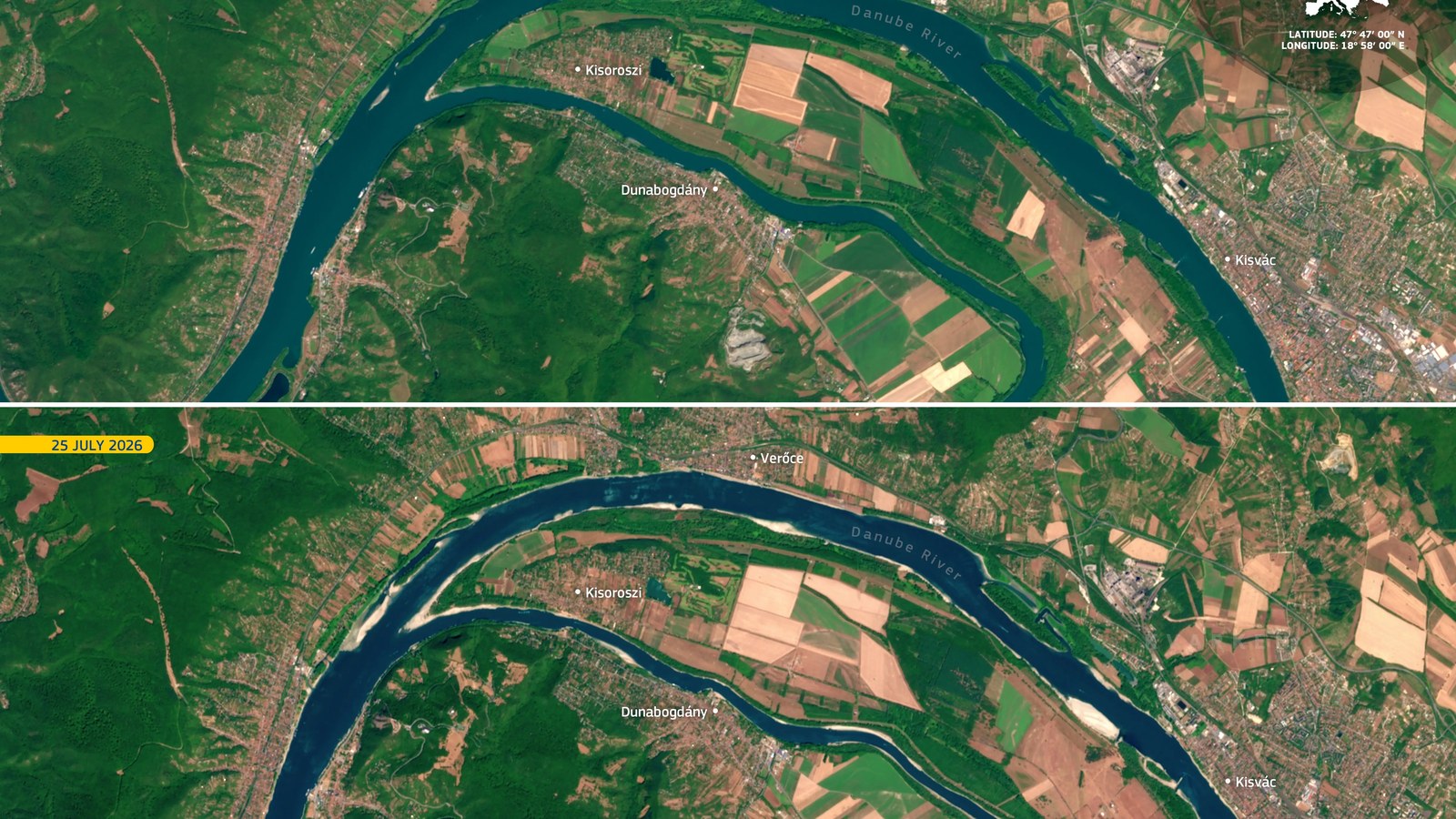
The official image record points in the same direction. The EU Space Support Office said Copernicus Sentinel-2 satellite images from July 2025 and July 2026 show exposed pale sediment bars along several bends of the Danube Bend in northern Hungary after prolonged dry conditions and intense summer heat. Copernicus noted that satellite data help authorities track exposed riverbanks and changes in surface-water extent during low-flow periods.
The immediate policy question is whether emergency measures can buy enough time until rainfall or cooler conditions ease demand. The longer-term question is whether nuclear plants, hydropower dams, ports, industrial sites, and river shipping systems are prepared for more frequent low-flow extremes.
What To Watch Next
The first signal is whether Danube levels rise enough to stabilize cooling at Paks and Cernavoda. If the river remains too shallow, Hungary and Romania may need deeper electricity savings, more imports, or longer industrial curbs.
The second signal is regional power pricing. When several countries need imported electricity at the same time, market stress can spread quickly. That is especially true during evening peaks, when solar generation falls but air-conditioning demand can remain high.
The third signal is shipping. Prolonged low water would keep pressure on freight routes, river tourism, and industries that depend on heavy cargo moving by barge. If the Rhine and Danube remain constrained together, the economic effect would be larger than a single river disruption.
For now, the Danube drought has moved from environmental concern to infrastructure risk. The emergency response in Romania, the reduced nuclear output in Hungary, and Serbia’s hydropower cuts all point to the same lesson: water availability is now a frontline factor in Europe’s energy security.