
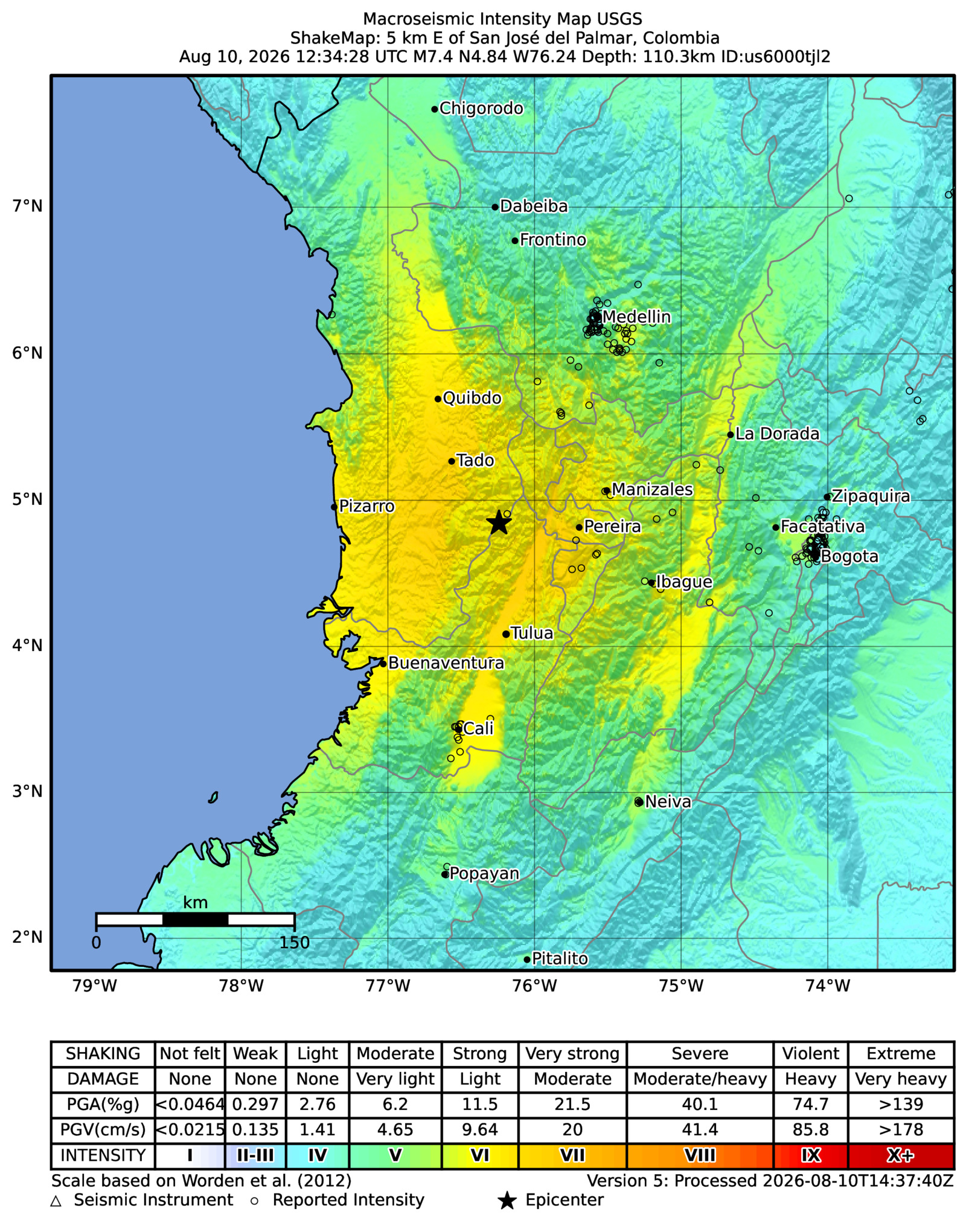
A powerful magnitude 7.4 earthquake struck western Colombia on Monday morning, killing at least 47 people, damaging buildings across several cities and forcing emergency crews into a fast-moving search for people trapped under debris.
The U.S. Geological Survey placed the quake near San Jose del Palmar in Choco department, close to Colombia’s Pacific region, at 12:34 UTC on August 10. The agency listed the depth at about 107 kilometers, a deep event that was still felt widely across Colombia and into neighboring Ecuador and Panama.
The first confirmed death toll made the earthquake one of Colombia’s most serious disasters in years. Associated Press reported collapsed buildings, evacuations as far away as Bogota and severe damage in cities including Cali, Pereira, Manizales and Quibdo. Al Jazeera and ABC also reported widespread damage and a developing emergency response as authorities warned residents to expect aftershocks.
The numbers may change as rescue teams reach damaged neighborhoods. Early disaster counts are often incomplete after major earthquakes because collapsed roads, damaged airports, overloaded communications and aftershock risk slow the first assessments. Colombian officials were still collecting reports from municipal authorities, hospitals, airport operators and rescue units by Monday evening.
What Happened
The earthquake hit at 7:34 a.m. local time, when many people were commuting, opening businesses or beginning the school and work day. The epicenter was near San Jose del Palmar, a small community in Choco, but the shaking spread across a much wider zone because of the quake’s size and depth.
USGS data classified the earthquake as magnitude 7.4, with an orange alert for possible economic losses and casualties. Its ShakeMap showed the strongest shaking in western Colombia, including areas where mountainous terrain, older buildings and difficult transport routes can complicate emergency work.
AP reported that people evacuated buildings in Bogota, about 400 kilometers from the epicenter. The capital appeared to avoid the worst damage, but the strong shaking there showed how far the event was felt. The heaviest early reports came from western and central cities closer to the impact zone.
In Pereira, damage at Matecana airport disrupted flights and added pressure to rescue logistics. In Manizales, reports described damage to historic structures, including the cathedral area. In Cali and Quibdo, local authorities were assessing collapsed or damaged buildings while emergency crews searched for residents who may have been trapped.
Why The Damage Spread
Colombia sits in a complex seismic zone shaped by the interaction of the Nazca, South American and Caribbean plates. That geography makes the country vulnerable to damaging earthquakes, especially along the Pacific side and the Andean region where steep terrain and dense urban settlements can amplify the consequences.
Depth matters, but it does not remove danger. A deeper earthquake can sometimes produce less extreme surface shaking near the epicenter than a shallow event of the same magnitude. But a large deep quake can also be felt across a wider area, exposing more cities, roads, bridges, airports, schools and hospitals to moderate or strong shaking.
That is the challenge Colombia faced on Monday. The quake was not confined to one town. It created a broad inspection problem across several departments at once. Authorities had to check damaged buildings, airport terminals, roads, hospitals, power lines and water systems while also warning residents not to re-enter unsafe structures.
The risk does not end after the first tremor. Aftershocks can damage weakened buildings, injure people who return too quickly and slow rescue work inside unstable structures. Officials therefore urged caution around cracked walls, fallen facades and buildings that had not been inspected.
Rescue And Government Response
President Abelardo de la Espriella, who had only recently taken office, moved quickly to put the national government at the center of the response. International reports said he pledged support and shifted attention to the emergency operation as regional officials asked for help with rescue teams, medical care and infrastructure checks.
The immediate priorities are straightforward but difficult: find survivors, treat the injured, move people away from unsafe buildings, restore emergency access and identify which hospitals and airports can keep operating. Those tasks usually determine how quickly a country can move from search and rescue into shelter, food, water and recovery planning.
Airport damage is especially important because western Colombia’s terrain can make ground movement slow after disasters. If runways, terminals or control systems are compromised, relief supplies and specialized teams may have to move by alternate airports, road convoys or helicopter routes.
Hospitals are another pressure point. Even when they remain standing, major earthquakes can overwhelm emergency rooms with crush injuries, fractures, trauma, panic-related injuries and patients who need dialysis, oxygen or other continuous care. The first 24 to 72 hours are usually decisive for rescue and medical triage.
Regional Impact
The earthquake was felt beyond Colombia’s borders, including in Ecuador and Panama. Early reports indicated limited damage outside Colombia, but regional monitoring remained important because large earthquakes can trigger landslides, infrastructure inspections and public alerts across neighboring countries.
International assistance may become more relevant if the death toll rises or if damage assessments show large shelter needs. Countries in the region have experience sending urban search-and-rescue teams, field hospitals, engineers and emergency supplies after major earthquakes.
For Colombia, the disaster also lands at a politically sensitive moment. A new administration must manage a national emergency while the scale of damage is still uncertain. That can test coordination between the presidency, departmental governors, mayors, police, firefighters, civil defense units and health authorities.
What To Watch Next
The first question is whether rescue teams can reach all collapsed buildings before the survival window narrows. Search operations will likely focus on the worst-hit urban areas, especially where residents were reported trapped.
The second question is infrastructure. Authorities will need clear inspections of airports, hospitals, bridges, schools, water systems and power networks before normal movement resumes. Even limited structural damage can keep critical facilities closed if engineers cannot confirm they are safe.
The third question is aftershocks. USGS and Colombia’s geological authorities will continue monitoring the sequence, and emergency officials will be watching whether additional tremors worsen already-damaged buildings.
The fourth question is the final casualty count. The confirmed toll of at least 47 could rise as local officials reconcile hospital, municipal and rescue-team reports. Responsible updates will depend on named authorities and verified field assessments, not social-media videos or unconfirmed claims.
Monday’s earthquake is a reminder that a single seismic event can become a national crisis within minutes. Colombia’s immediate task is rescue. Its next task will be proving which buildings, roads, airports and services are safe enough for people to use again.
Readers tracking other recent global-risk stories may also want to follow our coverage of Europe’s climate and river stress and regional crisis diplomacy in the Middle East, where infrastructure pressure and emergency planning are becoming central parts of international news.