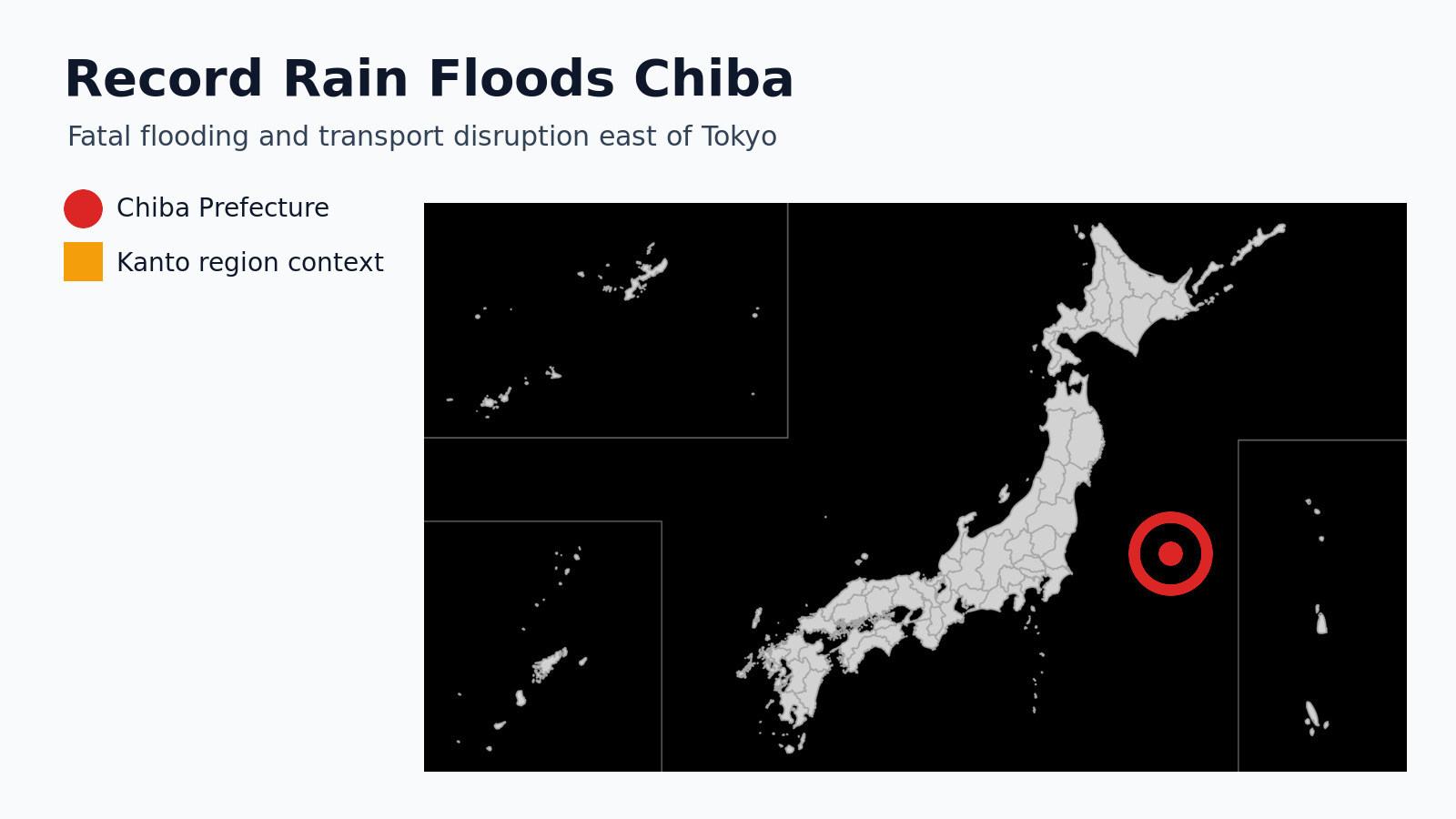
Record-breaking rain flooded Chiba Prefecture east of Tokyo, killing at least five people, injuring dozens and stranding thousands of travelers during one of Japan’s busiest holiday periods.
The Japan Meteorological Agency downgraded its most severe heavy-rain warnings on Friday after the worst of the overnight deluge eased, but it kept warning that saturated ground, swollen waterways and damaged transport links could still create danger. Local authorities and emergency crews were still assessing flooded homes, roads, rail lines and power outages across communities that sit close to the capital region.
Associated Press reported that Chiba officials confirmed at least five deaths, including people found in floodwater or trapped in vehicles. Other reports later cited local authorities putting the toll higher as searches and hospital updates continued. Because casualty counts can change quickly after flooding, the clearest public baseline by Friday evening was that the disaster had already become deadly and that at least one person had been reported missing.
The flooding mattered beyond one prefecture because it hit the Tokyo region’s transport system during Bon, when millions of people travel to visit family or return from holidays. Thousands were left waiting at Narita Airport, one of Japan’s main international gateways, while rail and road disruptions also affected commuters, tourists and residents trying to move through eastern Tokyo’s wider transport network.
What Happened In Chiba
The rain intensified from Thursday into early Friday, overwhelming urban drainage systems and sending water across roads, rail corridors and residential streets. JMA data cited in international reports showed extraordinary short bursts of rain, including more than 100 millimeters in an hour in parts of Chiba and nearly 100 millimeters in Sakura.
That kind of rainfall can become dangerous quickly in a built-up region. Water has less open ground to soak into, drains can back up, underpasses and low roads can fill before drivers realize the depth, and small rivers or channels can rise sharply. The deaths reported in Chiba underline one of the most common flood hazards: vehicles becoming trapped when roads turn into fast-moving or deep water.
Photos and television footage from the affected areas showed muddy floodwater around homes, cars and railway infrastructure. The Ground Self-Defense Force was sent to help move thousands of people stranded at Soga Station, a rail stop that also serves travelers heading toward the Tokyo Disney area. The resort itself reported no major damage, but the transport disruption showed how a localized weather event can ripple through a much larger metro economy.
Narita Airport also became a focal point. Airlines expected flights to operate, but access problems left thousands of people stuck overnight. For international travelers, the issue was not only flight schedules. It was whether trains, buses and roads could reliably get people between the airport and the rest of the region.
Why The Warnings Stayed Serious
JMA’s decision to downgrade the highest warnings did not mean the emergency was over. Heavy rain can leave risks behind after skies begin to clear. Slopes may fail hours later. Roads can remain undermined. Floodwater can hide open drains, broken pavement, downed electrical equipment and contaminated runoff.
That is why officials continued urging residents to watch local evacuation orders and hazard maps. A Level 5 warning in Japan signals an emergency in which life-threatening conditions may already be occurring. Once an area has reached that threshold, the follow-up work is not simply cleanup; it is preventing secondary casualties.
Japan’s Fire and Disaster Management Agency said Chiba had established a disaster response headquarters on Thursday evening. The agency also recorded fire and rescue activity, evacuation instructions and national-level coordination after the special heavy-rain warning was issued. Those official response records are important because they confirm that the event was being treated as a major disaster operation, not a routine rainstorm.
The timing made the response harder. Bon travel increases demand on airports, trains and roads. When flooding hits during a travel peak, emergency agencies have to serve residents who need evacuation, stranded passengers who need shelter and transport operators trying to restore movement without sending people into unsafe routes.
The Climate Signal
No single flood can be reduced to climate change alone, but the Chiba emergency fits a wider pattern that risk planners are watching closely: warmer air can hold more moisture, and intense downpours are becoming a larger part of disaster planning in advanced economies as well as lower-income countries.
Japan already has long experience with typhoons, landslides and river flooding. The concern is that record rain near dense urban corridors can now disrupt places that are highly engineered but still vulnerable to rainfall totals that exceed design expectations. Drainage, rail embankments, station entrances, airport access roads and underground spaces all become stress points.
The same issue has appeared in recent extreme-weather coverage elsewhere. NOAA’s July climate report showed how heat and heavy rainfall can combine to stretch infrastructure, while Europe’s recent heat and drought emergency showed that climate stress can move across energy, water, transport and public-health systems at the same time. The lesson from Chiba is similar: weather risk becomes a public-safety risk when it hits mobility, housing and power at once.
For Japan, the immediate question is whether the latest rainfall exposes specific weak points around Chiba’s roads, local rivers and rail network. Longer term, authorities may face pressure to improve flood mapping, emergency alerts, underpass controls, station drainage and evacuation communication for foreign travelers.
What Travelers And Residents Should Watch
The first priority is official local guidance. Residents should follow municipal evacuation orders, JMA warnings and transport operator notices instead of relying on old travel plans or social media clips. Conditions can vary sharply between neighborhoods, especially where small rivers, low roads and railway crossings create localized hazards.
Travelers using Narita should check airport access before leaving accommodation. A flight listed as operating does not guarantee that every train or highway route to the terminal is open. People connecting through the Tokyo region should also allow extra time for route changes as rail operators inspect tracks and restore suspended sections.
Drivers face a different risk. Flooded roads can look passable from a distance but hide deep water, lifted manhole covers or debris. Turning around before entering floodwater is safer than trying to judge depth from inside a vehicle.
For officials, the next 24 hours will be about three things: confirming the human toll, restoring transport links safely and deciding whether renewed rain could trigger more flooding or landslides. The floodwater may recede, but the danger does not end until inspections show that roads, slopes, homes and rail lines are stable.
Chiba’s record rain is therefore both a disaster story and an infrastructure warning. A prefecture next to one of the world’s largest metropolitan areas can still be brought to a standstill when extreme rainfall arrives faster than the built environment can move it away.