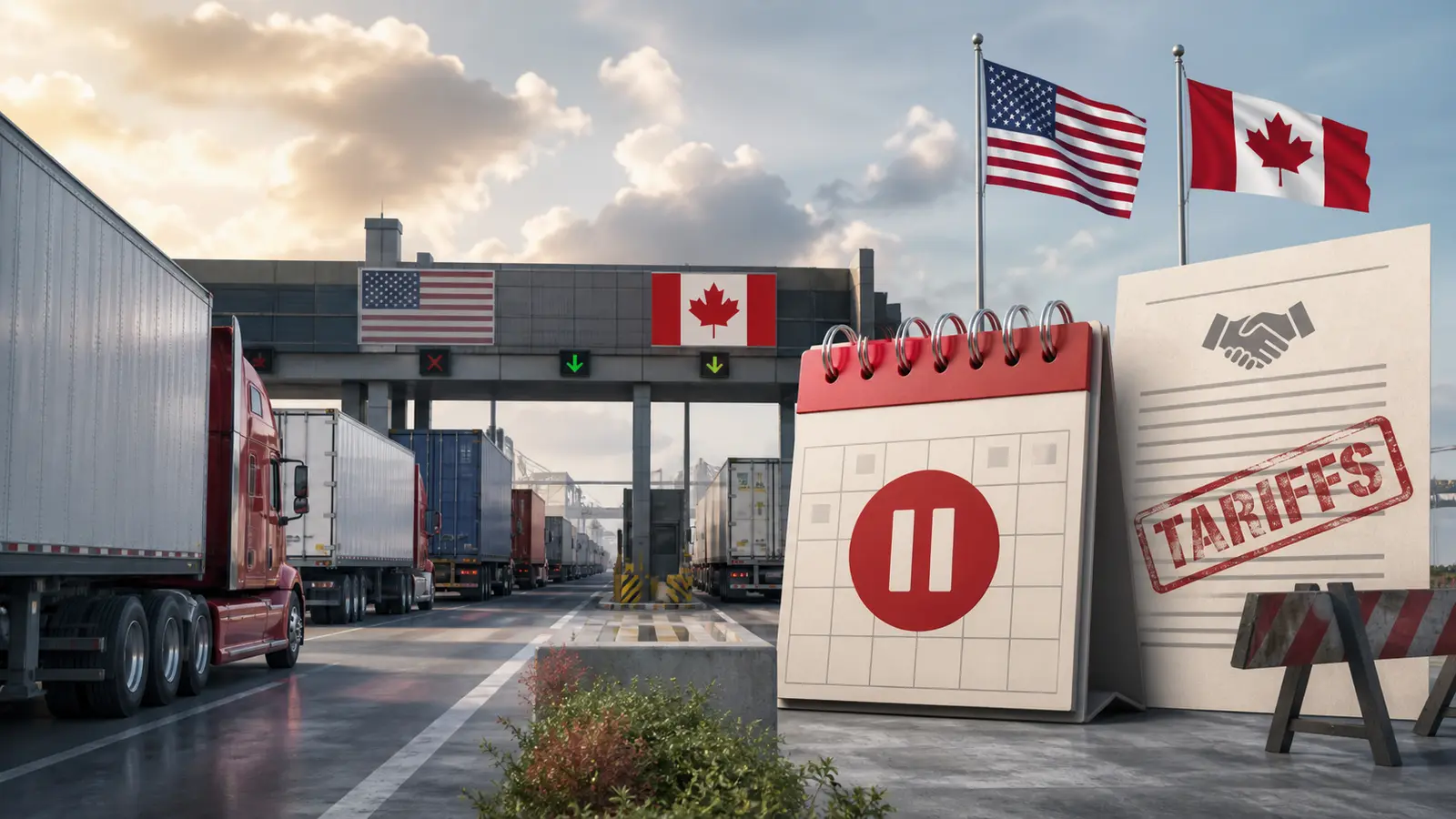

Canada’s plan to impose retaliatory tariffs on U.S. goods has turned a short-lived negotiating pause into a wider test of North American trade, with businesses now preparing for two rounds of duties rather than a diplomatic settlement.
Prime Minister Mark Carney said Canada would match Washington’s new tariffs dollar for dollar after talks broke down and U.S. 50% duties took effect on selected Canadian imports. Ottawa says the Canadian measures will begin on September 8 and focus on sectors including steel, dairy, appliances, agricultural equipment, pulp and paper, and electronics.
The verified development is clear: the three-day U.S.-Canada tariff pause did not produce a deal. The dispute has moved from deadline diplomacy to active tariff enforcement, planned countermeasures and renewed uncertainty over the trade rules that support factories, farms, retailers and logistics networks across the continent.
For global readers, this is more than a bilateral quarrel. The United States and Canada are among the world’s most integrated trading partners. A tariff fight between them sends a broader signal about how vulnerable supply chains can become when political pressure overrides predictable market access.
What Changed
The United States announced in July that it would impose additional 50% tariffs on certain Canadian imports under Section 338 of the Tariff Act of 1930. U.S. officials said the duties were meant to offset Canadian policies they described as discriminatory against American commerce, including disputes tied to vehicles, alcohol and dairy.
The White House later delayed the effective date from August 19 to August 22 while talks continued. That delay created a brief opening for a settlement. It also left companies with goods in transit trying to work out whether customs entries would face the extra duty.
That opening closed after both governments said the negotiations failed. Canadian officials said Washington introduced last-minute terms that were unfair, uneconomic and inconsistent with Canadian sovereignty. U.S. Trade Representative Jamieson Greer blamed Canada for new demands and said the United States would move ahead with countermeasures.
The practical consequence is that companies now face a tariff calendar, not just a negotiating calendar. U.S. duties are already in force on a list of Canadian goods. Canadian counter-tariffs are scheduled for September 8 unless the governments return to negotiations and reach a new arrangement.
Why Canada Retaliatory Tariffs Matter
Retaliatory tariffs are designed to create leverage. They show that one country will not absorb another country’s trade penalties without imposing costs of its own.
But they also raise domestic costs. Canadian importers that rely on U.S. machinery, electronics, farm equipment, steel inputs or consumer goods may face higher prices. U.S. exporters could lose sales in one of their largest and closest markets. Consumers on both sides may see the effect through slower restocking, narrower product selection or surcharges before broad price increases are visible.
That is why the dispute matters to companies far beyond headline sectors. A small manufacturer may buy a U.S. component, ship a finished product across the border, and rely on a distributor whose contracts were priced before the latest tariff announcements. A retailer may have seasonal inventory ordered months before the policy changed. A construction firm may see material quotes shift because suppliers are unsure which side of the border will absorb the cost.
The Canadian government says its response will be targeted. That matters because broad retaliation can spread economic pain quickly, while narrow retaliation may preserve more room for renewed talks. The final product list will determine whether the burden falls mainly on politically sensitive U.S. exporters, Canadian companies that use American inputs, or both.
The Supply Chain Risk
North American trade has been built around the assumption that goods can move repeatedly across borders under stable rules. Autos are the clearest example, but the same logic applies to steel, packaging, food processing, machinery, energy services and many consumer goods.
When tariffs are imposed by product code and origin rule, broad sector labels are not enough. Businesses need to know the exact tariff classification, whether the good qualifies under the United States-Mexico-Canada Agreement, whether any exemption applies, and which customs entry date controls the duty.
That technical work is expensive even when the tariff bill is manageable. Companies may have to review contracts, update landed-cost models, change inventory timing, reroute shipments, request supplier declarations or renegotiate who bears duty exposure.
The dispute also lands while markets are already watching other policy shocks, including U.S. sanctions pressure on Iran and recent bond-market stress. Tariff uncertainty can add to inflation risk because importers often pass at least part of higher costs to customers when margins are already tight.
The Political Signal
Carney’s message has been that Canada will not accept a deal that weakens its sovereignty, key industries or cultural protections. In public remarks, he said Canada had been willing to drop remaining retaliatory tariffs on strategic sectors if the United States substantially lowered its own duties enough to make exporting economically viable.
He also framed Canada’s response as part of a wider diversification strategy. Ottawa has argued that Canada must build more trade options beyond the United States, even while recognizing that the U.S. remains its dominant export market.
Washington’s position is different. The U.S. says the Section 338 actions respond to Canadian measures that disadvantage American exporters. U.S. officials have argued that the latest breakdown was a missed chance for Canada to secure favorable treatment compared with other major exporters.
Those competing explanations matter because they make a quick reset harder. If the dispute were only about tariff rates, negotiators could search for a middle number. When it also includes sovereignty, culture, supply management, vehicles, steel, alcohol access and the future of North American trade rules, each concession becomes politically harder to sell.
What To Watch Next
The first test is Canada’s final retaliatory list. Ottawa has identified broad sectors, but businesses need product-level detail to calculate exposure. The closer the list gets to essential industrial inputs, the more pressure Canadian companies may place on their own government to narrow or delay the measures.
The second test is whether Washington escalates again. Recent U.S. threats around Canadian autos and other strategic sectors have raised concern that the current duties may not be the ceiling. A wider auto tariff would be especially disruptive because vehicles and parts are deeply integrated across U.S., Canadian and Mexican production networks.
The third test is whether the dispute spills into the wider USMCA/CUSMA framework. If companies begin to doubt that the agreement can protect qualifying goods from sudden tariff action, investment decisions could slow even in sectors not directly listed today.
The fourth test is market reaction. Tariffs covering a limited share of trade may look contained on paper, but their effect can be larger if they change business confidence, contract terms, purchasing decisions or inflation expectations.
For now, the central fact is that Canada retaliatory tariffs are no longer a theoretical threat. They are Ottawa’s planned answer to U.S. duties that have already taken effect. Unless negotiations restart quickly, September 8 becomes the next date cross-border businesses have to build around.