NASA is preparing a global broadcast for next week’s total solar eclipse, setting up one of the most closely watched sky events of 2026 as Spain, Iceland, Greenland, northern Russia, and a small part of Portugal fall under the Moon’s narrow shadow.
The eclipse on Wednesday, August 12, will not be visible in the same way everywhere. People inside the path of totality will briefly see the Moon fully block the Sun. A much larger audience across Europe, northwestern Africa, Canada, parts of the United States, and northern Asia will see a partial eclipse, with the Sun appearing as if a dark bite has been taken from it.
NASA says its live coverage will begin at 1:15 p.m. Eastern Time, with telescope views, expert commentary, and footage from a WB-57 high-altitude research aircraft chasing the Moon’s shadow. The broadcast gives viewers outside the path a safe way to follow totality without looking directly at the Sun.
Why August 12 Matters
Total solar eclipses happen somewhere on Earth roughly every 18 months, but they are rare for any one location. This eclipse is drawing unusual attention because it brings totality to parts of mainland Spain, a major tourism market, shortly before sunset. Associated Press has noted that Spain has not had a comparable mainland total eclipse in more than a century.
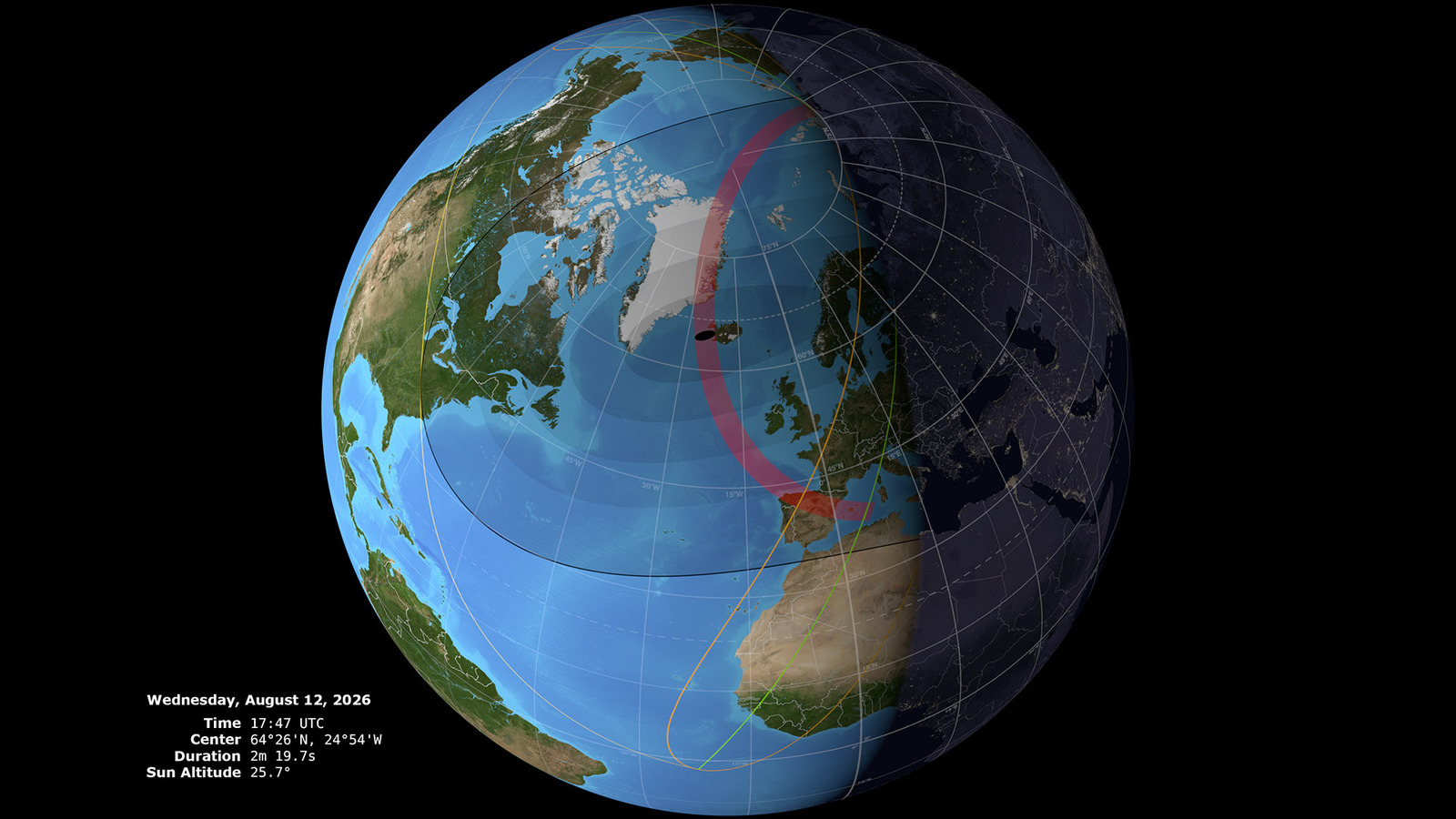
NASA’s eclipse map shows the totality path crossing northern Russia, Greenland, Iceland, the Atlantic Ocean, Spain, and a small corner of Portugal. The agency says most people in the path will get less than two minutes of totality, while locations closer to the centerline near Greenland, Russia, and the North Atlantic may get slightly longer, but still under two and a half minutes.
The timing adds to the spectacle. In Spain and Portugal, the eclipse arrives late in the day, so some areas will see an eclipsed Sun close to the horizon. NASA says many places in mainland Europe and Africa will experience sunset while the Sun is still partially eclipsed.
Where The Eclipse Will Be Seen
The full eclipse will be visible only along a narrow track. NASA lists Leon, Reykjavik, Valencia, and Zaragoza among the cities where totality can be seen, though local weather and horizon conditions will matter.
Timeanddate calculates the worldwide eclipse sequence beginning with the first partial phase at 15:34 UTC, the first total phase at 16:58 UTC, maximum eclipse at 17:46 UTC, and the last total phase ending at 18:34 UTC. The final partial phase ends at 19:57 UTC.
The partial eclipse zone is much wider. NASA says Alaska, parts of Canada, the northeastern United States, Europe, and northwestern Africa will see varying levels of coverage. London is expected to see about 91 percent coverage, Paris about 92 percent, Berlin about 85 percent, Lisbon about 95 percent, Casablanca about 87 percent, and Algiers about 96 percent. New York, Boston, Washington, and other U.S. cities will see a much smaller partial eclipse.
For viewers in Nairobi, the eclipse itself will not be a local event. The main options will be livestreams from NASA and observatories in the path, followed by the Perseid meteor shower later in the night for observers with clear, dark skies.
Safety Is The Central Message
The most important public guidance is simple: do not look at the Sun without proper protection during the partial phases.
NASA and the National Solar Observatory both warn that regular sunglasses are not safe for solar viewing. Viewers need certified eclipse glasses, handheld solar viewers, or properly mounted solar filters for cameras, binoculars, and telescopes. The only exception is the brief period of totality, and only for people located inside the narrow totality path while the Sun is fully covered.
That distinction matters because many cities will see a deep partial eclipse but not totality. Even if 90 percent or more of the Sun is covered, the remaining exposed solar disk can still injure eyes. NASA also warns against looking through a camera, telescope, or binoculars while wearing eclipse glasses unless the optical device has its own front-mounted solar filter.
People without eclipse glasses can use indirect projection methods, such as a pinhole projector, to watch the changing shape of the Sun without looking at it directly.
A Night For The Perseids
The eclipse is not the only skywatching event clustered around August 12. NASA’s August skywatching guide says the Perseid meteor shower peaks overnight from August 12 into the early morning of August 13, and the new Moon will keep skies darker than usual.
EarthSky places the predicted Perseid peak at 14:53 UTC on August 13, with the mornings of August 12 and 13 likely to offer the best viewing. Under dark skies, observers often report high meteor counts during strong Perseid years, though real visibility depends on weather, light pollution, and local timing.
The overlap is unusual because a solar eclipse occurs at new Moon, and new Moon is also the best lunar phase for meteor watching. That means people traveling for the eclipse could also have strong evening conditions for the Perseids if clouds stay away and they move far from city lights.
Claims of a “planet parade” are circulating widely online, but the more firmly verified public skywatching highlights are the eclipse, the Perseids, bright Venus after sunset later in the month, and a partial lunar eclipse on August 27 and 28. NASA’s August guide emphasizes those events and gives the August 12 eclipse and August 12-13 Perseids as the main midmonth pairing.
What Scientists Will Watch
For scientists, totality is more than a public spectacle. The National Solar Observatory says total solar eclipses allow researchers to study the Sun’s corona, the faint outer atmosphere normally hidden by the Sun’s glare. Those observations help refine understanding of the corona and its interaction with Earth.
NASA’s high-altitude aircraft coverage is part of that wider scientific interest. Flying above much of the atmosphere can improve visibility, reduce weather risks, and extend the observing window compared with a fixed ground station.
The event also comes during a busy stretch for space and climate coverage, following recent stories on Danube drought risks and Strait of Hormuz talks. The eclipse is different in tone, but it has similar global reach: it will affect travel planning, science outreach, livestream audiences, and public safety messaging across several continents.
What To Watch Next
The final week before the eclipse will be dominated by weather forecasts, travel controls in crowded viewing areas, and safety campaigns. Spain, Iceland, Greenland, and Portugal are likely to see the heaviest attention from eclipse travelers, while major cities outside totality prepare for partial viewing.
For anyone in the path, the checklist is practical: confirm local eclipse timing, check whether the Sun will be near the horizon, use certified eye protection, arrive early, and have a livestream backup if clouds move in.
For everyone else, NASA’s broadcast will carry the main event. The science is precise, but the viewing experience remains dependent on sky conditions, safe equipment, and being in the right place at the right minute.