
Trump’s East‑Africa Showdown: US Sanctions Rwanda as Kagame Vows Fierce Retaliation
The United States has imposed fresh sanctions on Rwanda’s Defence Forces (RDF) and several top military officials, citing alleged violations of the Washington‑brokered DRC–Rwanda peace deal and continued support for the M23‑affiliated forces in eastern Democratic Republic of Congo.
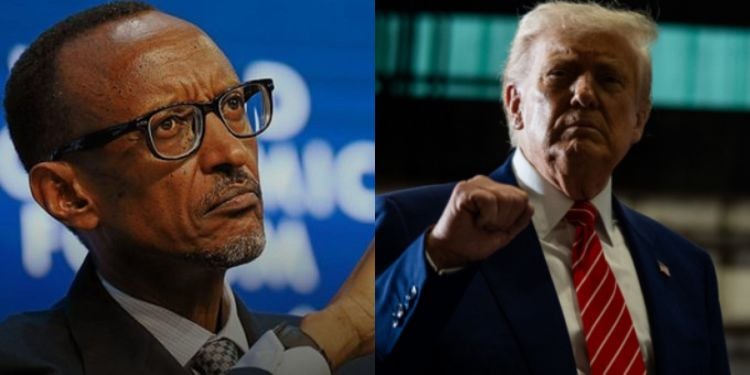
The measures include asset freezes and travel restrictions on the Rwandan army chief of staff, key RDF commanders, and the Rwanda Defence Force itself, cutting off US‑based property and financial interests.
Washington says these sanctions are part of President Donald Trump’s “hard‑line” approach to enforcing the DRC–Rwanda accords, which he had previously touted as a “glorious triumph” in stabilising the mineral‑rich Great Lakes region.
“The DRC committed, in the Washington Accords, to an irreversible and verifiable end to state support for the FDLR and associated militias, but has not taken any steps to do so,” the statement read.
The US Treasury arguesthat RDF backing enabled major M23 advances in Goma and Bukavu, leading to widespread human‑rights abuses and displacement of civilians.
Kagame’s furious response
Rwandan President Paul Kagame has responded with blistering anger, dismissing the sanctions as “absolute foolishness” and accusing Washington of targeting only one side in a complex conflict.
“The sanctions issued today by the United States, unjustly targeting only one party to the peace process, misrepresent the reality and distort the facts of the conflict in eastern Democratic Republic of Congo,” the statement read.
Further, he stated that the ongoing attacks have resulted in significant Rwandan civilian and military casualties.
“Consistent and indiscriminate drone attacks and ground offensives constitute clear violations of ceasefire agreements by the DRC, and continue to cost many lives,” he noted.
In public remarks, Kagame has reportedly told countries imposing sanctions on Rwanda to “go to hell,” underscoring his refusal to buckle under Western pressure.
Kigali’s line is that Kinshasa, not Rwanda, has violated the peace deal, pointing to Congolese drone strikes and alleged use of ethnic militias and mercenaries as proof of bad faith.
The government also insists that Rwanda’s presence in eastern Congo is purely defensive, aimed at countering armed groups that threaten its security and regional stability.
Why this matters for East Africa
At the heart of the row is control over eastern DRC’s critical minerals copper, cobalt, coltan vital for global tech and electric‑vehicle supply chains.
The US‑backed peace deal was designed to calm the region so that American firms could gain a stronger foothold in Congo’s mining sector, but repeated flare‑ups fuel suspicion that Rwanda may be using M23‑linked forces to secure lucrative corridors.
For the East African Community, the US move risks hardening regional fault lines, with Rwanda likely to lean more heavily on partners such as China, the UAE, and regional allies reluctant to challenge Kigali’s narrative.
It also raises questions about how Rwandan‑led peacekeeping and security‑cooperation with neighbours will be affected if the sanctions bite into RDF’s finances and procurement networks.
How the Kenya media angle fits
Outlets including This have picked up on the diplomatic earthquake this sanctions round has triggered across the region, framing it as a test of US clout versus African sovereignty.
The coverage highlights how Trump’s return to the White House has shifted Washington’s posture toward Rwanda from relatively accommodating under previous administrations to openly confrontational as he seeks to assert a “peace‑maker” image while securing American mineral interests in the DRC.
Kenyan analysts commenting through such platforms argue that Kenya and other EAC states must tread carefully, balancing their desire for regional stability, trade ties with Rwanda, and dependence on US security and development partnerships.
There is also concern that any sharpening of the US–Rwanda rift could spill over into trade flows, security cooperation, and even regional peace‑enforcement missions where Rwandan troops have played a visible role.
What this showdown signals going forward
Trump’s decision to directly sanction Rwanda’s military marks a rare escalation in US policy toward a key East African partner, signalling that Washington is willing to weaponise its financial‑power tools even against countries long regarded as relatively friendly.
Kagame’s fury, meanwhile, underscores his determination to resist what he sees as external interference in Rwanda’s security calculus, raising the prospect of a prolonged diplomatic war of words and tit‑for‑tat measures.
For watchers in Nairobi and across Africa, this episode is likely to be read as a symptom of a broader contest over influence, resources, and regional order, with the DRC–Rwanda‑US triangle at its core.
How that contest plays out could reshape security dynamics, trade routes, and diplomatic alignments across East and Central Africa in the months and years to come.