
Court Halts Ruto’s Landmark KSh208B Trump Health Pact: Privacy Fears Ignite Legal Firestorm.
A High Court ruling delivers a setback to President William Ruto’s administration by suspending the rollout of a KSh208 billion health cooperation framework signed with US President Donald Trump on December 4, 2025.
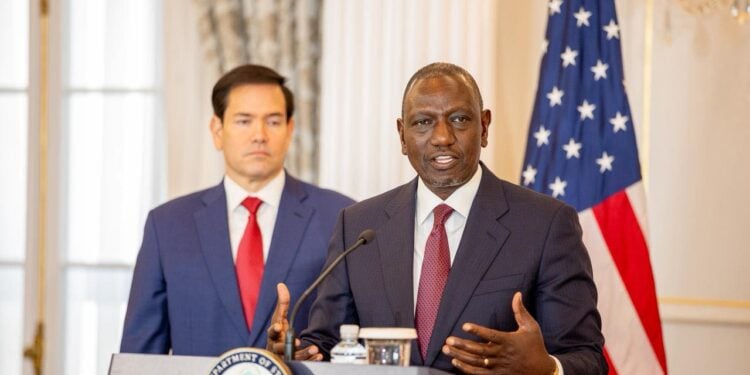
The deal, valued at $2.5 billion over five years with Kenya matching $850 million, targets HIV/AIDS, malaria, TB, maternal health, and equipment upgrades but faces blocks over data privacy and procedural lapses.
The order, issued on Wednesday, December 10, 2025, by Justice Bahati Mwamiye, came in response to a Notice of Motion Application filed by the Consumers Federation of Kenya in case number HCCRPET/E809/2025.
“Pending the inter partes hearing and determination of the Petitioner/Applicant’s Notice of Motion Application dated 09/12/2025, a conservatory order is hereby issued suspending, staying, and/or restraining the Respondents from implementing, operationalizing, or giving effect to the Health Cooperation Framework executed on or about December 4, 2025, insofar as it provides for the transfer, sharing, or dissemination of medical, epidemiological, or sensitive personal health data,” the court order states.
Court Orders Stem from Dual Petitions
Busia Senator Okiya Omtatah and the Consumer Federation of Kenya (Cofek) filed separate suits claiming the agreement bypassed public participation, parliamentary oversight, and constitutional safeguards.
Omtatah argues the rushed signing in Washington DC usurps legislative powers and risks mismanaging funds without stakeholder input, while Cofek highlights threats to patient data sovereignty.
The court issued this directive pending the inter partes hearing and final determination of the Petitioner’s application.
As to procedure, the Respondents are required to enter their appearances and file their respective responses to both the Application and the petition by the close of business on January 16, 2026.
The petitioner is then slated to file a rejoinder by January 30, 2026.
The matter is scheduled for a mention on February 12, 2026, before Justice Lawrence Mugambi, to confirm compliance with the orders and set dates for the expedited hearing and determination of the petition.
This order comes just hours after President William Ruto defended the recently signed Kenya-United States Health Cooperation Framework during a meeting with governors at State House in Nairobi.
The temporary injunction halts implementation pending full hearings, addressing fears that US access to Kenyan health records could violate privacy laws amid Trump’s direct-aid model bypassing NGOs.
Deal’s Ambitious Scope and Ruto’s Defense
Signed by Prime CS Musalia Mudavadi and US Secretary Marco Rubio, the framework shifts from USAID patchwork to government led investments in hospitals, workforce expansion, and insurance coverage.
Ruto championed it as a solution to healthcare burdens, vowing transparent use to prevent bankruptcies from medical bills and praising Kenya’s Haiti mission role in securing the pact.
Health CS Adan Duale promised forthcoming implementation details and co financing matrices, dismissing data sharing alarms as unfounded while committing to privacy protections.
This reflects public scrutiny on sovereignty in foreign pacts post reelection. Critics warn matching funds strain budgets amid debt woes, diverting from grassroots needs, while supporters see it advancing Universal Health Coverage (UHC) goals.
President Ruto assured that the agreement does not undermine Kenyan rights, especially regarding health data.
He stated that the Attorney General’s office has thoroughly reviewed it and confirmed that Kenyan data protection laws take precedence over any U.S. provisions.
“Nobody will take advantage of Kenyans… The U.S., as a deeply democratic nation, will not allow its officials to exploit us,” said Ruto.
Ruto accused entities that have been benefiting from these resources of sponsoring misinformation, urging critics to address issues with the U.S. government rather than Kenya.
This clash tests judicial checks on executive foreign policy, echoing past deal controversies, with outcomes shaping health reforms and bilateral trust under Trump’s “America First” aid overhaul.