Smoke alarms are easy to ignore because they are quiet on a normal day. That silence is exactly why they need a simple maintenance routine. You do not want the first real test to happen when a pan is smoking, a charger overheats, a candle falls, or someone is asleep behind a closed door.
The task is small: check that the alarms are present, powered, loud enough, not expired, and matched with a fire escape plan. Done once a month, it becomes ordinary household maintenance rather than a dramatic safety project.
Quick Answer
Test smoke alarms once a month by pressing the test button and confirming that the sound is loud enough to alert the household. Replace removable batteries at least once a year or when the alarm chirps, replace smoke alarms that are about 10 years old or older, and follow the manufacturer’s instructions for sealed-battery and hardwired models. Homes should also have a practiced escape plan and, where fuel-burning appliances or attached garages are present, carbon monoxide alarms in appropriate locations.
Start With A Walk-Through
Begin by finding every alarm in the home. Do not assume you know where they are. Look in bedrooms, hallways, living spaces, stair landings, basements, utility areas, near attached garages, and any area added during renovations.
The U.S. Consumer Product Safety Commission advises smoke alarms on every level, outside sleeping areas, and inside each bedroom. Local codes can be stricter, and rental rules vary, so treat that as a baseline rather than the only standard.
During the walk-through, note:
- Which rooms and levels have smoke alarms.
- Which sleeping areas can hear an alarm through closed doors.
- Whether any alarms are missing, hanging loose, painted over, covered, or blocked.
- Whether the alarm is battery-powered, hardwired, sealed-battery, or interconnected.
- The manufacture date, expiry date, or replacement label.
If an alarm is too high to inspect safely, do not balance on furniture. Use a stable step stool, ask another adult to steady the area, or arrange help from a landlord, building manager, electrician, fire-safety program, or qualified installer.
Test The Sound, Not Just The Button
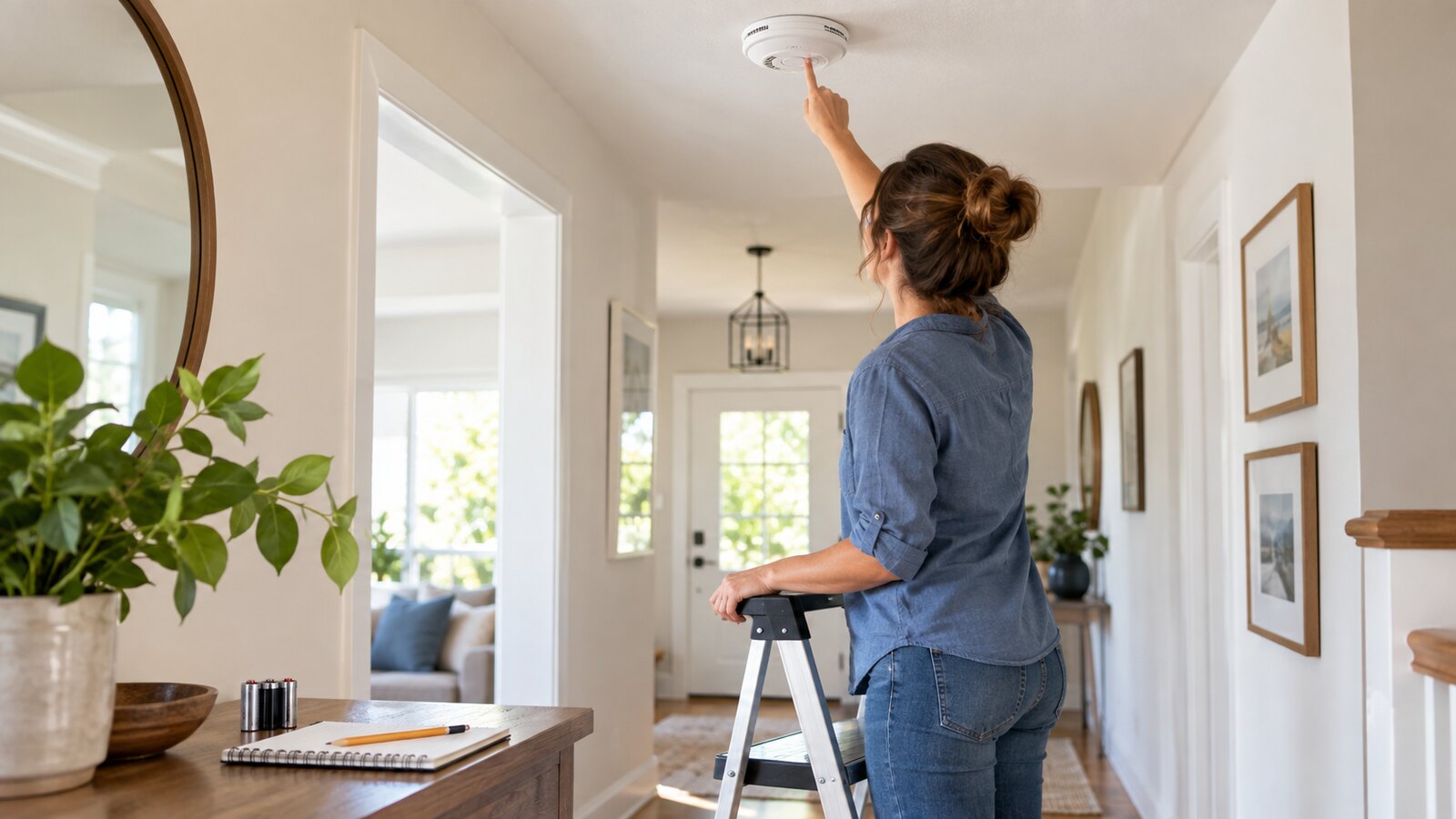
Most household smoke alarms have a test button. Press it long enough for the device to sound according to the instructions. The goal is not only to prove that the button works. It is to confirm that the alarm can be heard where people sleep, work, shower, cook, or use headphones.
Tell everyone before testing so the sound does not cause panic. If you have babies, older adults, pets, night-shift workers, neighbors through thin walls, or someone with sensory sensitivities, choose a predictable time.
After pressing the button, ask practical questions:
- Could people hear it from the bedrooms with doors closed?
- Did interconnected alarms sound together, if the home has that feature?
- Did any alarm stay silent, chirp weakly, or sound distorted?
- Did anyone in the household not recognize the sound?
- Would a person with hearing loss, mobility limits, or deep sleep wake up?
For households with hearing loss, standard alarms may not be enough. Look for approved alerting options such as strobe lights, bed shakers, low-frequency alarms, or connected notification systems that comply with local requirements.
Replace Batteries Before The Chirp Becomes Normal
Battery guidance depends on the alarm type. Some alarms use replaceable batteries. Others use sealed long-life batteries. Hardwired alarms may still have backup batteries. Always follow the label and manual for your exact model.
As a practical rule, replace removable batteries at least once a year or when the alarm chirps with a low-battery warning. If a sealed-battery alarm chirps near the end of its life, the whole unit may need replacement rather than a new battery.
Do not remove a battery to silence nuisance alarms and then forget to replace it. That is one of the easiest ways to leave a home unprotected. If cooking steam or shower humidity often triggers an alarm, the better fix is usually placement, ventilation, cleaning, or the right alarm type for the area, not disabling the device.
Keep a small note in your maintenance calendar with the battery type for each alarm. That saves the annoying moment where you are standing on a stool with the wrong battery in your hand.
Check The Age Of The Alarm
Smoke alarms do not last forever. Fire-safety guidance commonly treats 10 years as the replacement point for smoke alarms, even if the test button still makes noise. Sensors age, dust accumulates, and older devices may no longer respond as expected.
Look for a manufacture date or replacement date on the side or back of the alarm. If you cannot find a date, the alarm is discolored, damaged, unreliable, or old enough that no one remembers when it was installed, plan to replace it.
For hardwired alarms, use care. Turning off power, matching wiring, preserving interconnection, and complying with local code may require a qualified electrician or building professional. Renters should contact the landlord or property manager rather than replacing building-owned equipment without permission.
Do Not Forget Carbon Monoxide Alarms
Smoke and carbon monoxide are different hazards. Smoke alarms detect particles from fire. Carbon monoxide alarms detect a colorless, odorless gas that can come from fuel-burning appliances, blocked chimneys, generators, vehicles, grills, or other combustion sources.
The CPSC recommends testing smoke and CO alarms monthly and replacing their batteries annually. It also advises CO alarms on each level of the home and outside sleeping areas. If your home has gas, oil, coal, wood, charcoal, a fireplace, an attached garage, a generator, or any fuel-burning appliance, carbon monoxide alarms deserve the same routine attention as smoke alarms.
Never run generators, grills, camp stoves, or fuel-burning tools indoors, in garages, or near open windows. An alarm is a backup warning, not permission to use combustion equipment in unsafe places.
Connect Testing To An Escape Plan
An alarm gives warning. The household still needs to know what to do next.
The U.S. Fire Administration warns that people may have less than two minutes to escape after a home fire alarm sounds. That does not mean every household needs a complex drill. It does mean everyone should know two ways out where possible, a meeting place outside, and the rule that once you are out, you stay out.
Walk through the plan:
- Identify two exits from sleeping rooms where possible.
- Make sure keys, window locks, security bars, and doors can be opened quickly.
- Choose a safe meeting place away from the building.
- Teach children not to hide from firefighters.
- Plan help for older adults, disabled household members, visitors, pets, and anyone who may need assistance.
- Keep emergency numbers available and set up phone emergency contacts where useful.
GDU’s guide to setting up emergency contacts on your phone can support this part of the plan, especially for households where one person usually manages safety details.
Make It A Monthly Habit
The best alarm routine is the one you will actually repeat. Pick one trigger and keep it boring.
You might test alarms:
- On the first Saturday morning of each month.
- When paying rent or a mortgage.
- When changing air filters.
- When reviewing a household budget.
- When cleaning bedrooms.
- When checking an emergency folder.
Record only what matters: date tested, batteries replaced, units that need replacement, and anything that did not sound. A note app, paper calendar, maintenance spreadsheet, or reminder in a shared family calendar is enough.
If you already keep important household records, add alarm replacement dates to the same system. GDU’s guide to building an emergency folder explains how to keep essential home information easy to find without turning it into a paperwork project.
Fix Problems Promptly
Do not let a failed test become a note you ignore. A silent alarm, missing battery, expired unit, damaged cover, repeated false alarm, or alarm that cannot be heard from bedrooms should move to the top of the household repair list.
If money is the barrier, check whether local fire departments, Red Cross programs, community safety groups, landlords, insurers, charities, or municipal programs offer free or discounted alarms. Availability varies by location, but many places run smoke-alarm installation or replacement programs for higher-risk households.
If the issue is layout, get advice before guessing. Large homes, multi-story apartments, outbuildings, closed bedroom doors, high ceilings, hearing loss, and interconnected systems can change what “enough alarms” means in practice.
Bottom Line
Testing smoke alarms is not complicated, but it is easy to postpone because nothing seems wrong. That is the point of the routine: find the problem while the day is calm.
Once a month, press the test button, listen from the rooms that matter, check batteries and dates, include carbon monoxide alarms, and keep the escape plan fresh. A working alarm cannot prevent every fire, but it can buy the time a household needs to get out.