Airport security feels stressful when your bag turns into a small guessing game. Is toothpaste a liquid? Does a half-full 150 ml bottle count? Can peanut butter travel in a cabin bag? What about medicine, baby food, duty-free perfume, sunscreen, or a water bottle?
The safest approach is simple: pack as if the strict 100 ml rule still applies unless your departure airport, transfer airport, and return airport clearly say otherwise. Some airports now use newer scanners and may allow larger containers, but rules are not consistent everywhere. A carry-on bag that works under the stricter rule is less likely to slow you down when your itinerary crosses different airports.
Quick Answer
Pack carry-on liquids in containers of 100 ml or 3.4 oz or less, place them in one clear resealable bag when required, and keep that bag easy to remove. Treat gels, creams, pastes, sprays, aerosols, liquid makeup, yogurt, jam, honey, and similar items as liquids. Put full-size toiletries, large sauces, drinks, and extra products in checked luggage, or buy them after security when that makes more sense. Always check the rules for your departure, connection, and return airports before travel.
Why The Rules Can Feel Inconsistent
Liquid rules are changing in some places because airports are upgrading screening equipment. That does not mean the same rule applies across every airport on your trip.
GOV.UK advises travellers to check the rules at the airport they are flying from and at any other airports they will travel through, including the return journey. It also says that at most airports, containers larger than 100 ml cannot go through security, even if the container is only partly full. Some airports may allow containers up to 2 litres, but that depends on the airport.
That is the key planning point. Your outbound airport may be relaxed, your connection may not be, and your return airport may follow a different system again. If the product matters to you, pack it for the strictest expected checkpoint.
What Counts As A Liquid
Most travellers remember water and shampoo. The surprises are usually semi-solid foods and personal-care products.
Airport security agencies commonly treat these as liquids, aerosols, gels, pastes, or similar items:
- Drinks, including water, juice, coffee, and soft drinks.
- Shampoo, conditioner, shower gel, body wash, mouthwash, and liquid soap.
- Creams, lotions, oils, sunscreen, perfume, cologne, mascara, liquid foundation, and lip gloss.
- Toothpaste, shaving foam, shaving gel, deodorant gel, spray deodorant, hairspray, and body spray.
- Contact lens solution and similar solutions.
- Honey, jam, syrups, yogurt, pudding, peanut butter, chocolate spread, cheese spread, soups, sauces, and other non-solid foods.
The Canadian Air Transport Security Authority lists many of these examples and notes that non-solid foods can fall under the same liquids, aerosols, and gels category. If an item spreads, pours, sprays, squeezes, smears, or holds its shape only loosely, assume it may be screened as a liquid.
Use The Container Size Rule, Not The Remaining Amount
One common mistake is packing a large bottle that is almost empty. Security rules are usually based on the size printed on the container, not how much product remains inside.
If a 200 ml shampoo bottle has only a small amount left, it can still be rejected at a checkpoint that uses the 100 ml rule. Transfer what you need into a clearly sized travel bottle instead. Better yet, choose containers that are marked by the manufacturer, because handwritten labels may not reassure every screener.
For short trips, you often need less than you think. A few days of cleanser, moisturizer, sunscreen, toothpaste, hair product, or shaving product can usually fit in travel-size containers. For longer trips, pack only the first few days in your carry-on and buy refills after arrival, or place full-size items in checked baggage if you are checking a bag.
Make The Clear Bag Easy To Inspect
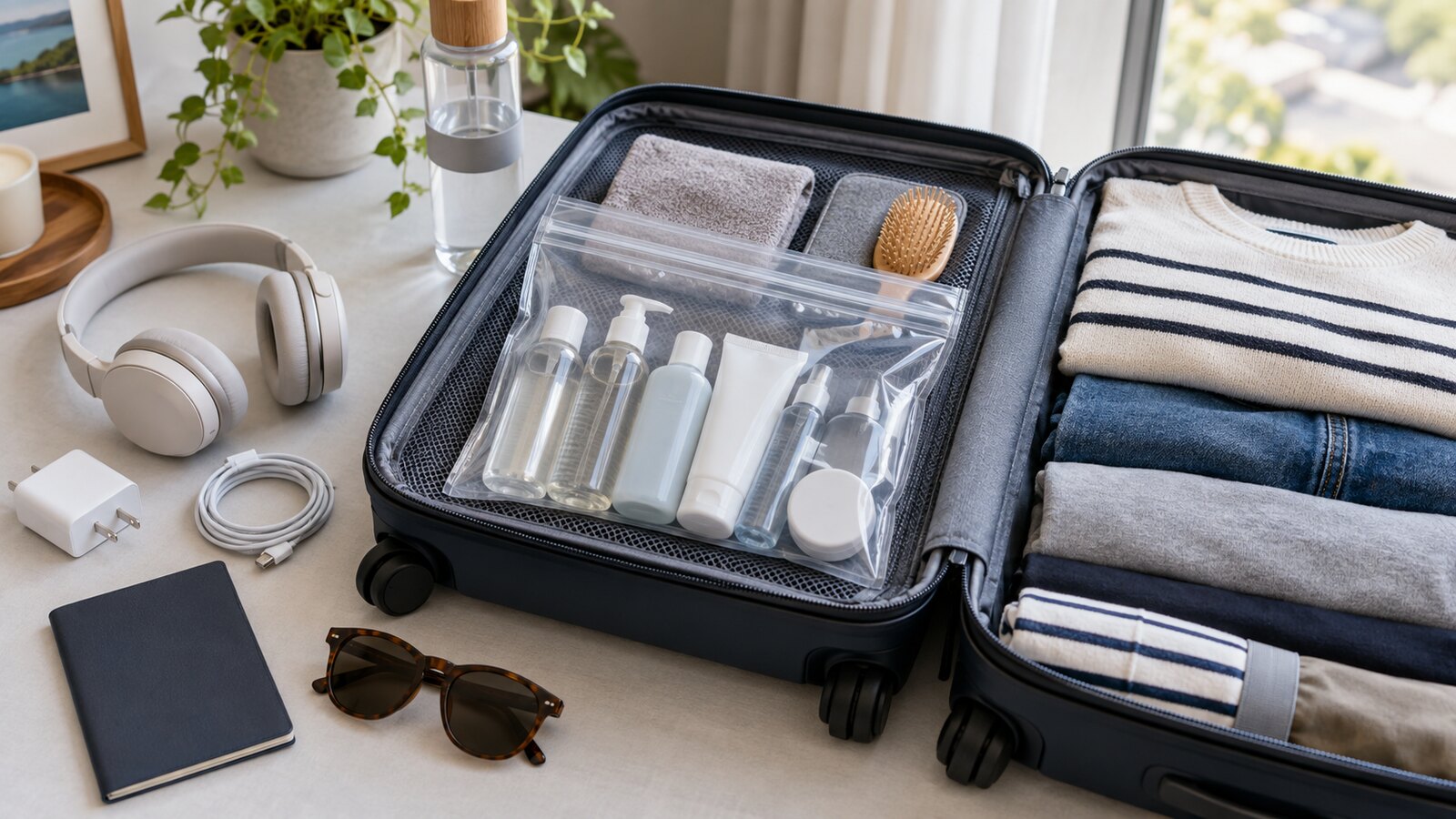
At many airports, liquid containers must fit inside one clear, resealable plastic bag. The European Union’s Your Europe guidance says cabin liquids such as aerosols, drinks, toothpaste, cosmetic creams, or gels must be in a transparent plastic bag with a maximum capacity of 1 litre, with no container holding more than 100 ml. CATSA gives similar practical advice for Canada, saying containers must fit in one clear resealable bag no more than 1 litre in capacity.
Do not overpack the bag until it bulges. If it cannot close, it is harder to inspect and easier to challenge. Put the bag near the top of your carry-on or in an outside pocket so you can remove it quickly if asked.
A simple setup works well:
- One clear resealable liquids bag.
- Travel-size bottles for daily products.
- A small toothpaste.
- One sunscreen or moisturizer if needed during travel.
- Minimal liquid makeup, with powder or solid alternatives where practical.
- Contact lens solution only in a compliant small bottle unless an exemption applies.
Keep spare toiletries out of the cabin bag. Extra shampoo, lotion, fragrance, and hair product usually belong in checked baggage or on the shopping list after arrival.
Choose Solid Alternatives When They Make Sense
Solid products can reduce the pressure on your liquids bag. They are not automatically right for everyone, but they are useful when space is tight.
Consider:
- Solid deodorant instead of spray or gel.
- Shampoo and conditioner bars instead of bottled products.
- Bar soap instead of shower gel.
- Powder makeup instead of liquid foundation when suitable.
- Toothpaste tablets instead of paste if you already like them.
- Solid snacks instead of yogurt, pudding, dips, or spreads.
Do not switch to a new skin-care, hair-care, or dental product for the first time on an important trip if irritation or dislike would be a problem. Test it at home first. The goal is smoother travel, not a packing experiment that makes the trip less comfortable.
Pack Medicines And Essential Items Separately
Medicines, baby food, baby milk, breast milk, special dietary liquids, and some medical supplies may be exempt from the standard 100 ml limit, depending on the jurisdiction and the item. Exempt does not mean invisible. You may need to declare the item, separate it for screening, or allow additional inspection.
CATSA says prescription medicines and essential non-prescription medicines can be exempt, and that some medically needed items such as gel or ice packs may be allowed when they are needed for medication or certain care needs. GOV.UK lists exemptions for essential medical purposes, special dietary requirements, baby food, and baby milk.
For practical packing:
- Keep essential medicines in your personal item, not deep in a roller bag.
- Keep labels, prescriptions, or supporting documents where they are easy to show if they help explain the item.
- Do not mix exempt medicine with ordinary toiletries if that makes it harder to identify.
- Bring only what is reasonable for the journey and immediate needs unless official guidance for your route allows more.
- Check destination rules for medicines, especially controlled medicines, injectables, or products with ingredients regulated differently abroad.
If medicine is important to your health, do not place the only supply in checked baggage. Bags can be delayed, and security questions are easier to manage than a missing medication problem.
Watch Food, Gifts, And Souvenirs
Food creates many airport surprises because travellers think of it as a snack, while security may see it as a liquid, gel, paste, or spread.
Solid food is usually easier. Sandwiches, crackers, fruit, dry snacks, and baked goods are less likely to trigger the liquids rule, although destination customs and biosecurity rules may still matter. Semi-liquid food is different. Yogurt, jam, honey, nut butter, sauces, dips, soups, syrups, and similar foods can be treated like liquids and may need to be 100 ml or less in a compliant bag.
Gifts are another trap. Do not wrap gifts before security if they may need inspection. Avoid packing snow globes, bottled sauces, lotions, perfumes, liquor, or similar souvenirs in your carry-on unless they meet the rules or were purchased after security under accepted duty-free procedures.
If an item is expensive, sentimental, or hard to replace, do not gamble with it at the checkpoint. Check it, ship it, buy it after security, or leave it at home.
Understand Duty-Free Liquids Before A Connection
Duty-free liquids can be allowed in carry-on baggage when they are sealed correctly, but connecting flights can complicate the plan.
Your Europe says duty-free liquids purchased from an airport or airline may be carried as hand luggage if the item and receipt remain sealed inside the security bag provided at purchase, and the bag is not opened until the final destination. Security officers may still need to open and screen the item, and if there is a connecting flight, travellers should ask for it to be resealed in a new security bag.
The practical rule is to keep the receipt visible, keep the security bag sealed, and avoid opening anything mid-journey. If you have a tight connection or multiple security checks, think carefully before buying large liquids during the first leg of the trip.
Build A Two-Minute Pre-Security Routine
Before you join the security line, do a quick reset:
- Finish or empty any drink above the allowed size.
- Put the clear liquids bag at the top of your carry-on.
- Separate medicines, baby items, or special dietary liquids if they need declaration.
- Move loose coins, keys, and small metal items into a pocket or pouch.
- Keep your travel documents easy to reach.
- Check whether laptops, tablets, or electronics need to come out at that airport.
This pairs well with broader trip preparation. Before an international trip, check your passport validity before booking travel, set up your travel eSIM before you fly, and compare travel insurance for the trip you are actually taking rather than leaving all the admin for departure day.
A Carry-On Liquids Packing Checklist
Use this the night before travel:
- Check liquid rules for departure, connection, and return airports.
- Use 100 ml or 3.4 oz containers unless every checkpoint clearly allows more.
- Put liquids, gels, aerosols, creams, pastes, and non-solid foods in one clear resealable bag when required.
- Keep the bag under 1 litre where that rule applies.
- Replace some liquids with solid alternatives if you need more space.
- Keep medicine and essential care items separate and easy to explain.
- Do not rely on a partly empty large bottle.
- Pack full-size toiletries in checked baggage or leave them behind.
- Keep duty-free liquids sealed with the receipt visible.
- Empty water before security and refill after screening where available.
Bottom Line
The easiest airport security experience is the one with no debate. Pack your carry-on liquids in small, clearly sized containers, keep them together, separate exempt essentials, and check every airport on your route before assuming the rules have changed.
New scanners may make travel easier at some airports, but a strict-rule packing plan still travels well. When your liquids bag is boring, the rest of the journey has one less thing to argue with.