
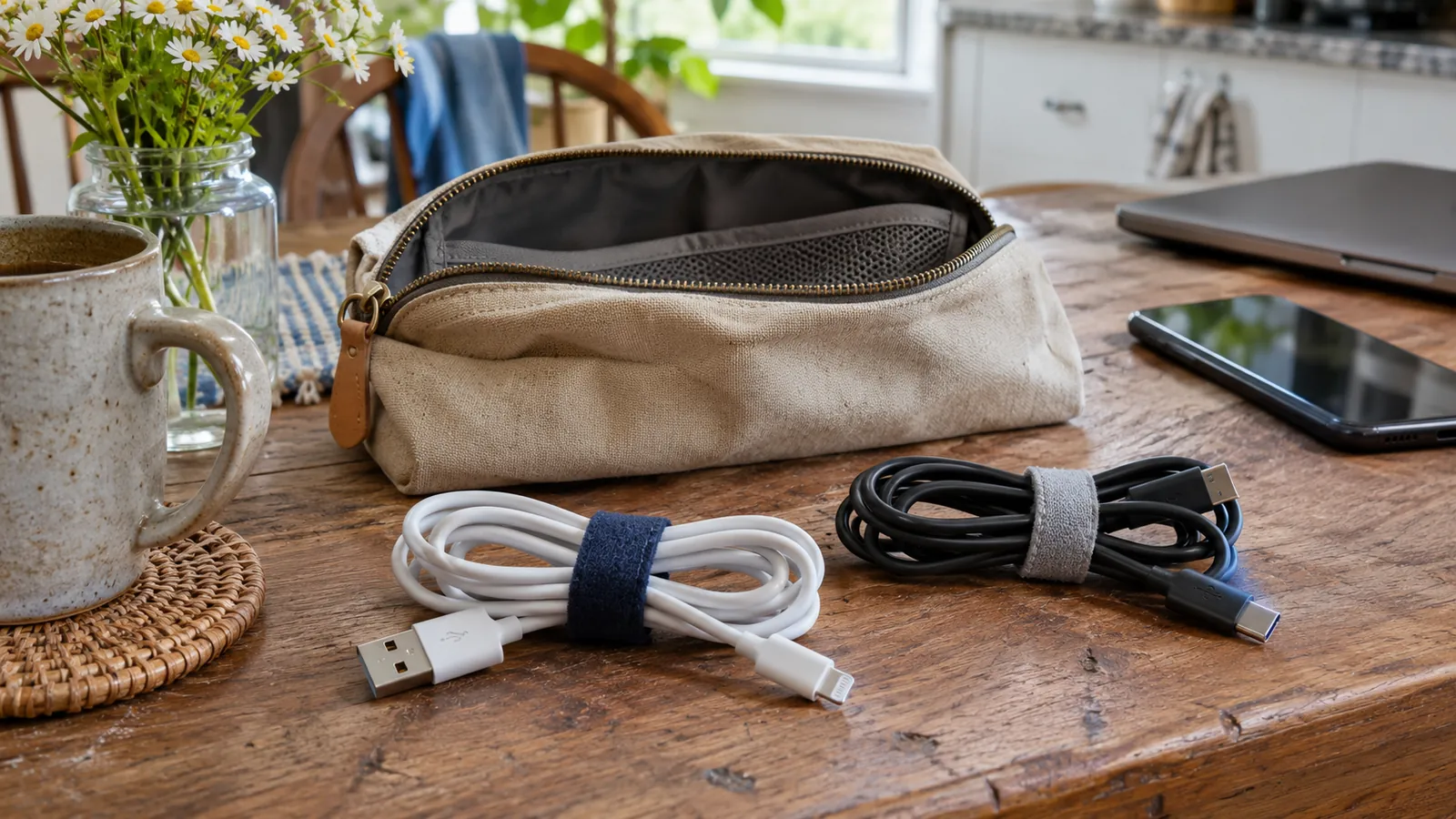
A charging cable is easy to drop into a bag and surprisingly awkward to retrieve when it has wound itself around everything else. To organize charging cables, separate the leads you actually need, give each one a loose coil, secure it gently and keep it in a consistent pocket or pouch.
You do not need an elaborate organizer. The useful test is whether you can take out one cable without emptying the bag, then put it away just as easily. A small routine matters more than a perfectly arranged photograph.
Start With the Devices You Will Carry
Empty the cable pocket onto a clear surface. Match each lead to a device and check both ends. Put aside duplicates that have no purpose on this particular trip rather than carrying your entire drawer as insurance.
For a normal workday, you might need one phone lead and one laptop lead. An overnight stay might add a watch charger. These are examples, not a universal packing list: write down your actual devices and the connections they require.
Keep a spare deliberately if losing a cable would create a serious problem. Store it separately from the everyday lead so that you can find it without unfastening the whole kit. A spare has a clear job; an unidentified cable does not.
If you carry a portable battery, check the complete arrangement before leaving. Our guide to choosing a power bank explains why the battery, cable and device need to work together. A connector that fits does not by itself establish every charging or data capability.
Pack Each Lead as a Separate Item
Use the following sequence while the cable is disconnected. Follow any storage instructions supplied for your particular accessory, especially unusually stiff or permanently attached leads.
Check before coiling. Look along the outer covering and at both connectors for splitting, fraying, sharp kinks or other visible damage. Stop using a damaged lead and arrange a suitable replacement or manufacturer advice. A storage strap is not a repair.
Let twists relax. Lay the cable down and release tangles gently. Avoid pulling opposite ends to tighten a knot. Work the loops apart before deciding how to store it; forcing an existing twist into a smaller bundle makes packing harder.
Make broad, relaxed loops. Follow the cable’s natural curve rather than folding it into sharp corners. Leave the sections immediately beside the connectors relaxed. Apple advises gentle curves instead of angles for its charging cables because repeated bending in one spot can weaken them. There is no single loop diameter suitable for every lead.
Secure the middle gently. Use an existing soft reusable strap or a suitable hook-and-loop tie around the coil. Fasten it only enough to keep the loops together, without visibly pinching the covering. Leave the connectors free rather than pulling them tightly against the bundle.
Give the coil a place. Put it into a pocket or compartment large enough to hold its shape. Close the pouch without forcing the zip across a connector. If the bundle only fits after being crushed, remove something or choose a less restrictive space.
Keep different cables individually secured. Binding three loose leads together may look tidy initially, but it means disturbing all three when you need just one. Individual coils are also easier to return to the correct compartment after use.
Choose Storage by How You Unpack
A soft pouch can work well for a few leads. An organizer with separate sections can be useful when several people share a kit or when you carry many similar accessories. Try a pouch you already own before buying a specialized one.
Choose enough room for gentle curves and easy access, rather than the maximum number of advertised compartments. Elastic loops that force a thick lead into a tight bend are not automatically a good fit simply because they hold it securely.
Keep heavy chargers in a separate section where practical, so that they do not press directly onto cable ends. Anker’s care guidance warns against placing cables where they can be squeezed or crushed. Protect the kit from leaking drinks, crumbs and other loose bag contents as well.
This is storage for disconnected accessories. Take the charger and cable out when you use them, and follow their ventilation and moisture instructions. Do not turn a closed travel pouch into a charging enclosure.
For a short commute, a dedicated inner pocket may be easier than a second bag inside your bag. For a trip involving several unpacking stops, a removable pouch makes it easier to check that the whole kit has come with you.
Label the Distinctions You Actually Need
Labels are most useful when two leads look alike but serve different purposes. Mark the strap or pouch section with a short description such as “phone,” “laptop” or “spare.” Keep labels clear of connector contacts and any important manufacturer markings.
Use a written description alongside a colour if several people use the kit. “Blue strap — laptop” is easier to explain than a colour system that only one person remembers.
Do not invent performance labels. Mark a cable with a charging rating or data capability only when you have verified that information from its markings or documentation. If you cannot identify an old lead confidently, keep it out of the essential travel kit until you can check it.
A practical two-part kit might place frequently used leads in the front pocket and occasional adapters behind them. This is an organizing choice, not a requirement: arrange items in the order you normally reach for them.
Make Putting Away as Easy as Taking Out
When disconnecting, hold the connector rather than tugging the cable itself. Let the lead settle into relaxed loops and return it to its place before moving on. Avoid tightly winding it around a charger merely because that seems faster.
Before closing the bag, check that the lead is fully inside and clear of the zip. A long end trailing from a pocket can catch on other belongings even when the rest of the coil is secured.
For travel, add the cable pouch to your final room check alongside your travel documents checklist. Prepare any offline maps before departure too, rather than relying on a charging stop to finish every task.
The aim is a small kit that resets easily. Keep only the leads you need, protect their natural curves and give each one an obvious home. If maintaining the arrangement feels fiddly, simplify the kit until putting a cable away becomes the easiest option.