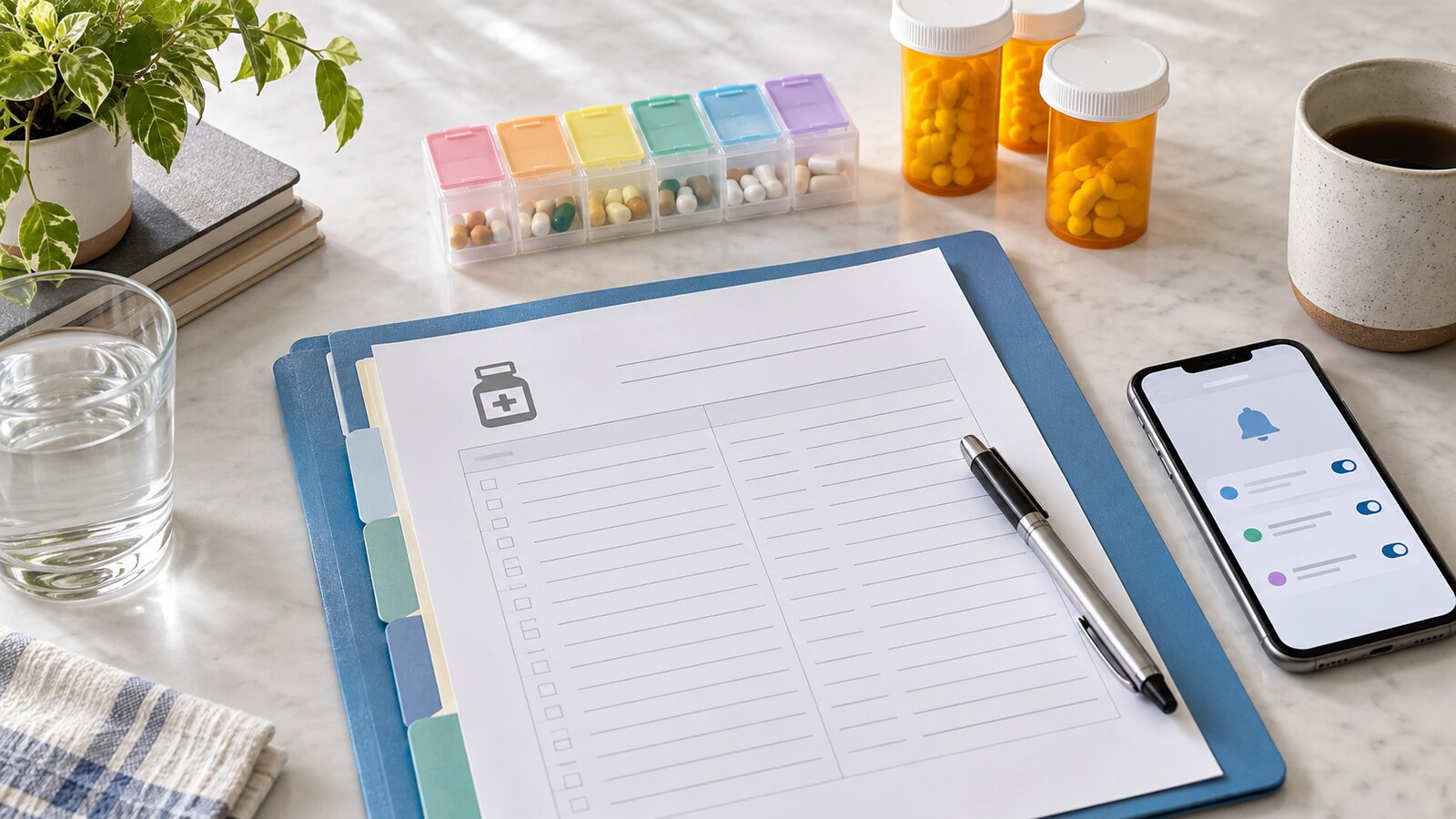
A medicine can be easy to take every day and surprisingly hard to explain under pressure. At a routine appointment, you may forget the exact dose. At a pharmacy, you may remember the brand name but not the active ingredient. In an emergency, someone else may need to answer questions when you cannot.
That is why a medication list is not just paperwork. It is a simple safety tool: one place that shows what you take, why you take it, how often you take it, what you are allergic to, and who should be contacted if something goes wrong.
This guide is for adults managing their own care, parents tracking medicines for children, caregivers helping older relatives, travelers, people with chronic conditions, and anyone who wants a clearer record before the next appointment.
Quick Answer
A useful medication list should include prescription medicines, over-the-counter medicines, vitamins, minerals, herbal products, supplements, allergies, doses, timing, reason for use, prescribing clinician, pharmacy, emergency contacts, and the date the list was last updated. Keep a copy on your phone and a printed copy where it can be found. Review it after every medicine change, appointment, hospital visit, pharmacy review, or new supplement.
Why A Medication List Matters
The U.S. Food and Drug Administration describes a medication list as a tool for tracking prescription drugs, over-the-counter medicines, vitamins, and supplements. It says the list helps health professionals understand current treatment and reduce the risk of medication errors or harmful interactions.
That sounds clinical, but the everyday value is very practical.
A medication list can help when:
- A doctor asks what you take and the appointment is moving quickly.
- A pharmacist checks whether two products can be used together.
- A lab, clinic, dentist, or specialist needs your current medicines.
- A caregiver has to refill a prescription.
- A medicine bottle is lost while traveling.
- A hospital team needs to know what should continue during care.
- A first responder needs allergy or medicine information in an emergency.
The list does not replace professional advice. It simply makes the conversation safer and less dependent on memory.
Include More Than Prescription Medicines
Many people think a medication list means prescription tablets only. That is too narrow.
Include:
- Prescription medicines.
- Over-the-counter pain relievers, cold medicines, allergy tablets, antacids, sleep aids, and creams.
- Vitamins and minerals.
- Herbal products and traditional remedies.
- Protein powders, concentrated extracts, or other supplements used for health reasons.
- Inhalers, eye drops, ear drops, patches, injections, implants, and medicated devices.
- Medicines taken only when needed.
- Recently stopped medicines if the change is still relevant.
This matters because non-prescription products can still affect care. The NHS explains that some medicines are available without a prescription, while others require a qualified health professional. The fact that a product is bought in a shop, supermarket, pharmacy, or online does not make it irrelevant to a doctor or pharmacist.
If you are unsure whether something belongs on the list, include it and let the health professional decide whether it matters.
Record The Details That Prevent Confusion
For each medicine or supplement, capture the details someone would need if you were not there to explain.
Use these columns:
| Item | What to write |
|---|---|
| Medicine name | Brand name and generic or active ingredient if you know both |
| Strength | For example, the amount on the label |
| Dose | How much you take each time |
| Timing | Morning, evening, weekly, monthly, before food, with food, or as needed |
| Reason | The condition, symptom, or purpose in plain language |
| Prescriber | Doctor, nurse, dentist, specialist, clinic, or pharmacist where relevant |
| Pharmacy | Name, branch, phone number, or app used for refills |
| Start or review date | When it began, changed, or should be reviewed |
| Notes | Side effects, missed-dose instructions from a clinician, or special storage |
Do not guess when accuracy matters. Copy names and strengths from the label, prescription record, pharmacy app, hospital discharge note, or patient leaflet. If the label is unclear, ask the pharmacist to help you update the list.
MedlinePlus advises people to list medicines, doses, times of day, what the medicine does, and side effects, and to bring the list and medicine bottles to provider appointments and pharmacy visits. That combination is useful: the list gives the overview, while the bottles help confirm exact labels.
Add Allergies And Serious Reactions
A medication list should sit beside allergy and reaction information.
Write down:
- Medicine allergies.
- Food, latex, dye, or other allergies that affect medical care.
- Serious past reactions and what happened.
- Whether a reaction was confirmed by a clinician or is still uncertain.
- Emergency contacts and caregiver names.
Use plain language. “Rash after amoxicillin in 2022” is more useful than “bad reaction.” “Severe swelling after X” is more useful than “cannot take X.” If you do not know whether an event was an allergy, intolerance, side effect, or unrelated symptom, say so clearly instead of turning uncertainty into a firm allergy label.
This is not about self-diagnosing a reaction. It is about preserving the history so a qualified professional can interpret it.
Keep One Master List
Medication records become risky when they are scattered across memory, old discharge papers, several apps, pharmacy bags, and family messages.
Choose one master list. It can be:
- A printed form.
- A note on your phone.
- A spreadsheet.
- A health app.
- A notebook page.
- A file inside a household emergency folder.
The best format is the one you can update quickly and show easily. A beautifully designed spreadsheet that no one opens is less useful than a simple phone note that is always current.
Keep a copy in more than one place. The FDA suggests keeping the list with you, such as on a smartphone, in an app, or as a physical copy with an insurance card, and sharing it with a trusted relative, friend, or caregiver.
If you already keep important household documents together, add the medication list to that system. GDU’s guide to building an emergency folder explains how medical details, contacts, insurance information, and key documents can be organized for situations when normal routines are disrupted.
Update It At The Moments Most People Forget
A medication list is only as good as its last update. Build updates into events that already happen.
Review the list when:
- A new medicine is prescribed.
- A dose changes.
- A medicine is stopped.
- A short course, such as an antibiotic, is completed.
- A supplement is added or removed.
- A hospital, urgent-care, or emergency visit happens.
- A specialist changes treatment.
- A pharmacy switches brands or packaging.
- You move, change pharmacy, or change insurance.
- You prepare for travel.
- A caregiver starts helping with medicines.
Add the update date at the top. That small detail helps a clinician judge whether the list is current or possibly stale.
For people who manage several medicines, set a monthly reminder to compare the list with the bottles, pill organizer, pharmacy record, and refill schedule. If the list and the bottles disagree, do not quietly choose one. Ask the prescriber or pharmacist to help reconcile them.
Use It Before Appointments
Bring the list to every medical appointment, not only major ones.
Before the visit, mark:
- New medicines since the last appointment.
- Medicines you stopped or skipped.
- Side effects or concerns.
- Refills that are running low.
- Questions about timing, food, alcohol, driving, pregnancy, breastfeeding, storage, or missed doses.
- Medicines from another doctor that this clinician may not know about.
This saves time and reduces vague answers. Instead of saying, “I take a small white tablet,” you can point to the medicine name, dose, and schedule.
The list can also help you ask better questions. For example: “Can this be taken with my allergy medicine?” “Should I separate this from calcium or iron?” “What should I do if I miss a dose?” “Is this still needed?” “Which side effects should make me call?”
Do not stop, split, restart, or combine medicines based only on a checklist or online search. Use the list to make professional advice easier.
Make It Useful For Emergencies
Emergency information should be short, clear, and reachable.
Keep a compact version that includes:
- Full name and date of birth.
- Emergency contacts.
- Major conditions that affect urgent care.
- Critical allergies.
- Current medicines and doses.
- Pharmacy or clinic contact.
- Language, communication, or accessibility needs if relevant.
If your phone allows emergency medical information on the lock screen, consider adding the most important items there. GDU’s guide to setting up emergency contacts on your phone explains how to add concise medical details on common smartphones. Keep that emergency profile brief; the full medication list can live in your wallet, health folder, or phone files.
For privacy, do not publish your medication list in shared cloud folders, group chats, or unsecured public notes. Share it deliberately with people who may need it.
Prepare A Travel Copy
Travel adds small complications: time zones, lost bags, border checks, refills, new pharmacies, and unfamiliar clinics.
Before a trip:
- Carry medicines in original packaging when practical.
- Keep essential medicines in carry-on luggage if flying.
- Bring enough supply for delays where allowed.
- Save a copy of the medication list offline.
- Include generic names where possible because brand names vary by country.
- Note storage needs, such as refrigeration.
- Carry prescriptions or clinician letters when required for controlled medicines, injectables, or medical devices.
Rules for medicines vary by destination and transit country. Check official travel or customs guidance before carrying controlled medicines or large quantities internationally. A medication list helps you explain what you carry, but it does not override local law.
Help Caregivers Without Creating A Mess
Caregiving often starts informally. A parent forgets a refill, a partner has surgery, a child needs a new inhaler plan, or a relative needs help after hospital discharge. Suddenly several people are trying to understand a medicine routine.
A shared medication list can reduce confusion, but it needs ownership.
Decide:
- Who keeps the master list updated.
- Who checks refill dates.
- Which pharmacy is used.
- Who attends appointments or receives instructions.
- Where hospital discharge papers are stored.
- How changes are communicated.
Avoid several competing versions. If one person updates a phone note and another updates a paper copy, the family can end up with two different truths. Use one master list and print or export copies from it.
For children, older adults, or anyone with complex care, ask the pharmacist or clinic whether they can print a current medicine profile. Compare it with what is actually being taken at home, including over-the-counter products and supplements.
Common Mistakes To Avoid
The first mistake is leaving out “small” products. Occasional pain relievers, sleep aids, antacids, allergy tablets, herbal teas used medicinally, and vitamins can still matter.
The second mistake is writing only brand names. Brand names can vary by country and manufacturer. Add the generic or active ingredient when you can verify it.
The third mistake is keeping an old list because it looks official. An outdated list can mislead care. Date every version and destroy or archive old copies clearly.
The fourth mistake is relying only on memory at appointments. Stress, pain, language barriers, time pressure, and fatigue can all make recall worse.
The fifth mistake is using the list as a treatment plan. A medication list records what is being used. It does not decide what should be started, stopped, or changed.
The Bottom Line
A medication list is a small document with a big job. It helps doctors, pharmacists, caregivers, emergency responders, and future you see the same facts at the same time.
Start with what you take today. Add prescriptions, over-the-counter medicines, vitamins, supplements, allergies, doses, timing, reasons, contacts, and the update date. Keep one master version, carry a copy, and review it whenever something changes.
The best time to make the list is a calm ordinary day, before anyone urgently needs it.