
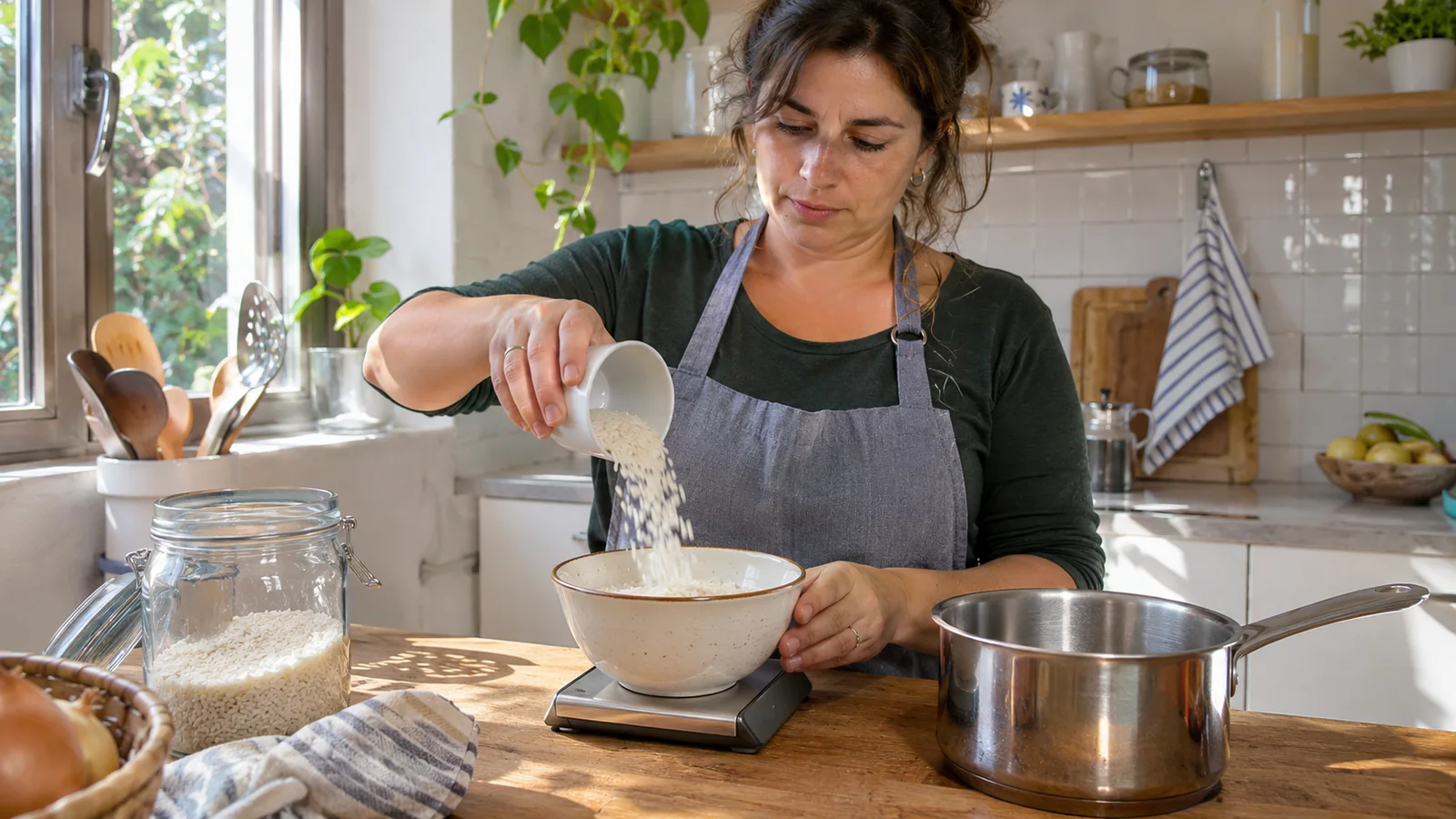
The easiest way to work out how much rice per person to cook is to measure it dry, choose a starting amount and check how well it fits the meal. For an ordinary meal, 60–75g of dry rice per adult is a useful starting range, with adjustments for appetite and the other food being served. It is a cooking estimate, not a nutritional requirement or a limit on what someone should eat.
A reliable household portion comes from a few meals of observation. Once you know the amount that works with your usual rice and dishes, you can stop guessing from the size of the saucepan.
Start With Dry Weight
Rice absorbs water during cooking, so dry and cooked weights describe different amounts of food. A recipe calling for 150g of uncooked rice is not asking for a 150g scoop from yesterday’s cooked batch. Check which measurement a recipe uses before you begin.
For a first attempt, choose a point in the range above rather than trying to find a universal perfect serving. Rice producer Tilda suggests 60g dry per person; Good Food’s basmati cooking guide uses 75g. These are useful kitchen reference points, with room to adapt.
The table shows the arithmetic for those two starting amounts. All quantities are dry rice, before rinsing or cooking.
| People eating | At 60g each | At 75g each |
|---|---|---|
| 1 | 60g | 75g |
| 2 | 120g | 150g |
| 3 | 180g | 225g |
| 4 | 240g | 300g |
| 6 | 360g | 450g |
Use the column that seems closest to the meal you are making. A smaller accompaniment alongside several dishes may call for a different amount from a rice bowl in which rice is the main base. Children and adults do not all need identical portions; serve according to the people eating rather than treating this table as a rule for everyone.
Measure a Batch in a Repeatable Way
A kitchen scale makes the process straightforward, but consistency matters more than owning extra equipment. Use this sequence before turning on the cooker:
- Count who will actually eat. Include a planned extra meal only if you intend to store it safely. Do not automatically add another person’s portion just because you usually have.
- Choose the dry amount per person. Think about appetite and what else is on the plate. Use previous household experience when you have it.
- Multiply before pouring. For example, three people at 60g each need 180g dry rice. Write down the total if you are likely to lose track while cooking.
- Weigh into a dry bowl. Put the bowl on the scale, zero it and add the rice. Measure before rinsing so clinging water does not become part of the weight.
- Follow the rice’s cooking instructions. Portion size tells you how much rice to start with; the packet or appliance manual tells you how to cook that variety with your equipment.
Without scales, use the same small cup or scoop each time and level it consistently. Record the amount as “one level blue cup”, for example. That is more useful than switching between an unmarked mug, a heaped scoop and a recipe’s measuring cup.
Do not assume a household mug, a standard recipe cup and the cup supplied with a rice cooker are interchangeable. Keep the rice cooker’s measuring cup with the appliance and follow its instructions and fill limits.
Match the Portion to the Whole Meal
Decide what the rice is doing on the plate. Is it accompanying a substantial stew, joining several shared dishes or forming most of a simple bowl? Make that decision before measuring, rather than adding extra dry rice when you see an empty-looking pan.
For a household with different appetites, calculate a batch from individual estimates. Two people might prefer smaller helpings and another a larger one. There is no need to force the same amount onto every plate to make the maths tidy.
For a one-pot dish, use the recipe’s stated servings and rice quantity as the first guide. Added vegetables, pulses, meat or sauce change the meal as a whole. Scaling only the rice while leaving everything else unchanged may produce a dish you did not intend.
If dinner plans often change, check attendance before starting. Our guide to planning a grocery list can help connect the food you buy with the meals your household expects to eat.
Keep a Small Note for Next Time
After serving, record three things: the dry amount, the number of people and whether it was too much, enough or too little. Add the dish if that helps distinguish a curry evening from a rice-heavy meal.
A useful note might say: “240g dry, four people, bean stew, a little too much.” Next time, try a modest reduction for that same meal. This is a household experiment; it does not need a precise food-waste calculation or a complicated spreadsheet.
Change one thing at a time. If you switch rice variety, pan and portion together, it becomes harder to tell why the result changed. Keep separate notes for dishes that your household eats in noticeably different amounts.
When you deliberately cook an extra portion, identify its destination before cooking. “Tomorrow’s lunch” is a plan; an increasingly full container at the back of the fridge is not. For broader preparation ideas, see our weekend meal-prep guide.
Handle Leftover Rice Promptly
UK Food Standards Agency guidance advises cooling leftover rice quickly, ideally within one hour, then refrigerating it and consuming it within 24 hours. Divide it into small portions to help cooling; do not leave it sitting in the cooking pan or rice cooker.
Reheat rice only once and make sure it is steaming hot throughout. Poor storage can allow bacteria to produce toxins that reheating will not remove. Follow local food-safety advice and any stricter product instructions; discard rice if you cannot establish that it was handled safely.
For more general handling guidance, read about storing leftovers safely. Planning a smaller fresh batch may be easier than managing excess rice when you have no suitable storage or definite next meal.
The most useful portion is the one you can repeat and adjust. Start with a measured dry amount, pay attention to the meal and keep one short note. Your household’s next batch can then be based on experience instead of another guess.