
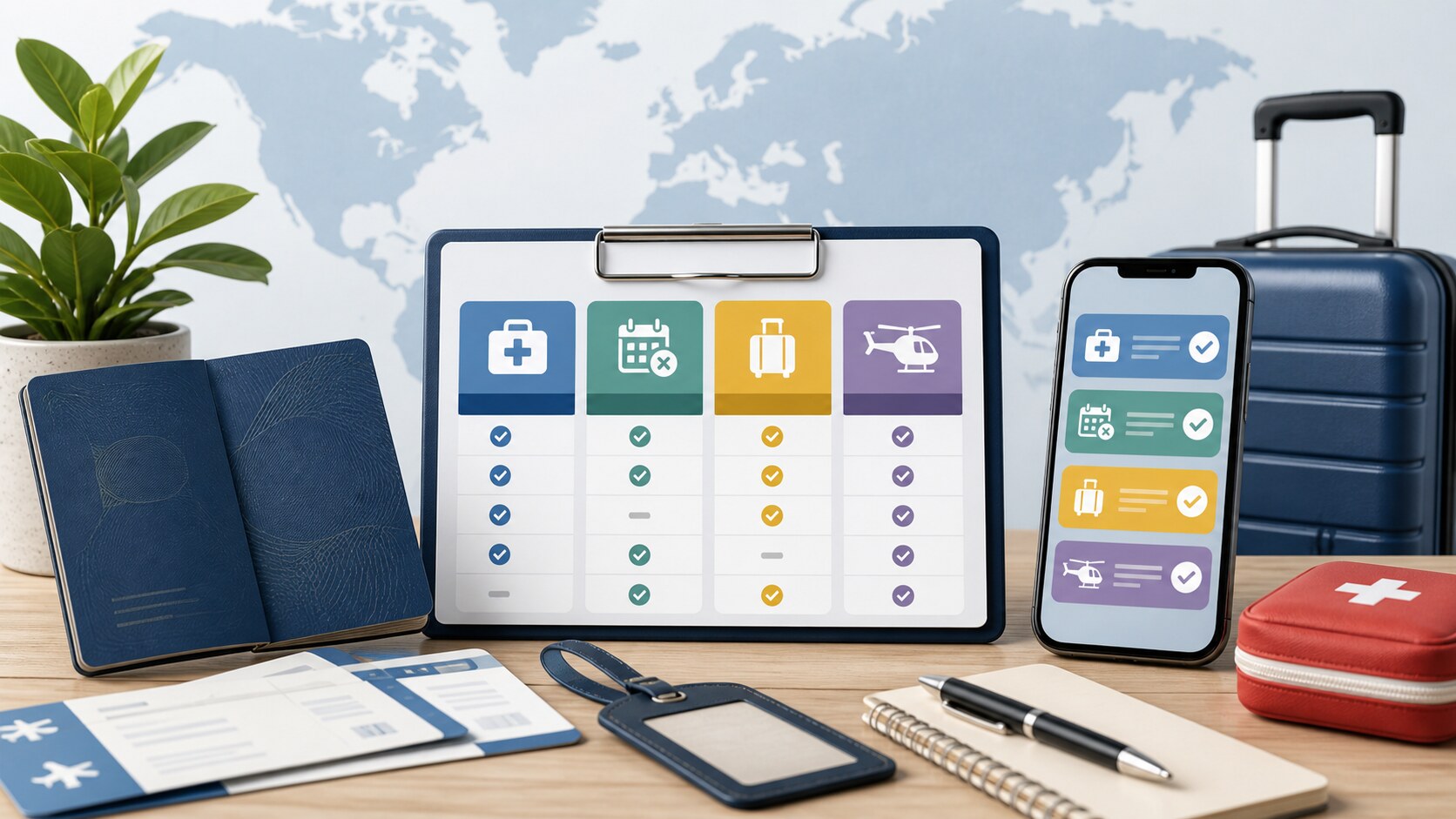
Travel insurance is easy to treat as a checkout add-on. That is a mistake. The best policy for an international trip depends on where you are going, how much money is prepaid, what medical care may cost, whether you need evacuation cover, and which problems the policy actually excludes.
A cheap policy can be useful if the trip is simple and the risks are modest. It can also be nearly useless if it excludes the reason you need to claim. A good comparison starts with the trip, not the premium.
Quick Answer
To compare travel insurance, list your prepaid non-refundable costs, destination health risks, planned activities, medical needs, baggage value, and cancellation concerns. Then compare policies on emergency medical cover, medical evacuation, trip cancellation and interruption, delays, baggage, exclusions, pre-existing condition rules, claim documentation, emergency assistance, and the insurer’s licensing or regulatory status.
Do not assume that credit card cover, domestic health insurance, airline compensation, or a basic travel policy solves every problem. Travel medical insurance, disruption insurance, and evacuation cover can be separate benefits with different limits.
Start With What You Need Covered
The first question is not “Which travel insurance is best?” It is “What could create the biggest financial loss on this trip?”
For a short domestic trip with refundable bookings, baggage and delay cover may matter more than medical evacuation. For an international trip, health care abroad can become the central risk. The U.S. State Department tells travelers to check medical insurance, evacuation assistance, and trip cancellation cover before departure, and it strongly recommends medical evacuation insurance for higher-risk destinations or places with limited medical care.
The Centers for Disease Control and Prevention gives similar practical advice: check whether your health insurance covers care abroad and consider extra cover for health care and emergency evacuation, especially for remote destinations. Its travel health guidance also separates travel disruption insurance from travel health and medical evacuation insurance, because one policy may not automatically include all three.
That distinction matters. A plan that reimburses a cancelled hotel may not pay for overseas treatment. A medical plan may not reimburse a cancelled tour. An evacuation benefit may be capped, conditional, or available only through the insurer’s assistance provider.
Compare the Main Types of Cover
Most travelers should compare four broad areas.
Travel medical cover helps with treatment costs if you become sick or injured while abroad. Check the limit, deductible or excess, excluded conditions, whether the provider pays hospitals directly, whether pre-approval is required, and whether routine care is excluded.
Medical evacuation and repatriation cover pays for emergency transportation when local treatment is not adequate or when medically necessary transport is approved. The CDC notes that evacuation from a remote area to a high-quality hospital can otherwise cost more than $100,000. The State Department says air ambulance evacuation back to the United States can range from $20,000 to $200,000 depending on location and medical condition. Exact costs vary, but the lesson is clear: evacuation is not the same as an ordinary clinic bill.
Trip cancellation, interruption, and delay cover reimburses prepaid costs only for reasons the policy covers. The National Association of Insurance Commissioners lists examples such as illness, injury, severe weather, transportation disruption, a natural disaster affecting your home or destination, or a covered family emergency. Read the covered reasons carefully. “I changed my mind” is usually not the same as a covered cancellation.
Baggage and personal effects cover helps when luggage is lost, damaged, delayed, or stolen. Check per-item limits, electronics limits, documentation rules, depreciation, receipts, and whether the airline or another provider must handle the claim first.
Match the Policy to the Trip
A city break, cruise, backpacking route, safari, ski holiday, business trip, study-abroad semester, family visit, pilgrimage, and remote trekking trip do not need the same policy.
Destination matters because medical costs, hospital access, transport distance, security conditions, and visa rules differ. Trip length matters because longer trips increase exposure. Age and health matter because some policies price or restrict cover by age band or medical history. Activities matter because skiing, diving, sailing, climbing, motorcycling, racing, manual work, or adventure tourism may be excluded unless a specialist add-on is purchased.
The UK government’s foreign travel insurance guidance tells international travelers to buy appropriate insurance before travel, including cover for existing physical or mental health conditions and activities planned abroad. The Association of British Insurers also stresses that travelers should disclose pre-existing medical conditions fully and honestly so the policy reflects the real risk.
That advice is useful beyond the UK. If an insurer asks about medical history, medication, pending tests, recent treatment, pregnancy, age, destination, or activities, answer accurately. A lower premium based on incomplete information can become an expensive problem when a claim is reviewed.
Check What Is Not Covered
Travel insurance policies are built around exclusions. A comparison that ignores exclusions is incomplete.
Look for exclusions tied to pre-existing medical conditions, alcohol or drug use, reckless behavior, illegal activity, undeclared sports, unattended baggage, travel against official advice, war or civil unrest, pandemics, mental health claims, pregnancy limits, high-value electronics, cash, missed connections, supplier insolvency, and cancellation for personal preference.
Also check whether the policy covers every country on the itinerary, including stopovers. A long layover, side trip, cruise port, border crossing, or multi-country rail route may complicate cover if the policy territory is too narrow.
If you already have travel cover through a credit card, employer, bank account, airline package, or membership program, read it before buying another policy. It may be enough for a simple trip, or it may have low medical limits, no evacuation cover, short trip-duration limits, weak baggage protection, or strict payment-card requirements.
Compare Cost the Right Way
The cheapest travel insurance is not always poor, and the most expensive policy is not automatically better. Compare total value.
Start with the premium, then check the deductible or excess, cancellation limit, medical limit, evacuation limit, baggage limit, per-item limit, delay waiting period, claim process, assistance access, and exclusions. A policy with a slightly higher premium may be better if it removes a large deductible, covers a key activity, or provides much stronger medical evacuation cover.
For trips with large prepaid costs, compare whether you need cancellation cover based on the full trip cost. For trips where flights and hotels are refundable, a medical-focused plan may be more relevant than a broad cancellation package.
If you are building a trip budget, keep travel insurance separate from everyday emergency cash. GDU’s guide to choosing the best account for an emergency fund explains why cash access still matters even when insurance exists.
Verify the Seller and Keep Records
Scam and mis-selling risk is real. The Federal Trade Commission advises travelers buying insurance to check that the agency is licensed and to carry a copy of the insurance card while traveling. Use official regulator tools where available, buy from a traceable provider, and keep the policy wording, certificate, receipt, emergency phone number, and claim instructions offline as well as online.
Store copies with other travel essentials. If you are also setting up mobile connectivity for the trip, GDU’s guide to setting up a travel eSIM covers one practical way to keep emergency access available after arrival.
Before departure, share the insurer’s emergency assistance number with a trusted contact. If a serious medical problem happens abroad, call the assistance line as early as practical, because some policies require approval before evacuation, hospital transfer, or certain treatment.
Common Mistakes
The first mistake is buying at checkout without reading the policy. The summary box may not show every exclusion.
The second mistake is confusing travel medical insurance with trip cancellation insurance. They solve different problems.
The third mistake is ignoring medical evacuation. It may be irrelevant for a nearby low-risk trip, but it can be central for remote travel, cruises, rural destinations, or countries with limited specialist care.
The fourth mistake is hiding or minimizing pre-existing conditions. That can lead to claim disputes.
The fifth mistake is assuming baggage cover will replace expensive devices at full value. Many policies cap electronics, cash, jewelry, cameras, and unattended items.
The sixth mistake is waiting until a storm, illness, strike, or political disruption is already known. Insurance is designed for uncertain events, not losses that are already foreseeable when the policy is purchased.
FAQ
Should I buy travel insurance for every international trip?
Not every trip needs the same level of cover, but international travelers should at least check medical care abroad, evacuation risk, prepaid costs, and cancellation exposure before deciding.
Is credit card travel insurance enough?
Sometimes, but only after you read the benefit terms. Check medical limits, evacuation cover, trip-duration limits, eligible purchases, exclusions, claim documents, and whether companions are covered.
What is the difference between travel medical insurance and medical evacuation insurance?
Travel medical insurance focuses on treatment costs abroad. Medical evacuation insurance focuses on emergency transport to appropriate care or, when covered and medically necessary, transport closer to home.
What documents should I save before travel?
Save the policy certificate, full wording, receipt, emergency assistance number, claim form instructions, booking receipts, cancellation terms, medical declarations, and copies of any relevant prescriptions.
Summary
The right travel insurance policy fits the trip’s real risks. Compare medical care, evacuation, cancellation, delay, baggage, exclusions, pre-existing condition rules, activity cover, claim process, and seller legitimacy before comparing price.
A good policy will not prevent disruption, illness, or lost bags. It can make the financial and logistical shock easier to manage when a trip goes wrong far from home.