
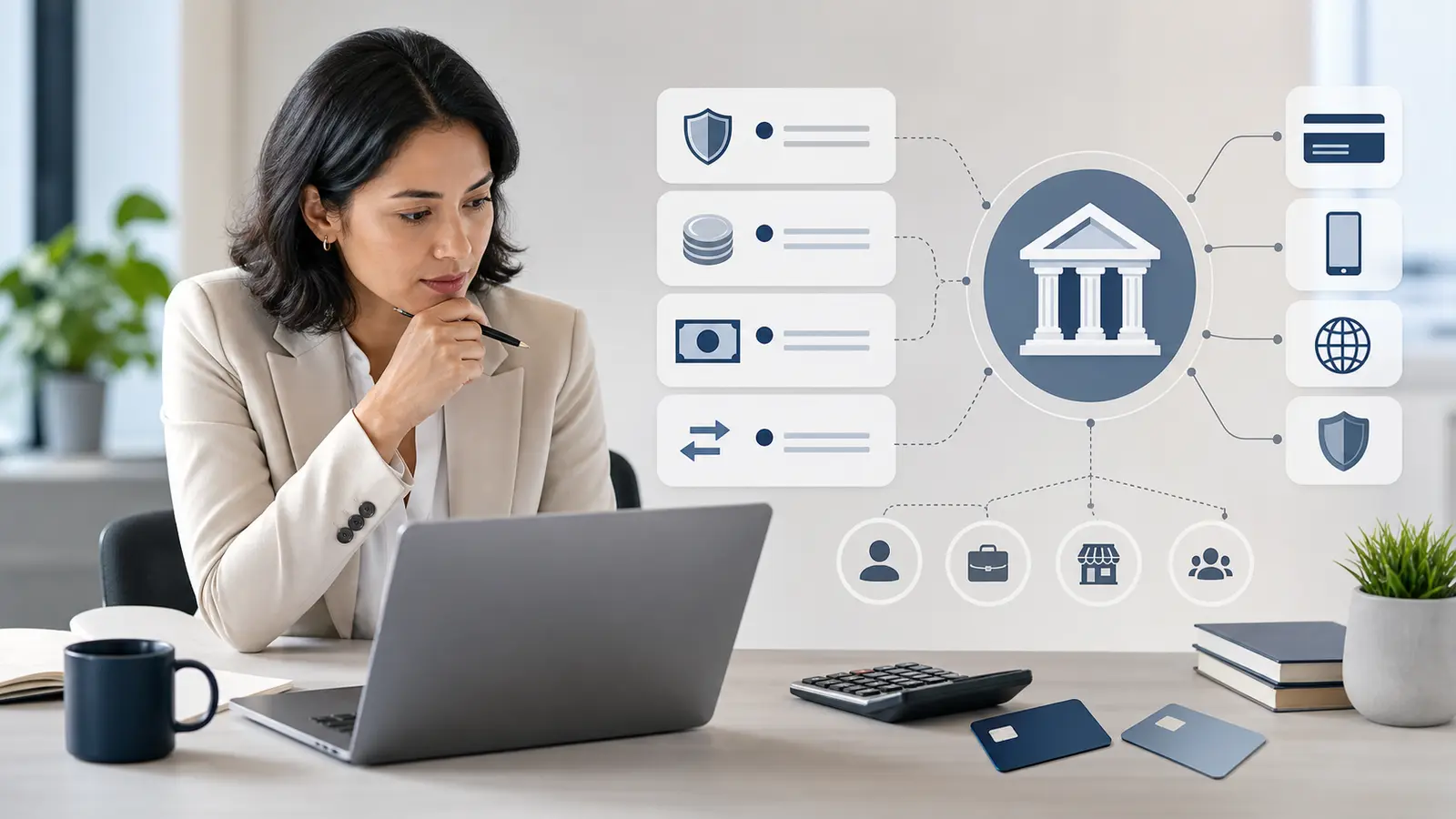
A small business bank account is not just a place to hold cash. It affects customer payments, supplier bills, payroll, tax records, loan readiness, fraud controls, bookkeeping, and the daily visibility a founder has over money coming in and going out.
The best small business bank account is usually the one that fits how the business actually receives money, pays people, keeps records, handles cash, uses cards, and separates business funds from personal funds. A freelancer, cafe, ecommerce seller, agency, clinic, contractor, and nonprofit may all need different account features.
Quick Answer
Compare a small business bank account by checking the monthly fee, fee-waiver rules, transaction limits, cash-deposit costs, wire and international transfer costs, card and ATM access, payment-processing links, deposit protection, accounting integrations, user permissions, branch or digital support, documentation requirements, and switching steps.
Do not choose only from a headline monthly fee. A low-fee account can become expensive if it charges heavily for cash deposits, extra transactions, incoming wires, foreign payments, chargebacks, or bookkeeping exports your business uses every month.
Start With Your Real Money Flow
Before comparing banks, write down how the business moves money in a normal month. Count customer card payments, bank transfers, checks, cash deposits, supplier payments, payroll runs, tax payments, subscriptions, international payments, refunds, and owner withdrawals.
This matters because many business accounts price activity differently. One account may be inexpensive for a digital consulting firm that receives a few bank transfers each month. Another may be better for a shop that deposits cash daily, pays several suppliers, and needs employee debit cards. A third may work best for an online seller that needs fast settlement from payment processors and clean accounting exports.
The U.S. Small Business Administration tells owners to open a business account once they are ready to accept or spend money as the business. It also notes that business banking helps separate business and personal funds, supports professionalism, and can help with credit access. Those benefits depend on choosing an account that matches the operating model rather than the bank you already use personally.
Compare the Total Monthly Cost
Business banking fees can include monthly account fees, minimum-balance charges, transaction fees, cash-deposit fees, check fees, domestic wire fees, international wire fees, foreign-exchange margins, ATM fees, stop-payment fees, overdraft charges, paper-statement fees, card-replacement fees, and early closure fees.
Build a simple monthly estimate using your actual activity. If the account includes 100 transactions, ask what counts as a transaction. If cash deposits are included only up to a limit, calculate the fee above that limit. If international payments matter, compare both the transfer fee and the exchange-rate markup.
The UK’s Competition and Markets Authority has pushed for clearer business-account cost information and says open banking tools can help businesses compare current account costs, including transaction tariffs. The lesson travels well beyond the UK: compare the account against your financial pattern, not against a generic “best account” list.
Check Deposit Protection and Provider Structure
A business account should make it clear which regulated institution holds the funds and what deposit protection applies. In the United States, FDIC insurance generally protects deposits at insured banks up to the applicable limit and ownership category. Other countries have their own deposit-protection schemes, limits, and eligibility rules.
This is especially important when comparing banks, neobanks, payment apps, fintech platforms, and merchant-account providers. Some products are directly offered by a licensed bank. Others are technology platforms that partner with one or more banks. That structure can still be useful, but the business owner should understand where funds are held, when deposits become protected, whether sweep programs are used, and what happens if the platform or partner changes.
If your business keeps balances above the local insured limit, ask about account titling, cash-management sweeps, treasury alternatives, and whether spreading funds across institutions is appropriate. Do not assume a dashboard balance is protected just because it looks like a bank account.
Prepare the Opening Documents
Account-opening documents vary by country, bank, business structure, and industry. Common requirements include owner identification, business formation documents, tax identification, ownership agreements, operating agreements, business licenses, registered address details, and information about anyone authorized to operate the account.
For U.S. businesses, the SBA says a federal Employer Identification Number can be needed to open a business bank account, and its account-opening guidance lists common documents such as an EIN or Social Security number for sole proprietors, formation documents, ownership agreements, and business licenses. The Taxpayer Advocate Service says eligible businesses can apply for an EIN for free through the IRS and generally receive it immediately after a completed online application.
Do not wait until the bank application is half finished to gather documents. Missing ownership records, mismatched addresses, expired IDs, or unclear beneficial-owner information can delay account approval and payment setup.
Match the Account to Payments
Your bank account and payment tools should work together. If customers pay by card, ask how card settlement reaches the account, how long deposits take, whether reserves can be held, and whether chargebacks appear clearly in the transaction feed. If customers pay by bank transfer, confirm payment references, same-day options, transaction limits, and fraud controls.
For ecommerce, subscriptions, marketplaces, or international sales, check whether the account supports the currencies, processors, payout methods, and reconciliation data you need. For a local service business, branch access, check deposit, cash deposit, and phone support may matter more than multi-currency features.
GDU’s guide to verifying invoice payment details explains why changed bank details should be confirmed through a separate channel. The same control should apply when setting up suppliers, contractors, payroll, tax authorities, and platform payouts in a new business account.
Review User Permissions and Security
Small businesses often outgrow one owner login. Ask whether the account supports separate users, role-based permissions, approval workflows, dual control for large payments, card spending limits, account alerts, device management, and multi-factor authentication.
Separate permissions matter because bookkeeping access is not the same as payment authority. A bookkeeper may need statements and exports without the ability to send money. A store manager may need a card with a defined limit. A co-founder may need approval authority above a threshold. A former employee or agency should lose access quickly.
GDU’s guide to comparing small business cyber insurance covers vendor and incident-response risk. Banking controls are part of the same operating discipline: know who can move money, who approves changes, and who reviews alerts.
Test Accounting and Payroll Fit
A good account should reduce reconciliation work. Check whether it connects cleanly to your accounting software, payroll provider, invoicing tool, tax records, and expense-management process. Ask whether exports include enough details for matching payments, fees, refunds, and taxes.
If payroll is coming soon, verify cut-off times, direct-deposit support, employee-payment limits, and whether payroll debits will trigger alerts or require special approval. GDU’s guide to comparing small business payroll software explains why payroll, tax liabilities, and cash movement need to reconcile without guesswork.
For web-based businesses, hosting, subscriptions, and payment processors can create many small monthly charges. GDU’s guide to comparing small business cloud hosting can help identify recurring technology costs that should be visible in banking and accounting records.
Plan Switching Before You Move
Switching business accounts is more than opening a new login. List incoming payments, customer billing links, payment processor payouts, payroll debits, tax payments, supplier direct debits, loan payments, software subscriptions, card-on-file charges, recurring transfers, and saved payees.
In the UK, the Current Account Switch Service says business switching can transfer regular payments and requires a chosen switch date, with the process taking seven working days when eligible. Other countries and banks use different processes, but the operating lesson is the same: pick a controlled switch date, keep old statements, monitor both accounts, and avoid setting up new payments in the wrong place during the transition.
Do not close the old account until refunds, chargebacks, outstanding checks, subscription renewals, tax debits, and customer payments have been handled. Keep exported statements and fee schedules for tax, audit, and dispute records.
Common Mistakes
The first mistake is choosing the bank with the lowest headline monthly fee while ignoring cash deposits, transfers, wires, foreign exchange, and transaction limits.
The second mistake is using a personal account for business activity for too long. It can blur records, make tax preparation harder, weaken liability separation, and look less professional to customers and suppliers.
The third mistake is assuming every fintech account has the same protection as a bank account. Verify the licensed institution, deposit-protection rules, and account terms.
The fourth mistake is giving everyone full payment access. Use separate users, card limits, alerts, and approval workflows where available.
The fifth mistake is switching without a payment map. Missing one payroll debit, processor payout, or supplier payment can create avoidable disruption.
FAQ
What is a small business bank account?
A small business bank account is an account used to receive, hold, spend, and track business money separately from personal funds. It may include checking, savings, debit cards, merchant services, payment tools, and links to accounting or payroll systems.
Is an online business bank account enough?
An online account may be enough for a digital business that rarely uses cash or branch services. A business that handles cash, checks, in-person deposits, local lending, or complex support issues may still value branch access.
What documents do I need to open a business account?
Common documents include owner identification, tax identification, business formation documents, ownership agreements, business licenses, and proof of business address. Exact requirements depend on the bank, country, business structure, and industry.
Should I keep business savings separate from checking?
Many businesses benefit from separating operating cash from reserves for taxes, payroll, emergencies, and planned expenses. The right setup depends on cash flow, deposit-protection limits, transfer timing, and bookkeeping discipline.
Summary
Compare a small business bank account by modelling how your business really uses money. Check total cost, deposit protection, documents, payment settlement, permissions, accounting integrations, payroll fit, support, and switching steps before opening the account.
The right account should make daily money movement boring, visible, protected, and easy to reconcile. That matters more than a sign-up promotion or a low monthly fee that does not match the way your business actually operates.