An empty lunch bag can still hold crumbs, a sticky patch under the lining or moisture around the zip. Unpacking it when you get home gives you time to deal with those details before tomorrow’s food goes in. The aim is a clean, fully dry bag, using a method its materials can tolerate.
To clean a reusable lunch bag, start with the manufacturer’s care instructions rather than a favourite cleaning trick. A washable cloth tote, a lined insulated bag and a bag with built-in freezer panels may need different treatment. Cleaning also has a separate job from refrigeration: a spotless bag cannot make an unrefrigerated lunch safe.
Check What Your Bag Can Handle
Look for a sewn-in care label, the product instructions or the manufacturer’s page for the exact model. Check washing method, water temperature, drying restrictions and whether any inserts can be removed. Keep a photograph of the label if the printing is becoming faint.
Do not assume that a soft exterior means the whole bag can go into a washing machine. As one example, PackIt instructs owners to hand-clean its bag interiors, spot-clean the exterior and air-dry with the flap open. Its bags are not suitable for a washer, tumble dryer or dishwasher. That is product-specific guidance, not a rule for every lunch bag.
If the instructions are missing, identify the bag before soaking it, applying strong chemicals or trying a hot cycle. Use another clean bag while you check. Guessing can damage insulation, coatings or seams and leave you with a bag that is harder to care for.
Make the After-Lunch Reset a Sequence
Set up near the sink with a clean cloth or gentle sponge and the cleaning product permitted for the bag. Keep the bag off the area where you are preparing ready-to-eat food. Public-health guidance recommends daily lunch-box washing; make care after each day’s use the default rather than waiting for a visible spill.
- Empty every compartment. Remove containers, cutlery, napkins, cold packs and loose packaging. Open the side pockets as well as the main compartment. Deal with food promptly; do not leave returned containers inside overnight.
- Remove loose debris. Tip crumbs into the bin and check the bottom corners. Lift a removable base only if the design allows it. Avoid pulling a fixed lining away from its seams.
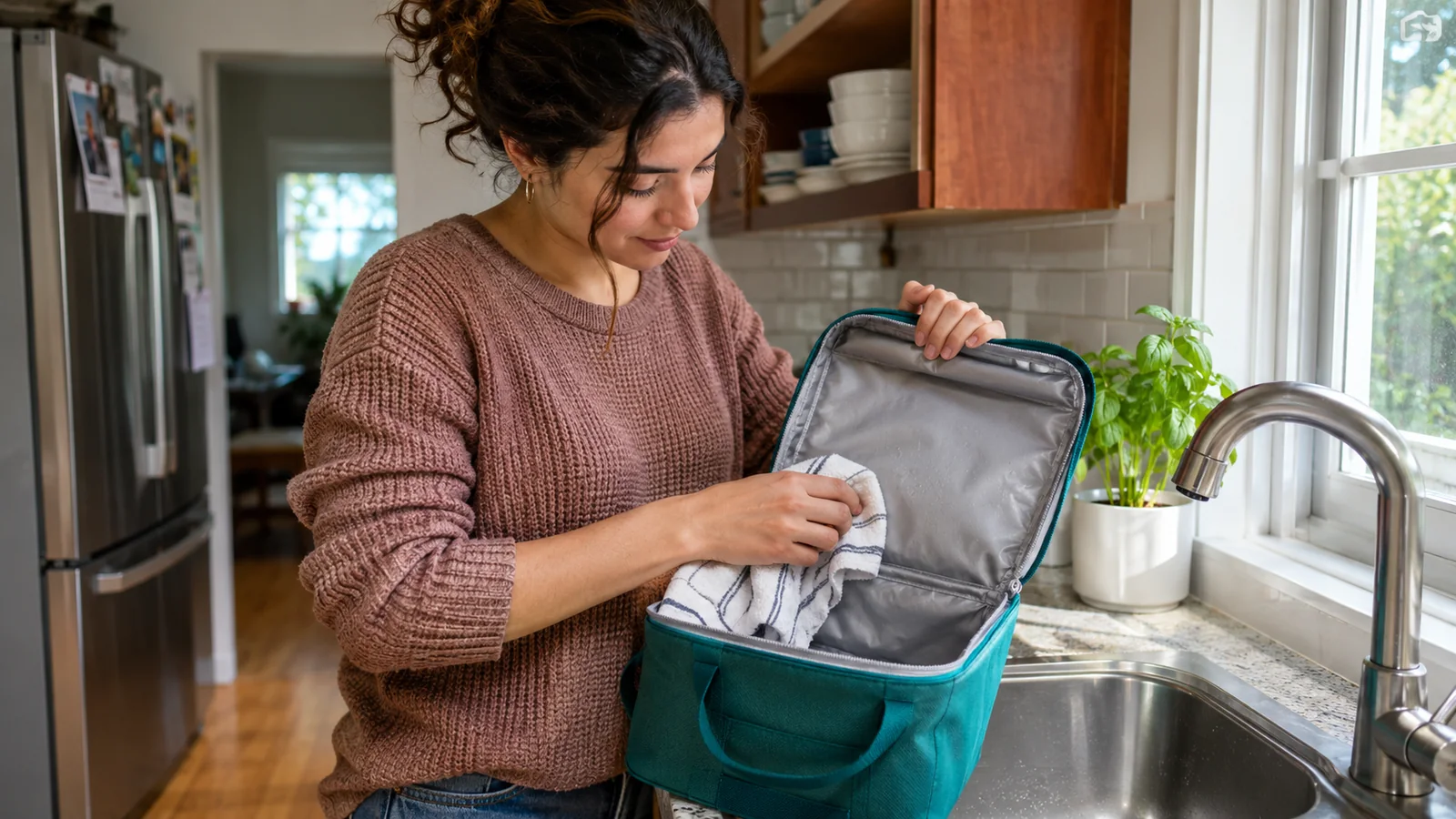
- Clean using the approved method. For a wipe-clean interior, follow its directions for mild soap and water, including how to remove soap afterwards. Work across the base, sides and accessible folds. Give sticky marks attention instead of wiping only the large flat panel.
- Check the parts you hold. Clean the handle, zip pull and exterior as the material instructions allow. Wash removable containers and utensils separately according to their own care guidance; the bag’s method may not suit them.
- Leave it open to dry fully. Arrange the opening so air can reach the interior. Let removable parts dry separately where permitted. Check folds and corners before closing, storing or repacking the bag.
The sequence is easier when it happens before the bag disappears into a cupboard. For example, put it beside the washing-up area as soon as you unpack, then return it to its storage place only when cleaning and drying are finished. This is a suggested household routine, not a timed cleaning standard.
Treat Spills as a Reason to Clean Now
A leaking dressing pot calls for more than removing the pot. Check beneath it, around the base and inside nearby pockets. Clean the affected surfaces before using the bag again, following the same material restrictions. Health Canada similarly advises thorough washing of reusable grocery bags after food juices leak; that guidance supports treating leaks seriously, while your lunch bag’s label determines the method.
If a particular container keeps leaking, investigate the lid, seal and packing position rather than repeatedly cleaning the same mess. A container that sits upright at home may tip onto its side during a commute. Test its closure before trusting it with another meal, and replace damaged parts when the manufacturer provides them.
Fragrance does not remove spilled food. Avoid using a scented spray to cover an odour and then treating the bag as ready. If you are considering a sanitizing product, confirm that both the bag and product instructions allow that use, and follow all required contact-time and rinsing directions. Do not improvise chemical mixtures.
Give Drying Its Own Place in the Routine
A bag can look finished while the seam at the bottom is still damp. Before putting it away, open it fully and inspect those less visible areas. Do not fold it tightly just because the outside feels dry.
Choose a clean drying position where the opening stays unobstructed. Keep a wet cleaning cloth elsewhere rather than dropping it back inside. Avoid applying a hairdryer, radiator heat or a tumble-dryer cycle unless the care instructions specifically permit the method.
For a freezer-panel bag, drying may also be part of the freezing instructions. PackIt requires complete air-drying before freezing to prevent frost. Check your own product’s directions for both preparation and storage; freezing is not a substitute for cleaning.
If you see mould, a torn lining or residue you cannot reach, pause use and ask the manufacturer about safe cleaning or replacement. A bag that cannot be cleaned and dried reliably should not be the one you keep packing by habit.
Keep Tomorrow’s Food Cold Separately
Cleaning addresses the bag’s condition. Temperature control addresses the food during storage and travel. Pack perishable lunches cold, use an insulated bag with at least two cold sources, and refrigerate at the destination when possible. Do not treat insulation alone as refrigeration or assume that an ice pack lasts for an entire day.
Our guide to packing salad for lunch covers the food-and-container side of that routine. If you are using cooked food from dinner, follow a separate leftover-storage routine before it ever reaches the lunch bag.
Keep the final check simple: the bag is empty of yesterday’s items, cleaned using the right method, dry in its corners and ready for a freshly packed meal. Doing that check while there is time to act makes the next morning easier.