
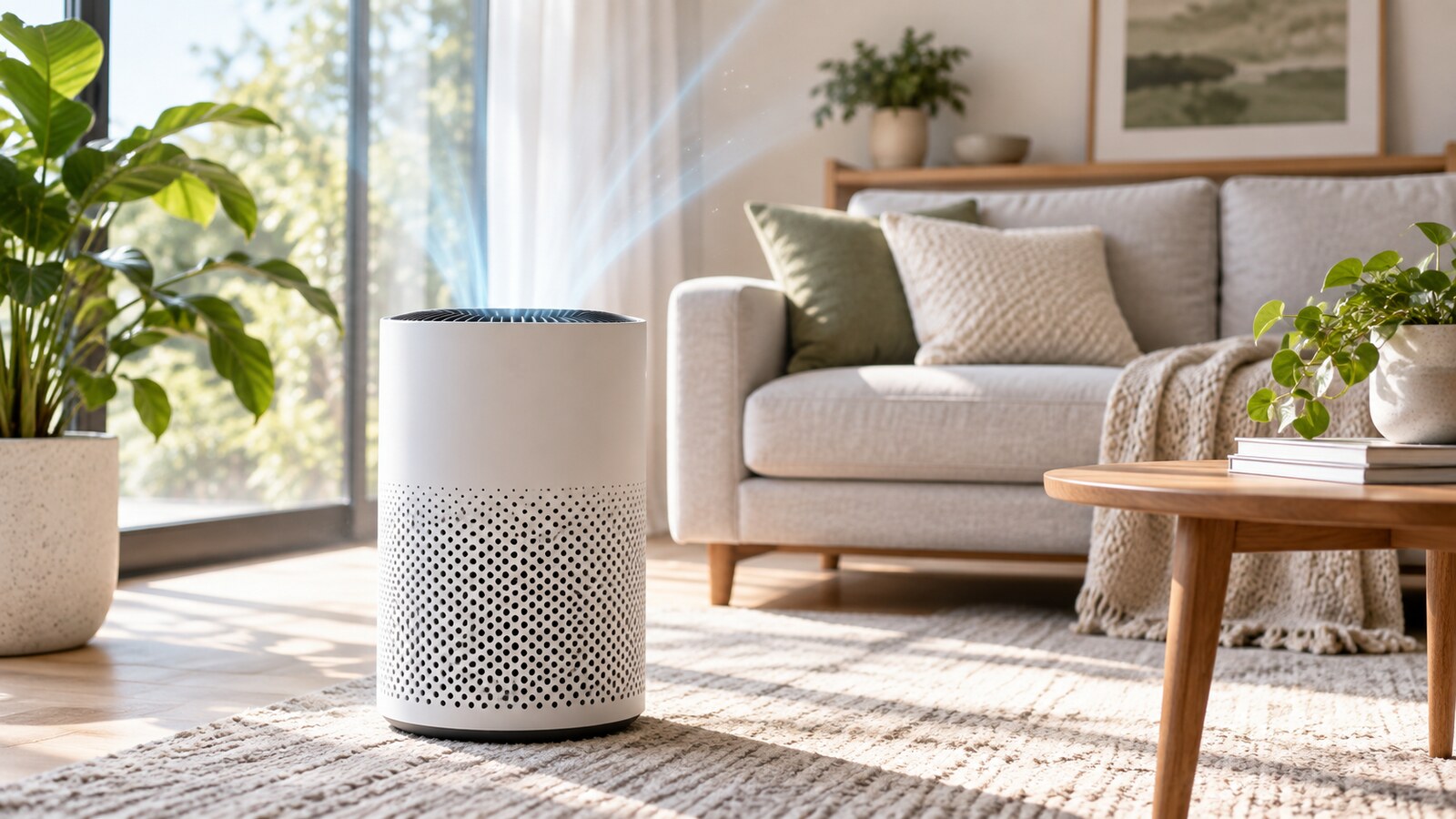
A home air purifier can be useful, but it is easy to buy the wrong one. Packaging often highlights large room claims, smart features, allergy language, odor promises, and quiet modes without making the trade-offs clear. The best choice is not the most expensive machine or the one with the longest feature list. It is the purifier you can run long enough, in the right room, with filters you can afford to replace.
Start with a modest expectation. An air purifier can reduce some particles and, with the right filter, some gases or odors. It cannot fix every indoor air problem, replace cleaning, remove a moisture source, or make an unsafe room safe by itself. The U.S. Environmental Protection Agency says filtration works best as a supplement to source control and clean ventilation, not as a substitute for them.
Quick Answer
Choose a home air purifier by matching its clean air delivery rate, or CADR, to the room size. Look for a high-efficiency particle filter such as HEPA for dust, smoke, pollen, pet dander, and fine particles. Add activated carbon if odors or gases are a real concern. Avoid ozone generators and be cautious with ionizer, plasma, or unsupported sanitizing claims. Check noise, electricity use, filter replacement cost, and whether the purifier can sit where airflow is not blocked.
Decide Which Room Matters Most
Portable air purifiers clean one room or area, not an entire home. Pick the room where cleaner air will matter most: a bedroom, home office, nursery, living room, or a closed room used during wildfire smoke or heavy pollution days.
Measure the room before shopping. Multiply length by width to get the floor area. A 12-foot by 15-foot bedroom is 180 square feet. If the ceiling is much higher than 8 feet, or the room opens into a hallway or kitchen, size up because there is more air to clean.
For outdoor air problems, pair the purifier with daily air-quality checks. GDU’s guide to checking air quality before outdoor activity explains how AQI can help you decide when to keep windows closed, adjust exercise, or spend more time indoors.
Use CADR Instead Of Marketing Room Claims
CADR is one of the most useful numbers on an air purifier label. It estimates how quickly the machine delivers filtered air for particles such as smoke, dust, and pollen. A higher CADR usually means faster cleaning for a larger room, especially at the purifier’s higher fan speed.
The EPA’s home air-cleaner guide gives a simple sizing chart: about 65 CADR for 100 square feet, 130 for 200 square feet, 195 for 300 square feet, 260 for 400 square feet, 325 for 500 square feet, and 390 for 600 square feet, assuming an 8-foot ceiling. Those numbers are estimates, but they keep you from buying a small purifier for a large open room.
If several CADR numbers are listed, pay close attention to the smoke CADR because it represents smaller particles. Dust and pollen ratings are still useful, but smoke CADR is often the stricter test for fine-particle cleaning.
Choose The Right Filter Type
For particles, look for a high-efficiency particle filter, commonly marketed as HEPA or HEPA-type. A true HEPA-style product with a strong CADR is the usual choice for fine particles, pollen, dust, pet dander, and smoke particles. Avoid relying only on vague claims such as “advanced purification” unless the product also shows testable performance numbers.
For odors and gases, look for activated carbon or another absorbent filter designed for gases. This is separate from particle filtration. Carbon can help with some odors and volatile organic compounds, but the EPA notes that gas-removal performance is harder to compare because CADR is for particles, not gases. A very thin carbon sheet may do little for long-term odor control.
If a product claims to destroy pollutants with ultraviolet light, plasma, ionization, photocatalytic oxidation, or a proprietary process, read carefully. Some technologies have limited real-world evidence in portable home devices, and some can create ozone or other byproducts.
Avoid Ozone-Generating Devices
Do not buy a purifier that intentionally produces ozone for use in occupied rooms. Ozone is a lung irritant. The EPA warns that air cleaners marketed as ozone generators can be harmful and are not approved by any federal agency for use in occupied spaces.
Be cautious with words such as “ionizer,” “plasma,” “energized oxygen,” “activated oxygen,” or “sanitizing” when they are not backed by clear low-ozone testing. Some products allow ionizing features to be switched off. If you are unsure, choose a filter-only model with independent performance data.
California’s air-cleaner certification program and AHAM’s directories can help shoppers identify products that have been tested for relevant claims. They are not a guarantee that a purifier solves every problem, but they are better than relying on promotional language alone.
Check Noise At The Setting You Will Use
Air purifiers clean more air at higher fan speeds. They also make more noise. A purifier that works well only on its loudest setting may end up switched off at night, which defeats the purpose.
Compare published decibel ratings if available, but pay attention to the setting. A quiet sleep mode may move far less air than the rated CADR speed. For a bedroom, it can be smarter to buy a slightly larger purifier and run it on a lower, quieter setting most of the time.
The EPA notes that around 50 decibels is roughly similar to a modern refrigerator. Some people can sleep through that; others cannot. If noise matters, look for real test data or a return policy that lets you try the unit in the room where it will run.
Count The Full Cost
The purchase price is only part of the cost. Check the price and availability of replacement filters before buying. A cheap purifier with expensive filters may cost more over two years than a better-built model with reasonable replacements.
Also check how often filters need replacing, whether pre-filters can be vacuumed or washed, and whether the purifier uses a combined cartridge or separate particle and carbon filters. Separate filters can be useful because odor-control carbon may wear out at a different pace than the particle filter.
Energy use matters because an effective purifier often runs for many hours a day. ENERGY STAR says room air cleaners can use a meaningful amount of electricity when operated continuously, and certified models are designed to deliver cleaner air more efficiently. The label speaks to energy efficiency, not health results, so use it alongside CADR and filter information.
Place It Where Air Can Move
Even a good purifier performs poorly when blocked. Put it in the room where you spend time, with open space around the intake and outlet. Keep it away from curtains, furniture edges, piles of laundry, and tight corners unless the manufacturer says that placement is acceptable.
Close windows during outdoor smoke or heavy pollution events unless heat, safety, or local guidance makes that unsafe. Avoid adding pollution indoors while the purifier is working. Burning candles, smoking, frying heavily, using some sprays, or running poorly vented combustion appliances can quickly overwhelm a small purifier.
If you use central heating or cooling, a good HVAC filter can help, but it is a different tool. HVAC filters clean air only when the system fan runs. The EPA suggests using the highest-rated filter your system can safely handle, often MERV 13 or higher, but homeowners may need an HVAC technician to confirm fit and airflow.
What To Skip
Skip oversized promises. No portable purifier removes all pollutants from a home. It will not solve mold if moisture remains. It will not make smoking indoors safe. It will not replace a working kitchen exhaust fan, clean vacuuming habits, or repairs that stop water damage.
Skip features that raise cost without improving the job you need done. App control, colored air-quality lights, fragrance cartridges, decorative lighting, and voice assistants may be convenient, but they should come after room size, CADR, filter type, noise, ozone safety, and filter cost.
Skip unknown replacement filters. If you cannot find the correct filter model, price, and supplier before buying, maintenance may become frustrating later.
Buying Checklist
- Measure the room and choose a CADR that fits the square footage.
- Prioritize HEPA or high-efficiency particle filtration for dust, pollen, smoke particles, and pet dander.
- Add substantial activated carbon only if odors or gases are a real concern.
- Avoid ozone generators and be careful with ionizer or plasma claims.
- Check noise at the speed that delivers the advertised performance.
- Confirm replacement filter cost, availability, and schedule.
- Look for independent testing, AHAM Verifide listings, or other credible certification where available.
- Consider ENERGY STAR certification for long-running efficiency.
- Place the purifier where airflow is not blocked.
Bottom Line
A good home air purifier is a practical appliance, not a miracle device. Buy for the room you actually use, compare CADR instead of vague room claims, choose the right filter for particles and odors, avoid ozone-producing technologies, and budget for replacement filters. The model that quietly runs every day in the right place will usually do more good than a flashy one that is too loud, too small, or too expensive to maintain.