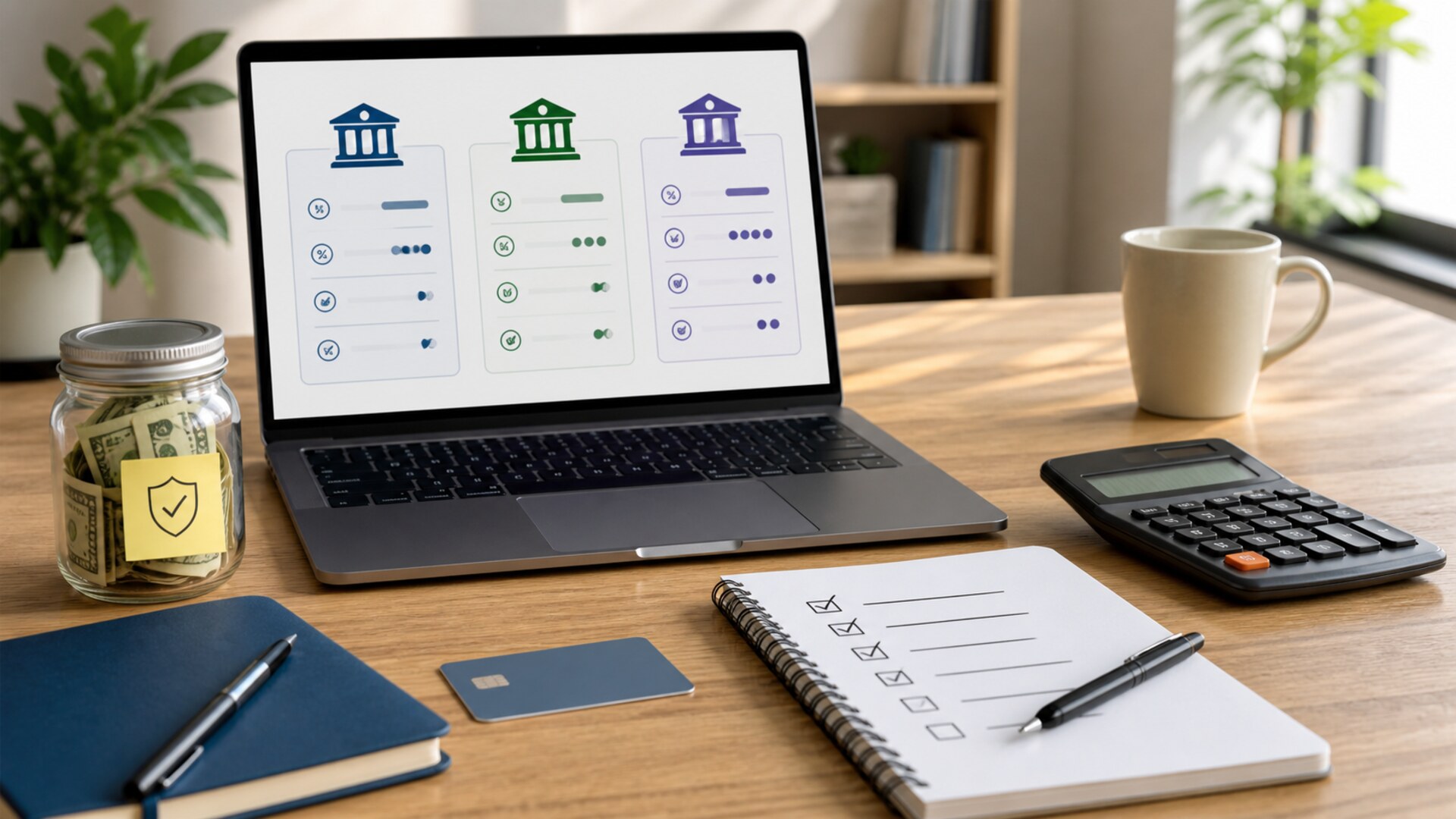

A checking account should make daily money movement easier. It should receive pay, pay bills, handle debit card spending, move money to savings, and give you a clear record of what happened. The wrong account does the opposite: it quietly charges monthly fees, adds overdraft costs, limits ATM access, delays deposits, or makes switching away difficult.
The best choice is not always the bank with the biggest branch network, the highest sign-up bonus, or the slickest app. It is the account whose rules match how you actually use money.
Quick Answer
Choose a checking account by comparing the total monthly cost, the ways to waive fees, overdraft settings, ATM access, deposit insurance, mobile banking tools, customer support, and account-opening requirements. Read the fee schedule before opening the account, not after the first charge appears.
If two accounts look similar, choose the one with fewer conditions. A free account that only stays free when you meet several rules can become expensive during a job change, travel period, late payment, or low-balance month.
Step 1: Start With Your Real Banking Habits
Before comparing products, write down how you use a checking account now. Do you receive direct deposit? Pay rent by bank transfer? Use cash often? Travel internationally? Keep a low balance near payday? Use mobile check deposit? Need joint access? Run a small side business? Send money through payment apps?
The account should fit those habits. A branch-heavy bank may be useful if you deposit cash or need in-person service. An online bank may work better if you rarely use cash and want lower fees. A credit union may offer strong local service and competitive account terms, but you must confirm membership eligibility and access options.
Step 2: Compare Monthly Fees and Waiver Rules
The monthly maintenance fee is the easiest charge to spot, but the waiver rule matters just as much. Some accounts waive the fee if you maintain a minimum balance, receive a qualifying direct deposit, make a certain number of debit card purchases, are a student, or link another account.
The Consumer Financial Protection Bureau tells consumers to ask about minimum balance requirements, monthly service fees, transaction fees, ATM costs, online access costs, overdraft fees, and low-balance alerts before opening an account. That checklist is useful because it separates the account’s advertised price from the account’s real price.
Look for the condition you can meet even in an imperfect month. If direct deposit stops because you change jobs, will the fee return? If your balance dips below the threshold for one day, does the account charge the full monthly fee?
Step 3: Understand Overdraft Choices Before You Opt In
Overdraft coverage can sound helpful because it may allow a debit card transaction or ATM withdrawal to go through when the account lacks enough money. The trade-off is cost. The FDIC warns that overdraft fees can add up quickly, and the CFPB has long treated overdraft as one of the major account-fee issues consumers should understand before choosing an account.
For ATM withdrawals and one-time debit card transactions in the United States, banks and credit unions generally cannot charge overdraft fees unless the consumer affirmatively opts in. That does not mean every transaction type works the same way, so read the account agreement and ask what happens with checks, automatic payments, debit card purchases, recurring subscriptions, and insufficient-funds events.
A practical default is to avoid overdraft opt-in unless you clearly understand the fee and have a reason to accept it. Low-balance alerts, a small linked savings buffer, careful bill timing, and organized subscriptions are often cheaper than repeated overdraft charges. GDU’s guide to buy now, pay later budgeting explains why automatic payment timing can create cash-flow pressure.
Step 4: Check Deposit Insurance and Institution Type
A checking account is usually meant for money you cannot afford to lose. Confirm that the institution has federal deposit insurance or the equivalent protection in your country.
In the United States, the FDIC protects deposits at insured banks, and the NCUA protects member accounts at federally insured credit unions. The standard coverage is generally applied per depositor, per insured institution, and per ownership category, subject to the official rules.
Do not assume a financial app, wallet, brokerage feature, or payment platform has the same protection as an insured checking account. Terms can differ. GDU’s guide to instant payments and stored app balances explains why payment speed and deposit protection should be evaluated separately.
Step 5: Review Access, Holds, and Payment Features
Daily access can matter more than the headline fee. Compare ATM networks, cash deposit options, debit card replacement rules, wire transfer costs, international card fees, bill pay, mobile check deposit, account alerts, budgeting exports, transaction search, joint account tools, and customer service hours.
Also ask how deposited funds become available. The CFPB notes that each bank or credit union has its own rules for check availability within legal limits. The FTC warns that seeing deposited check funds in an account does not prove the check is good, because fake checks can take longer to be discovered. That is especially important if a stranger sends a check and asks you to send money back.
If you regularly receive checks, compare hold policies and mobile deposit limits before opening the account. If you mostly receive electronic transfers, focus on transfer timing, limits, and notification quality.
Step 6: Calculate the Real Monthly Cost
Make a small comparison table with five rows: monthly fee, likely ATM cost, likely overdraft or insufficient-funds risk, transfer or wire costs, and any fee required to use the features you need.
Then estimate three scenarios.
First, a normal month when direct deposit arrives and your balance stays stable. Second, a tight month when the balance drops close to zero. Third, a disruption month when pay is delayed, you travel, replace a card, or deposit a large check.
An account that is free only in the first scenario is not truly free for someone with variable income. Freelancers, students, seasonal workers, and households with irregular bills should pay special attention to waiver rules, alerts, and overdraft settings.
Step 7: Plan the Switch Before Closing the Old Account
If you are moving from one account to another, do not close the old account on the day the new card arrives. Keep both accounts open long enough to move direct deposit, rent, utilities, subscriptions, loan payments, insurance payments, tax payments, investment transfers, and payment app links.
Download statements before closing the account. Keep enough money in the old account to cover final automatic payments. Review it after one full billing cycle to catch forgotten subscriptions.
This is also a good moment to look for old money. If you previously closed accounts, moved homes, changed employers, or lost track of financial paperwork, GDU’s guide to finding unclaimed money without paying a finder can help you search official databases.
Common Mistakes
The first mistake is focusing only on the sign-up bonus. A one-time bonus can disappear quickly if the account charges monthly, ATM, overdraft, or transfer fees.
The second mistake is ignoring minimum balance rules. The opening deposit and the balance required to avoid fees may be different.
The third mistake is opting into overdraft without understanding what it covers and what it costs.
The fourth mistake is assuming all money apps are checking accounts. Read the terms and confirm protection.
The fifth mistake is closing the old account too quickly and missing an automatic payment.
FAQ
Is an online checking account better than a branch account?
It depends on how you bank. Online accounts often compete on lower fees and stronger digital tools. Branch accounts may be better for cash deposits, in-person service, cashier’s checks, notarized documents, or local business needs.
Should I choose a bank or a credit union?
Compare the specific account, not only the institution type. Banks may offer wider networks and more digital features. Credit unions may offer strong member service and competitive terms. Confirm insurance, membership eligibility, ATM access, fees, and support hours.
How many checking accounts should I have?
One well-managed checking account is enough for many people. A second account can help separate bills, household money, business activity, or shared expenses. More accounts only help if you can monitor them.
What is the most important fee to avoid?
For many consumers, repeated overdraft fees are the most damaging because they can stack quickly. Monthly maintenance fees also matter because they are predictable and often avoidable.
Summary
A good checking account should be boring in the best way: predictable, insured, easy to monitor, and inexpensive under your normal habits. Compare the monthly fee, waiver rules, overdraft choices, ATM access, deposit insurance, funds availability, app tools, and switching steps before opening the account.
The smartest account is not the one with the biggest promise. It is the one that still works when the month is imperfect.