Most drivers notice tire pressure when something feels wrong: the steering is heavy, fuel use creeps up, the tire-pressure warning light appears, or a road trip is about to begin. By then, the tire may already be low enough to affect handling, wear, heat buildup, or safety.
A tire-pressure check is one of the simplest maintenance habits a driver can keep. It does not require advanced mechanical skill, and it often takes less time than buying coffee. The trick is knowing which number to use, when to measure, and what the warning light can and cannot tell you.
Quick Answer
Check tire pressure when the tires are cold, ideally after the vehicle has been parked for at least three hours. Find the recommended pressure on the driver-side door placard, fuel-door label, glovebox label, or owner’s manual, not on the tire sidewall. Use a reliable tire-pressure gauge on each tire, including the spare if your vehicle has one. Add or release air until each tire matches the vehicle manufacturer’s recommended pressure, then replace the valve caps and recheck before long trips or at least monthly.
Why Tire Pressure Matters
Tires carry the vehicle, passengers, luggage, cargo, braking forces, steering inputs, road heat, and weather. When pressure is too low, the tire can flex more than intended, build heat, wear unevenly, reduce fuel efficiency, and make the vehicle feel less stable. When pressure is too high, the tire can ride harshly, wear unevenly, and provide less contact with the road than designed.
The U.S. National Highway Traffic Safety Administration describes proper tire pressure as the most important part of tire maintenance because it affects safety, durability, and fuel use. NHTSA also notes that tire-pressure monitoring systems are not a substitute for regular checks because they usually warn only after a tire is significantly underinflated.
That makes tire pressure both a safety habit and a money habit. A few minutes with a gauge can help tires wear more evenly, reduce avoidable roadside trouble, and make the vehicle easier to trust before a long drive.
Use the Vehicle’s Number, Not the Tire’s Number
The most common mistake is reading the tire sidewall and assuming that number is the target. It usually is not.
The pressure molded into the tire sidewall is typically a maximum pressure for the tire, not the recommended pressure for your specific vehicle. The correct everyday pressure comes from the vehicle manufacturer because it accounts for the vehicle’s weight, suspension, handling, and tire size.
Look for the recommended pressure in:
- The driver-side doorjamb or door edge.
- The fuel door on some vehicles.
- The glovebox or storage compartment label on some vehicles.
- The owner’s manual.
- The manufacturer’s official app or service information if available.
The label may list pressure in PSI, kPa, or both. Some vehicles use different front and rear pressures, especially vans, pickups, performance cars, and vehicles designed to carry heavy loads. If the placard lists different values, follow the layout exactly.
If you recently changed tire size, tow heavy loads, carry unusual cargo, or use a vehicle for work, ask a qualified tire professional or the vehicle manufacturer for guidance. Do not guess from another vehicle.
Check When Tires Are Cold
Tire pressure rises as tires heat up during driving. That is why pressure guidance is usually based on cold tires.
For most everyday checks, cold means the vehicle has been parked for at least three hours or has been driven only a short distance at low speed. Morning is often convenient because the car has been sitting overnight.
If you have already been driving and discover a tire is low, do not ignore it just because the tire is warm. Add enough air to reach the recommended pressure as a temporary fix, drive cautiously, and recheck when the tire is cold. A warm reading may not be perfect, but driving on a badly underinflated tire is worse.
Temperature changes can also move pressure. A cold morning can make a tire-pressure warning light appear even if the tire looked fine the day before. Treat the light as a prompt to check all tires with a gauge rather than assuming the sensor is overreacting.
Keep a Gauge Where You Can Find It
You do not need a luxury tool, but you do need a gauge you can actually use.
Common options include:
- Pencil-style gauges, which are small and cheap.
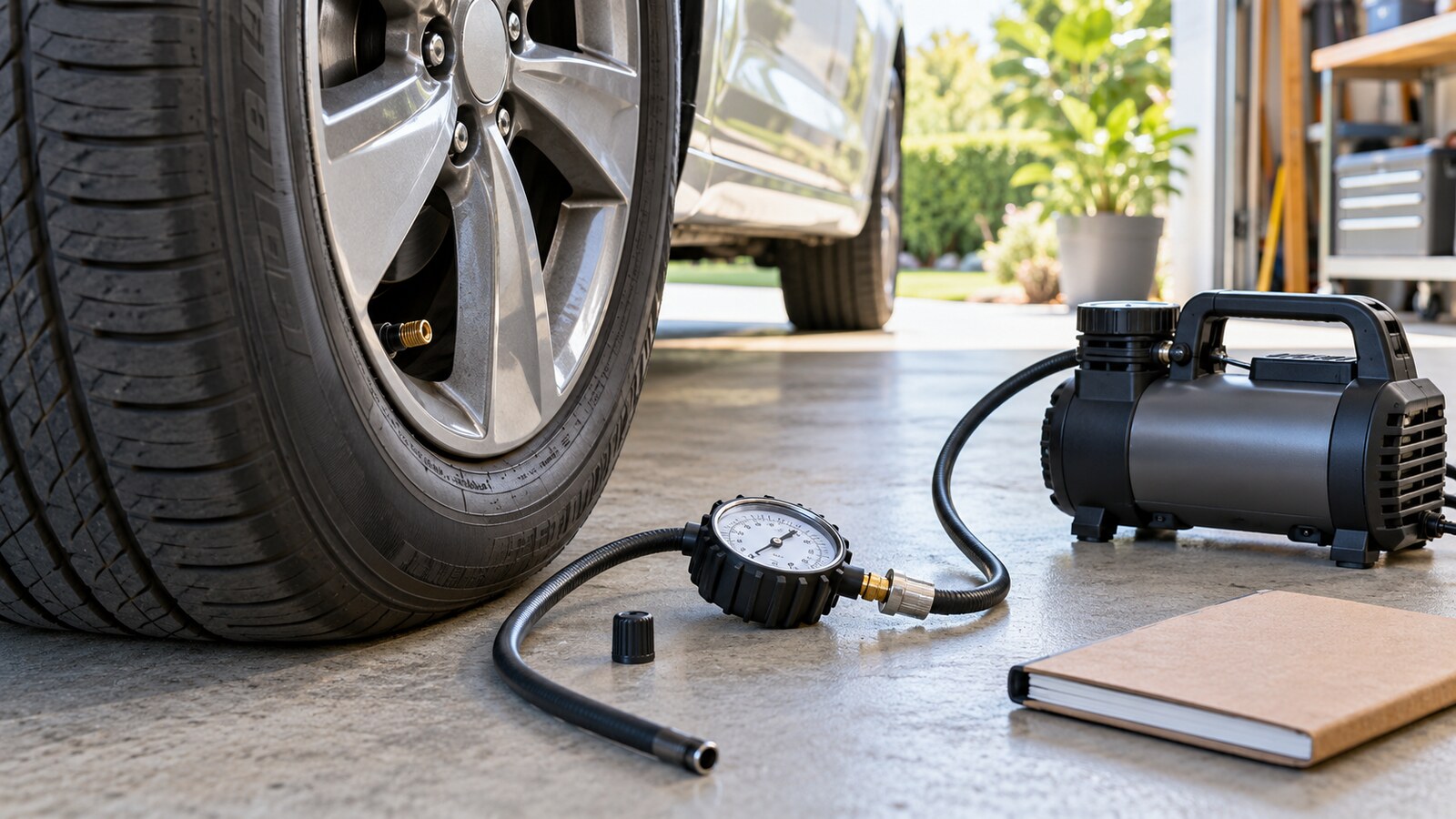
- Dial gauges, which are easy to read and often have a bleed valve.
- Digital gauges, which can be quick and clear if the battery is good.
- Portable inflators with built-in gauges, which are useful for home checks and travel.
Keep the gauge in the glovebox, tool kit, boot, trunk, or motorcycle storage where it will not disappear into the house. If you use a portable inflator, still consider keeping a separate gauge because built-in inflator readings can vary.
Replace damaged gauges, gauges that stick, or digital gauges with fading displays. A clean, readable gauge is more useful than a fancy one you do not trust.
Step-by-Step Tire Pressure Check
Start with the vehicle parked safely on level ground. Have the recommended pressure, gauge, and air source ready.
- Find the recommended pressure for the front tires, rear tires, and spare if listed.
- Remove the valve cap from one tire and put it somewhere it cannot roll away.
- Press the gauge straight onto the valve stem until the hiss stops and the reading appears.
- Read the pressure and compare it with the recommended number.
- If the tire is low, add air in short bursts, then recheck.
- If the tire is high, release a little air and recheck.
- Replace the valve cap firmly.
- Repeat for every tire, including the spare if your vehicle has one.
Do not forget the spare. Some vehicles have a compact temporary spare with a much higher pressure requirement than the road tires. Others use a repair kit instead of a spare. Know what your vehicle has before you are stuck on the roadside.
If one tire is repeatedly lower than the others, it may have a slow leak, damaged valve stem, rim issue, puncture, or previous repair problem. Reinflate it only as a temporary step and arrange a proper inspection.
Do Not Let TPMS Become the Whole Plan
Tire-pressure monitoring systems are useful. They are also easy to misunderstand.
If the TPMS light turns on, stop when safe, inspect the tires, and check pressure with a gauge. The warning may mean one tire is significantly low. It may also appear briefly in cold weather if pressure drops near the warning threshold. If the light flashes and then stays on, many systems use that pattern to indicate a system malfunction that needs service.
Even when the system works well, it is not meant to replace monthly maintenance. Some systems show individual tire readings, while others show only a warning. Sensors can age, batteries can fail, and indirect systems may need calibration after rotation or pressure adjustment.
Use TPMS as a warning layer, not as permission to skip a gauge.
Add a Tire Check to Road-Trip Prep
Before a long drive, check tire pressure earlier than the morning you leave. That gives you time to fix a leak, replace a damaged tire, find a working air pump, or read the manual without delaying everyone.
For road trips, also inspect:
- Tread depth and uneven wear.
- Cuts, cracks, bulges, scrapes, punctures, or exposed cord.
- Valve caps and visible valve damage.
- Spare tire pressure and the jack or repair kit.
- Load rating if the vehicle will carry many passengers or heavy luggage.
- Tire age if the vehicle is rarely driven.
If you are preparing for a trip, pair the tire check with GDU’s guide to downloading offline maps before travel. A sound vehicle and a usable route backup solve different problems, but both are easier to handle before departure.
Know When Air Is Not Enough
Adding air is maintenance. It is not a cure for every tire problem.
Get the tire inspected before driving normally if you notice:
- A bulge, blister, deep cut, exposed cord, or sidewall damage.
- A puncture near the sidewall.
- Pressure that drops again soon after inflation.
- Vibration, pulling, thumping, or steering changes.
- Uneven wear across the tread.
- A TPMS warning that returns after pressure is corrected.
- A tire that was driven while very low or flat.
Do not try to save a tire that a qualified technician says is unsafe. The cost of replacement is frustrating, but tire failure at speed is a much bigger problem.
If you are buying a used vehicle, tire condition should be part of the inspection rather than an afterthought. GDU’s used-car buying checklist explains why a history report cannot replace a physical inspection of tires, brakes, suspension, leaks, and other safety items.
Make It a Monthly Habit
A tire check works best when it is attached to something you already do. Choose a repeatable cue:
- The first weekend of each month.
- The day after payday.
- The morning before a regular commute.
- The day before a long drive.
- The same day you check oil, washer fluid, lights, and emergency supplies.
Record the normal pressure range if that helps you notice patterns. A tire that needs air every month is telling you something. A gauge reading that changes wildly may also tell you the gauge, valve, or technique needs attention.
For vehicles used by more than one person, make the storage location obvious. The best tire gauge is the one the next driver can find.
Common Mistakes
The first mistake is inflating to the sidewall maximum instead of the vehicle placard.
The second is checking only the tire that looks low. Underinflation can be hard to see, so check all tires.
The third is ignoring the spare until a flat tire happens.
The fourth is relying entirely on TPMS. A warning light matters, but a quiet dashboard does not prove every tire is correctly inflated.
The fifth is checking pressure after a long drive and treating the warm reading as the cold target.
The sixth is skipping inspection. Air pressure matters, but tread wear, cuts, bulges, valve damage, and tire age matter too.
Bottom Line
Checking tire pressure is not a car-enthusiast ritual. It is basic road preparation.
Use the pressure recommended by the vehicle manufacturer, measure when the tires are cold, check every tire with a gauge, correct small differences before they become bigger problems, and take recurring pressure loss seriously. Your dashboard warning light is helpful, but your monthly tire-pressure habit should arrive first.