
Australia's Consumer Data Right Shows How Open Banking Became Data Portability Infrastructure
A case study on Australia's Consumer Data Right, which turned open banking into a broader consent-based framework for sharing banking, energy, and lending data.
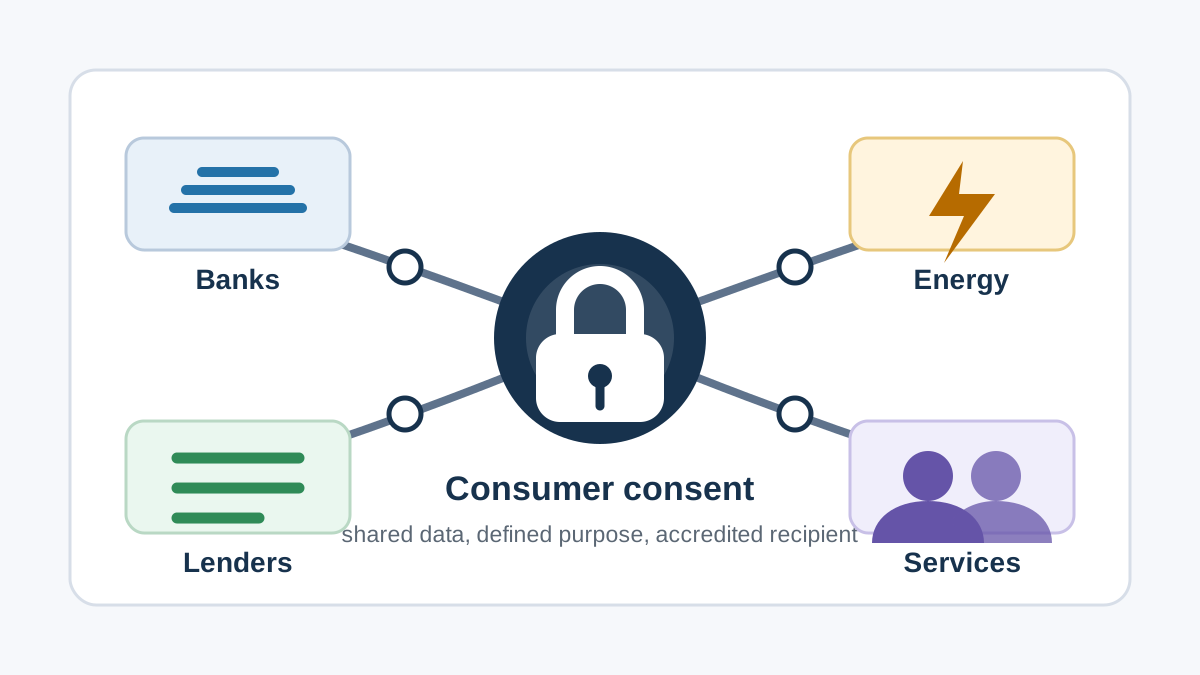
Australia’s Consumer Data Right is a useful case study because it treats open banking as one part of a larger consumer data portability system.
The core idea is simple: a person or business should be able to direct a service provider to share specified data with an accredited third party, under rules that govern consent, security, privacy, accreditation, and technical standards. That makes the Consumer Data Right, or CDR, more than a bank account feed. It is an attempt to build reusable data-sharing infrastructure across sectors.
The official Consumer Data Right site says CDR is active in banking and energy, allowing people to share banking or energy data with a chosen provider to seek a better offer or use a new service. The Australian Competition and Consumer Commission describes it as a data sharing and portability initiative that lets consumers safely share data held by businesses, compare products and services, and encourage innovation.
That framing matters. Many countries have approached open banking as a financial-sector reform. Australia designed a wider right first, then rolled it out sector by sector.
The Problem CDR Addressed
Consumers often need their own data to make markets work for them. A household comparing electricity plans needs usage and account information. A borrower applying for finance may need transaction and balance history. A small business switching banks may need accurate product, account, and payment data.
Before structured data portability, that information was hard to move. People could download statements, upload documents, grant screen-scraping access, or retype details into comparison tools and application forms. Each approach created friction. Some were slow, some were insecure, and some made it difficult for consumers to know exactly what data was being used.
CDR tried to replace that patchwork with a governed sharing model. A consumer gives consent. The data holder shares required data through standardised channels. The accredited recipient uses the data for the agreed purpose. Regulators and privacy rules define the boundaries.
The case-study lesson is that data portability is not just a download button. It needs legal rights, technical standards, accredited participants, consumer-facing consent flows, data quality obligations, complaint pathways, and enforcement.
Why The Economy-Wide Design Mattered
Australia’s most distinctive choice was to make CDR an economy-wide framework rather than a banking-only scheme. Banking came first, but the model was built to travel.
That matters because consumer decisions rarely fit neatly inside one industry. A household budget connects income, bank accounts, loans, insurance, utilities, and recurring payments. If data portability stops at banking, it can help with some decisions but not the full financial picture.
Energy was the next major proof point. A consumer’s electricity usage data can make plan comparison more accurate than generic estimates. A portability framework can also reduce the burden on people who do not know how to interpret bills, tariff structures, or usage patterns on their own.
The rollout is still gradual. The official CDR rollout page says Version 8 Rules extend the CDR to non-bank lenders from July 2026. The non-bank lenders sector page says product data sharing obligations apply from 13 July 2026, with consumer data sharing obligations beginning from 9 November 2026 for initial providers and 10 May 2027 for large providers.
That staged approach shows a practical tension in public digital infrastructure. A broad framework is powerful, but each sector has its own data sets, incumbents, compliance costs, consumer risks, and product realities.
Standards Turned The Right Into Infrastructure
A legal right is not enough if every participant implements it differently. Australia’s CDR depends on shared technical standards so data holders and accredited recipients can connect in predictable ways.
The Data Standards Body says part of the CDR requires common data standards, because consumers have the right to share data about themselves and their use of services with accredited third parties. Those standards define the implementation baseline that makes the right operational.
This is where CDR becomes infrastructure. Consumers do not experience API specifications directly, but they feel the result when a comparison app, lender, budgeting tool, or energy service can request data through a familiar consent process instead of asking for PDFs or passwords.
Standards also reduce market barriers. A new accredited service does not need a separate custom integration with every bank or energy retailer. A data holder does not need to support a different method for every app. The common layer creates a more contestable market around consumer-authorised data.
The trade-off is maintenance. Data standards have to evolve as products change, errors surface, and new sectors join. Infrastructure is not finished when the first version works.
Privacy Was Built Into The Model
Data portability can help consumers only if it does not expose them to new privacy harms. Australia’s model pairs sharing rights with specific privacy safeguards.
The Office of the Australian Information Commissioner says CDR is designed to keep data secure and protect privacy, and that there are 13 legally binding privacy safeguards. The official CDR rights page also explains that these safeguards set strict obligations on businesses collecting and handling CDR data.
That matters because consent alone is a weak protection if users cannot understand the request, revoke access, correct data, or complain when something goes wrong. A real portability framework has to define who can receive data, what they can do with it, how long they can retain it, how they must secure it, and what remedies exist.
The governance lesson is that data mobility and data protection should be designed together. If portability is too locked down, useful services never develop. If it is too loose, consumers may lose trust and avoid the system.
Enforcement Showed Data Quality Matters
CDR also shows that a data sharing system is only as useful as the accuracy of the data being shared.
In June 2025, the ACCC announced that National Australia Bank paid $751,200 in penalties after infringement notices for alleged breaches of CDR rules. The ACCC said the notices related to alleged failures to disclose, or accurately disclose, credit limit data in response to requests made by accredited providers on behalf of consumers.
The broader point is not about one bank. It is about operational discipline. If shared data is incomplete, late, or wrong, the consumer may get a worse recommendation, a flawed affordability assessment, or an unreliable product comparison. The right to share data depends on the duty to share usable data.
That is a useful warning for every open-data regime. APIs and consent screens do not automatically create better outcomes. Regulators still need compliance monitoring, penalties, correction processes, and a way to surface recurring data-quality problems.
What Other Countries Can Learn
The first lesson is to decide whether open banking is the destination or the first sector. Australia’s CDR shows the value of designing a reusable portability framework before expanding into adjacent markets.
The second lesson is to make consent operational. Consumers need clear choices, but institutions also need rules for accreditation, security, data minimisation, withdrawal, complaints, and record keeping.
The third lesson is to invest in standards. A portability right becomes scalable only when participants can implement it consistently.
The fourth lesson is to treat data quality as consumer protection. Bad data can quietly undermine the very competition and switching benefits that open-data systems promise.
Australia’s CDR is still evolving, and its slower rollout shows that economy-wide data portability is difficult. But the case study is valuable precisely because it reveals the full stack: law, regulators, privacy safeguards, technical standards, sector sequencing, and enforcement.
The larger lesson travels well. Consumer control over data is not created by a slogan. It becomes real when the market has a trusted, governed, and repeatable way to act on the consumer’s instruction.