
Instant Payments Put Speed Ahead of Second Chances
Real-time transfers are useful because money arrives quickly. The same speed makes scam recovery harder when a victim is coached into sending the payment themselves.
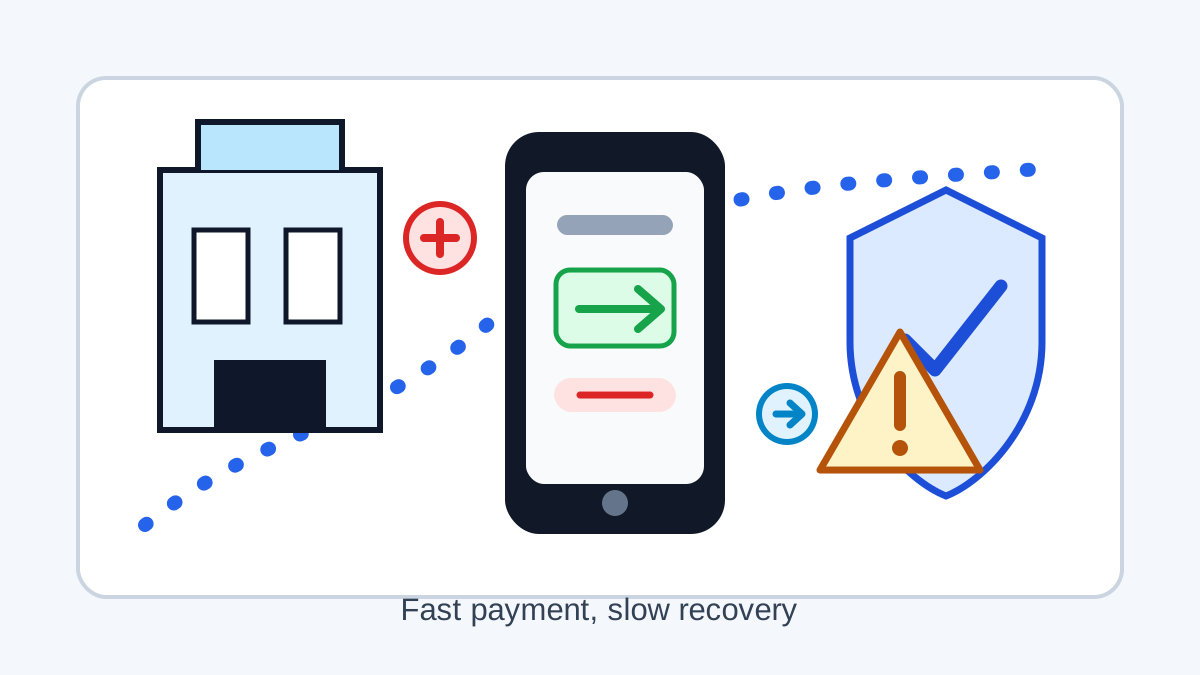
Instant payments solve a real problem. Rent can arrive before a deadline. A contractor can be paid after finishing a job. A family member can receive emergency money without waiting for a batch settlement window. For businesses and households, speed can reduce friction that used to feel like a banking tax.
The same speed changes the risk. When a payment moves in seconds, the window for doubt, cancellation, human review, or a cooling-off call becomes much smaller. That is why scammers increasingly focus less on stealing a card number and more on persuading the victim to authorize a transfer.
The Federal Reserve describes the FedNow Service as infrastructure that lets participating financial institutions send and receive instant payments in real time, around the clock, every day of the year. That is useful plumbing. It is also a reminder that modern payment safety is no longer only about stopping unauthorized access. It is also about stopping authorized payments made under deception.
The Scam Often Happens Before the Payment Screen
Many payment scams begin away from the banking app. A text says there is suspicious activity. A caller claims to be from the fraud department. A fake buyer says a small test transfer is needed. A romance contact asks for emergency help. A fake investment dashboard shows profits that can only be released after another payment.
By the time the victim opens a payment app or bank transfer screen, the fraud has already done its work. The person may believe the money is going to a safe account, a relative, a real merchant, a government agency, a landlord, a recovery expert, or an investment platform. The interface asks whether to send, and the victim says yes.
That difference matters. A stolen login and an induced transfer are both harmful, but they do not always travel through the same dispute path. The Consumer Financial Protection Bureau’s electronic fund transfer guidance addresses unauthorized electronic transfers, including examples where a fraudster uses a stolen debit card or compromised device. Scam payments can be messier when the consumer personally initiated the transfer after being manipulated.
This is why the front end of the scam deserves more attention. A faster payment network can improve settlement, but it cannot see every phone call, fake invoice, marketplace chat, social media message, or remote-access session that led to the payment.
Reversal Is Not the Product
Consumers often bring credit-card expectations into payment apps and bank transfers. They assume a disputed payment can be pulled back if the story was false. Sometimes a bank, card issuer, app provider, or receiving institution can help. Sometimes they cannot. The result depends on the payment method, timing, account status, facts, law, and company policy.
The Federal Trade Commission warns that wiring money is like sending cash because once it is sent, the sender usually cannot get it back. Its mobile payment app guidance gives the same practical warning in different language: payment apps are safest with people you know and trust.
Instant payment design intensifies that lesson. Speed is the point of the service. The money is meant to be available quickly to the recipient, not held in a long waiting room while everyone reconsiders. That makes instant payments valuable for legitimate use and attractive for criminals who want funds moved before suspicion catches up.
The Kansas City Fed has described authorized push payment scams as a serious challenge for fast payment systems because the sender is tricked into initiating the payment. The label sounds technical, but the consumer experience is simple: someone convinced you that sending money was the right action.
Stored Balances Add Another Layer
Payment apps can create a second risk when people leave money sitting in an app instead of moving it back to an insured bank or credit union account. The CFPB has warned that funds stored in popular payment apps may not always have the same federal deposit insurance protections people associate with ordinary bank accounts.
That does not mean every app balance is unsafe in the same way. It does mean consumers should read the account terms instead of assuming that a familiar app logo equals the same protection as a checking account. A payment app can be excellent for quick transfers and still be a poor place to park emergency savings, payroll money, rent money, or business operating cash.
The safer habit is boring: keep only the amount needed for near-term app payments, move larger balances to an account with clear deposit insurance coverage, and review app security settings before a problem occurs.
Recovery Scams Follow the First Scam
Fast-payment victims are often targeted twice. After the first transfer, another actor may claim to be a lawyer, hacker, government contact, investigator, cryptocurrency recovery firm, or law enforcement partner who can retrieve the money for a fee.
The FBI’s Internet Crime Complaint Center warns cryptocurrency scam victims to be wary of anyone claiming they can recover funds. IC3 has also warned that criminals impersonate recovery services and even claim to work with law enforcement. The pattern is cruel but predictable: once a person has paid under pressure, scammers know they may pay again to undo the damage.
A legitimate report should not require an upfront recovery fee paid by gift card, cryptocurrency, wire transfer, or personal payment app. If someone claims to represent an agency, the victim should independently find the agency’s official website or phone number instead of using contact details supplied by the message.
The Best Defense Is a Pause That Feels Awkward
The strongest consumer habit is to interrupt the transfer before it happens. Do not move money because an unexpected caller says an account is unsafe. Do not send a “test” payment to prove identity. Do not trust a payment request just because it appears inside a familiar app. Do not rely on caller ID, screenshots, urgent instructions, or a person who tells you to stay on the phone while you transfer funds.
The FTC’s advice on “protect your money” scams is direct: government agencies will not tell people to move money to protect it. A real bank problem can be checked by hanging up and contacting the bank through the number on the card, the official app, or the verified website.
Businesses need their own pause. A payment approval process should not depend on one inbox, one executive text message, or one employee in a hurry. Callback rules, vendor-change verification, dual approval for new payees, and limits on first-time transfers are not bureaucracy when the payment rail is fast enough to remove second chances.
Faster Payments Need Slower Decisions
Instant payments are not the villain. Slow payments can be expensive, exclusionary, and inconvenient. Real-time rails can help households, small businesses, gig workers, landlords, utilities, insurers, and public agencies move money when timing matters.
The consumer-protection problem is that speed should not be confused with certainty. A payment can be technically successful and still be socially engineered. A transfer can be authorized by the account holder and still be the result of fraud. A platform can work exactly as designed and still leave a victim with few practical recovery options.
The practical rule is to match the speed of the payment to the certainty of the relationship. Use instant payments for trusted recipients and expected bills. Slow down for new payees, urgent stories, investment pitches, marketplace strangers, account-security calls, and anyone coaching you through the payment screen.
Fast money is useful. But the decision to send it should be slower than the network that carries it.